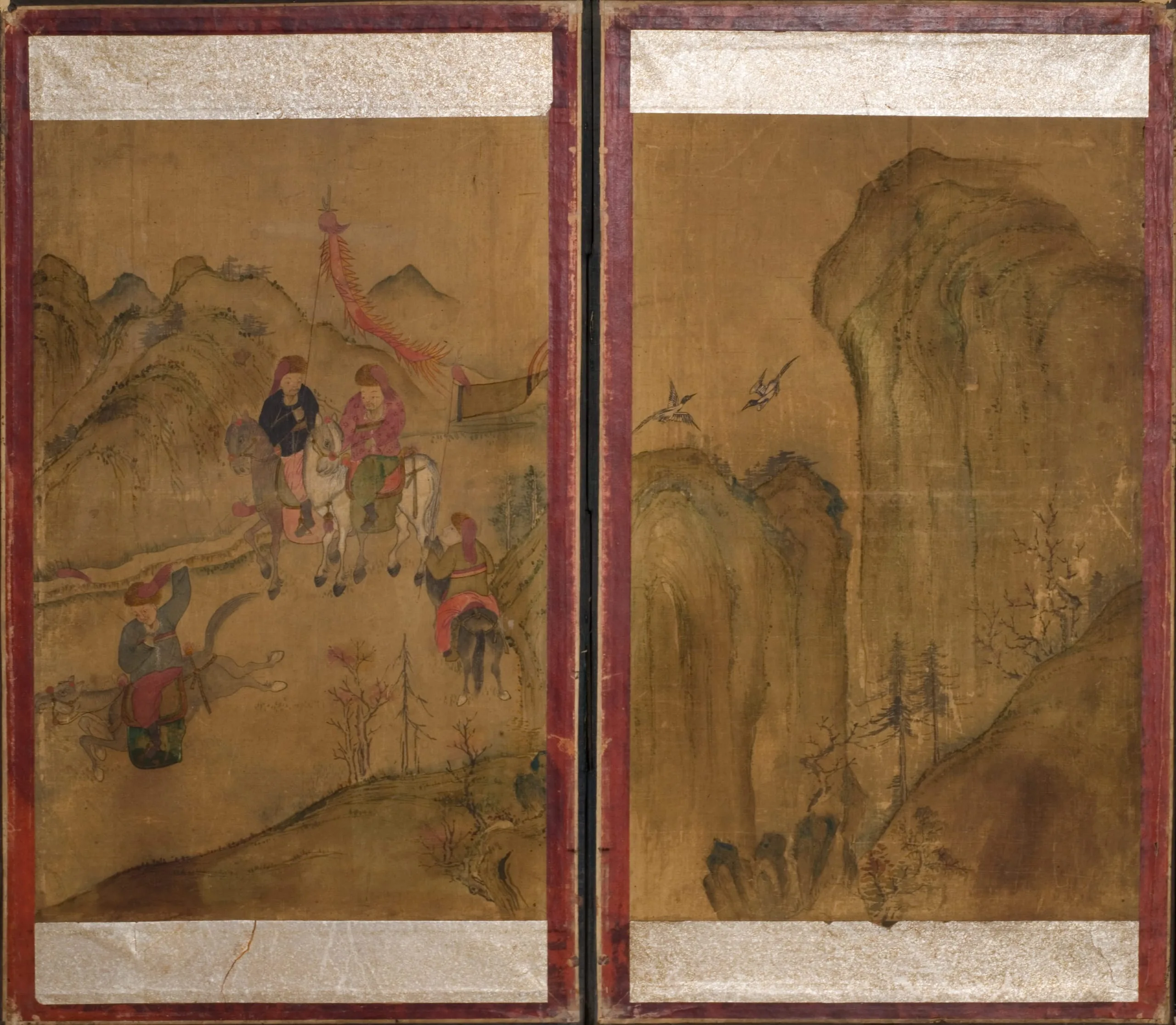
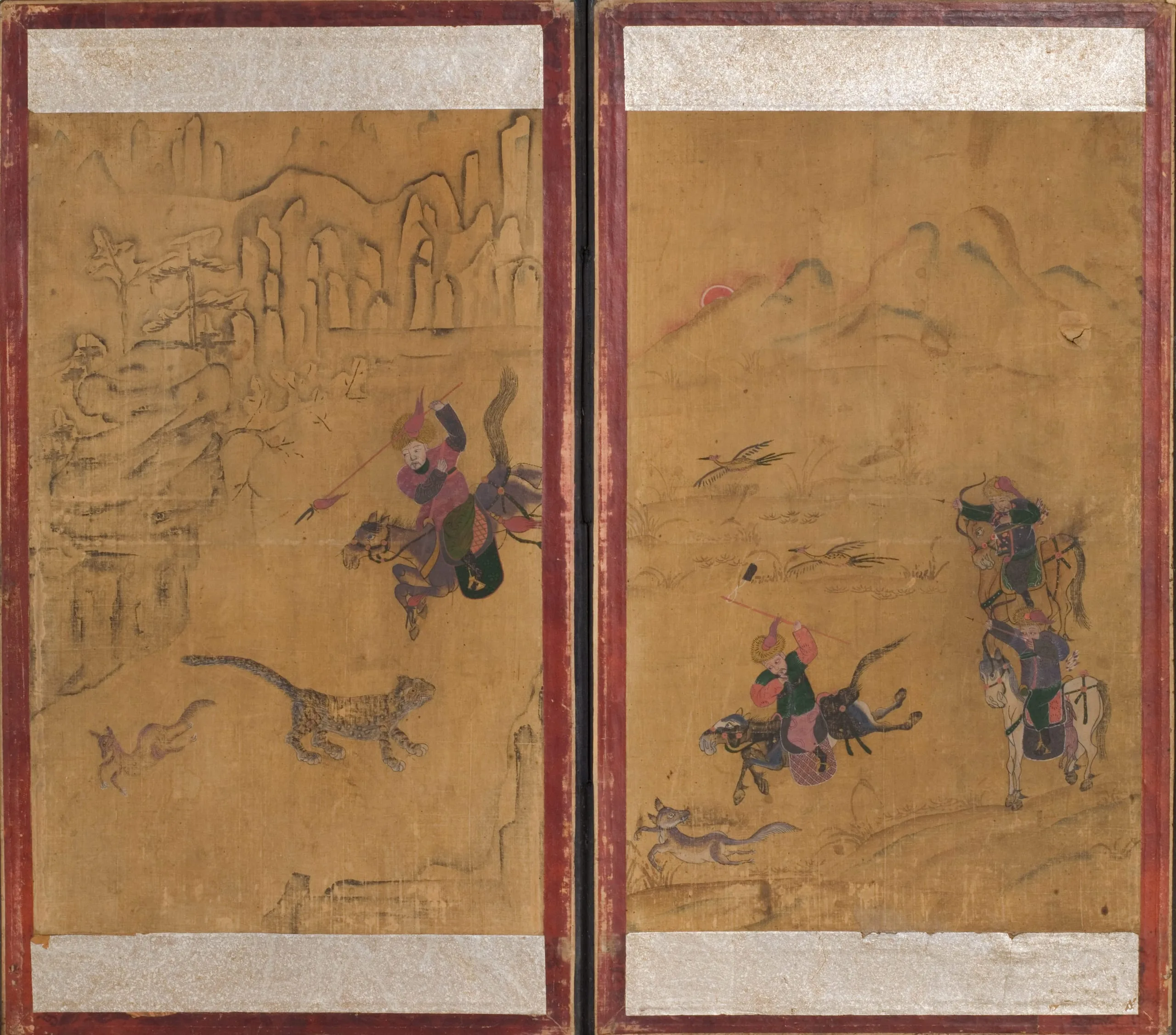
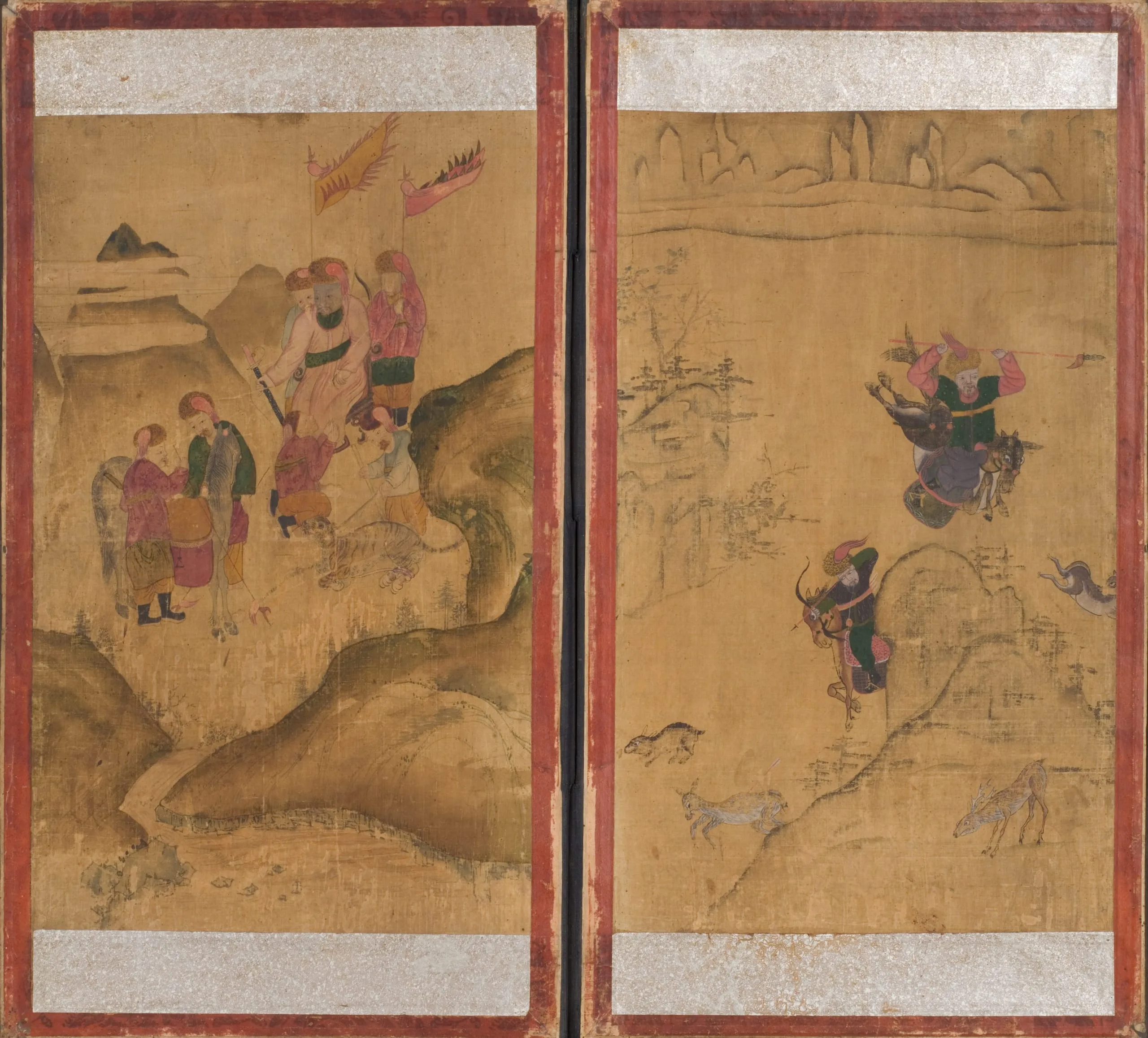
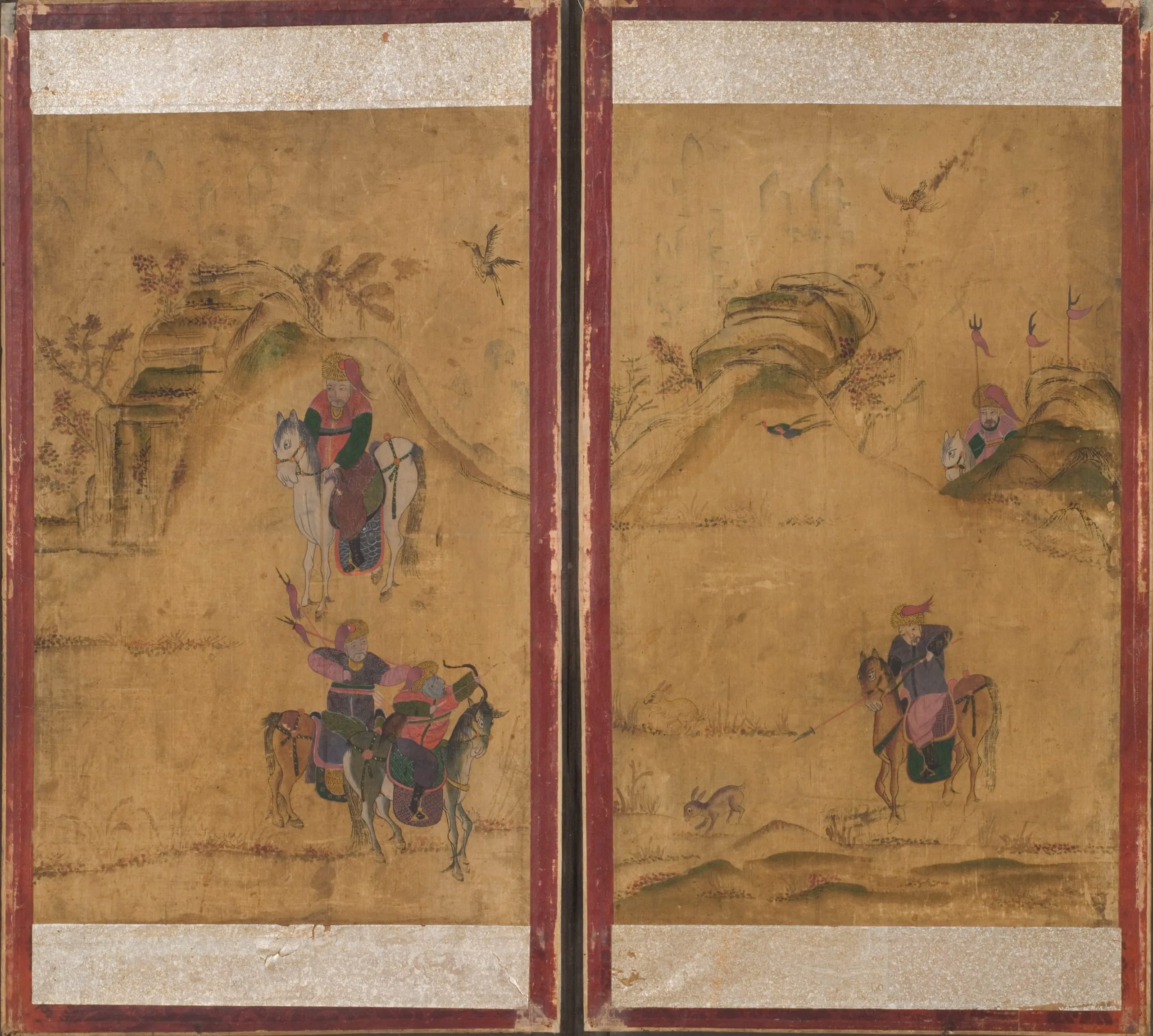
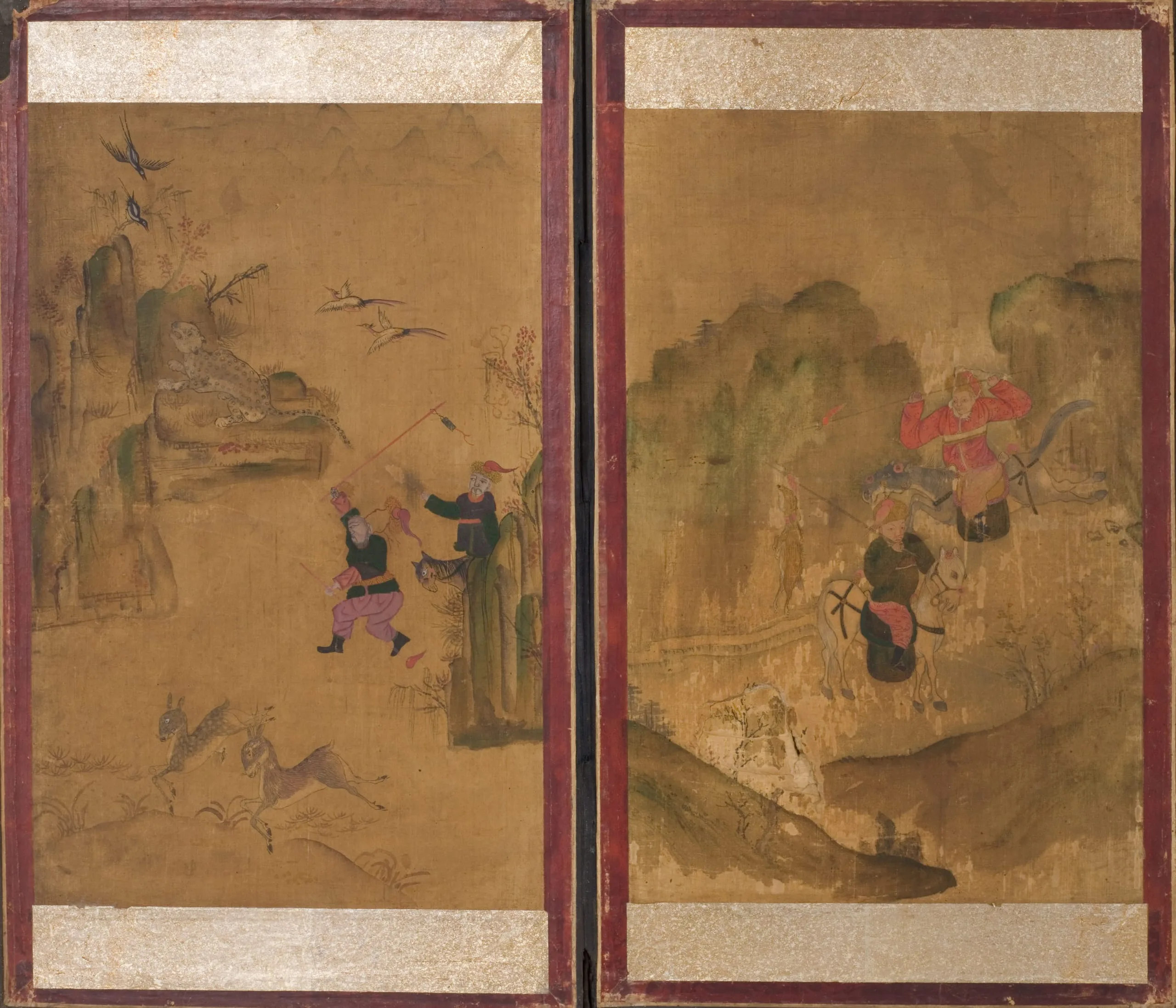
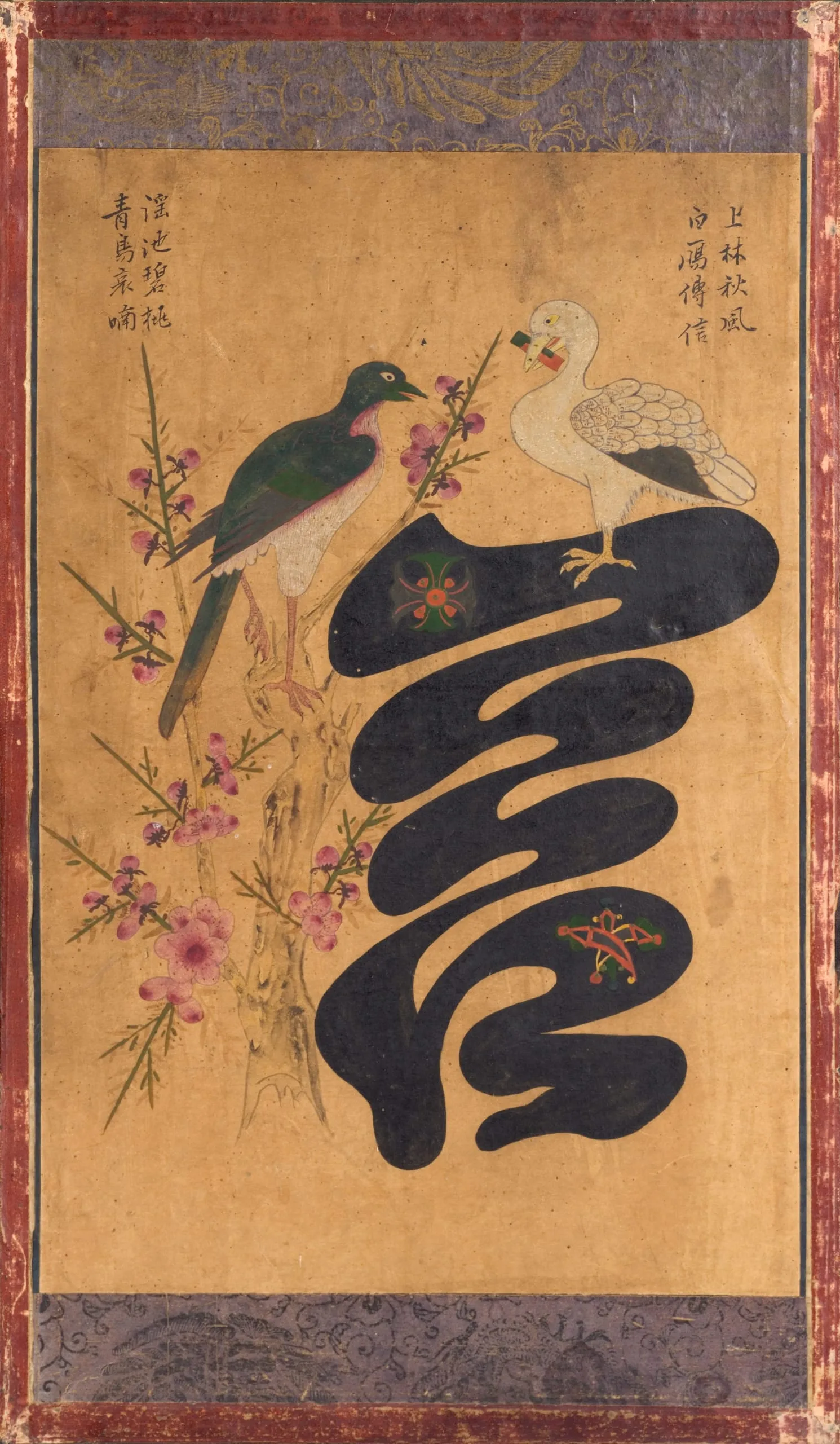
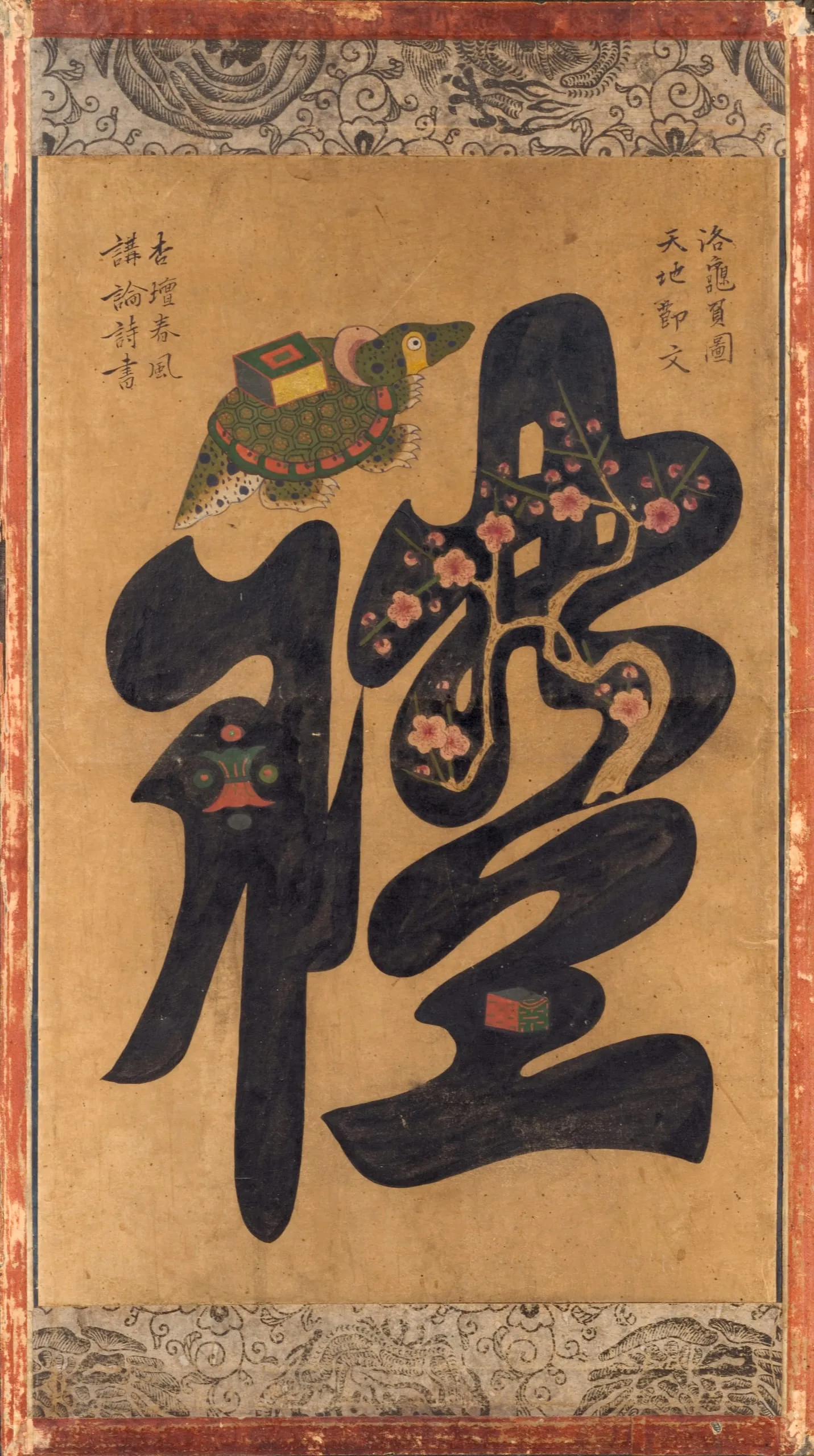
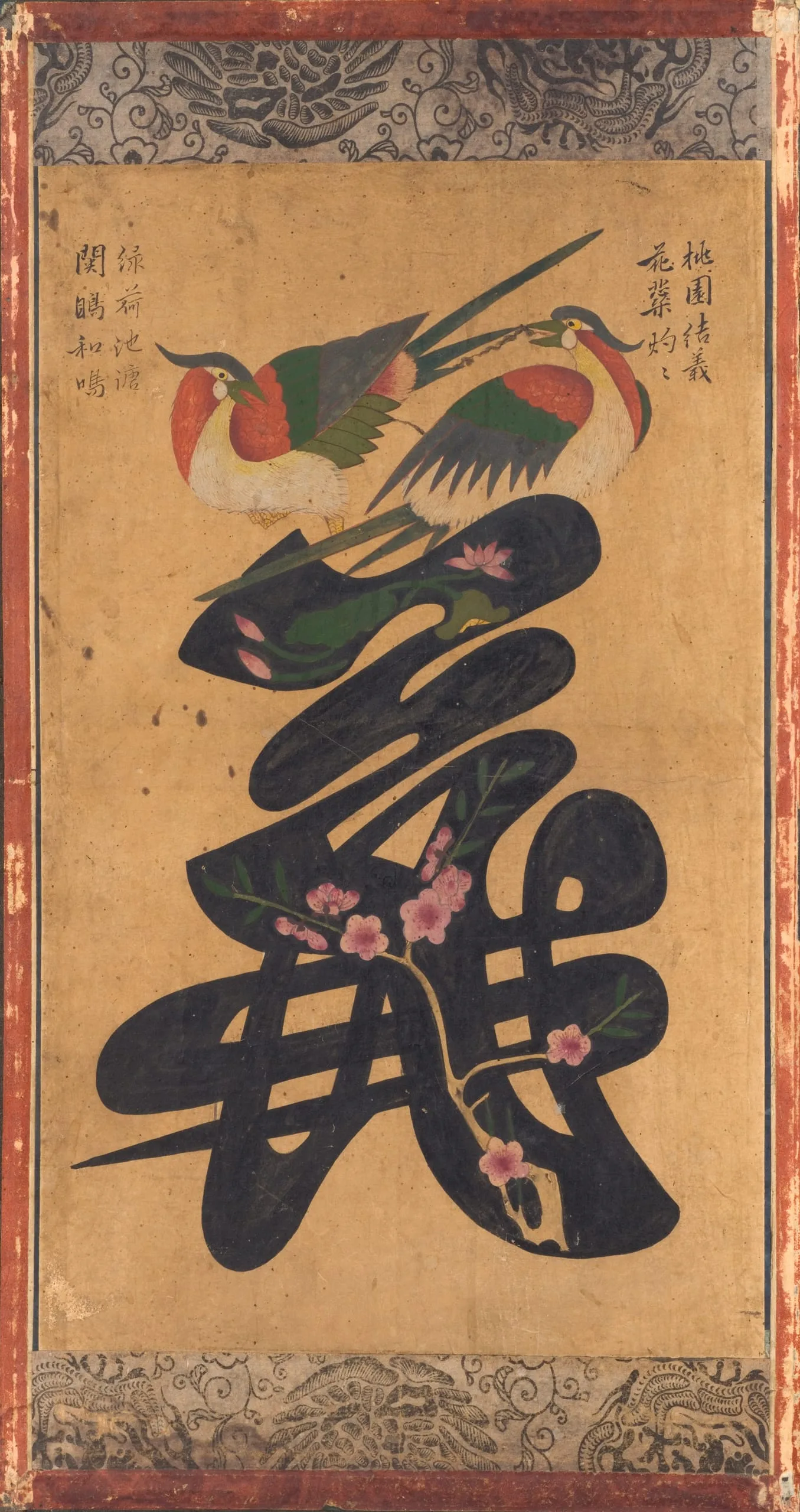
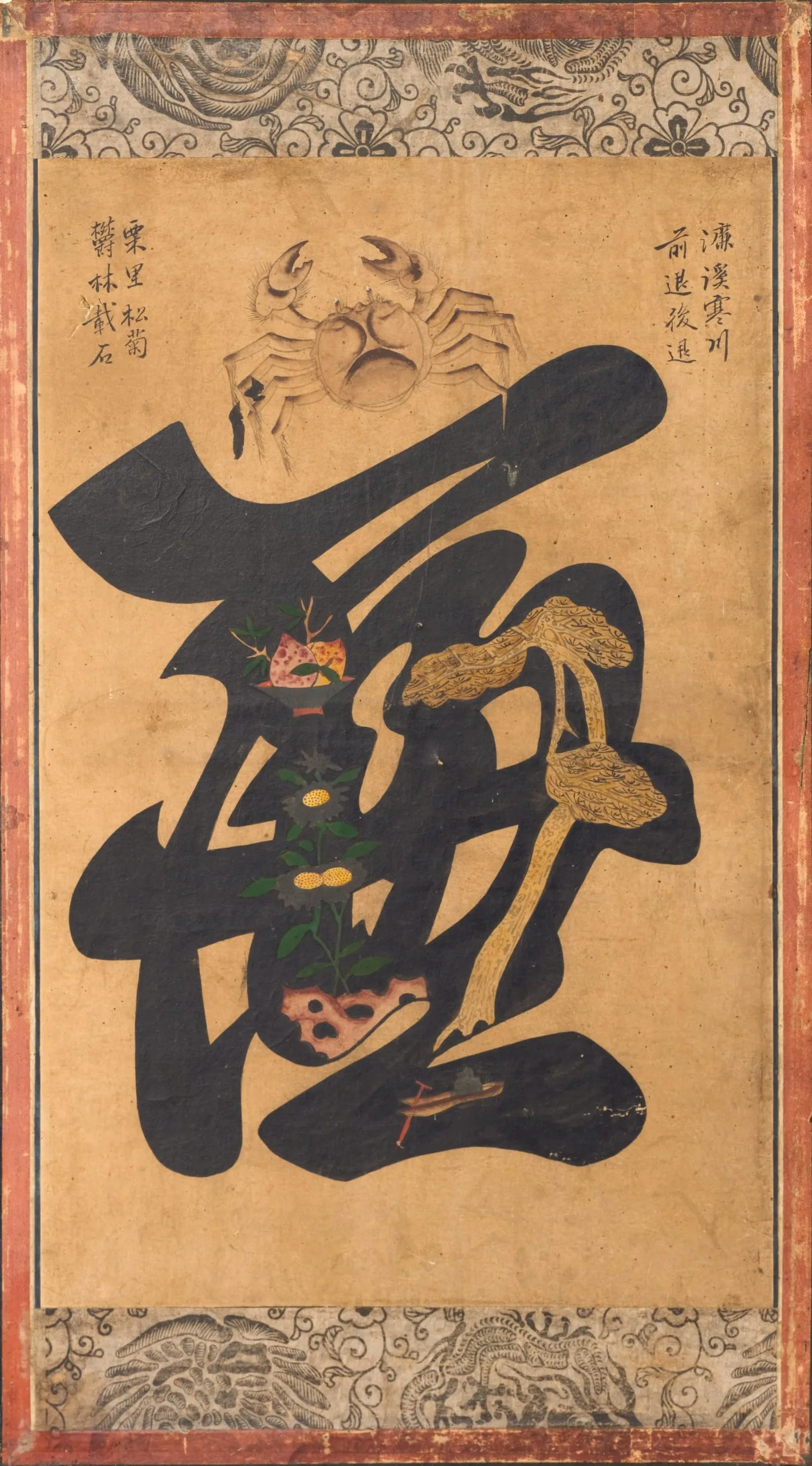
Mounted on each side of this screen are unrelated paintings: on one side is a set of the eight Confucian virtues, and on the other a Mongolian hunting scene. Works with these themes are generally considered folk paintings, or minhua, because they were favored by the public and mass-produced by unknown local artists. Screens had the practical functions of dividing space and blocking wind and sunlight, and folk screens such as this were extremely popular because many of their subjects were intended to evoke good fortune and success or to teach proper values. Both paintings capture the charm and beauty of Korean folk paintings, which are characterized by abstract form, a sometimes-crude technique, and subtle humor.
Pictorial Ideographs (Munjado) of the Eight Confucian Virtues
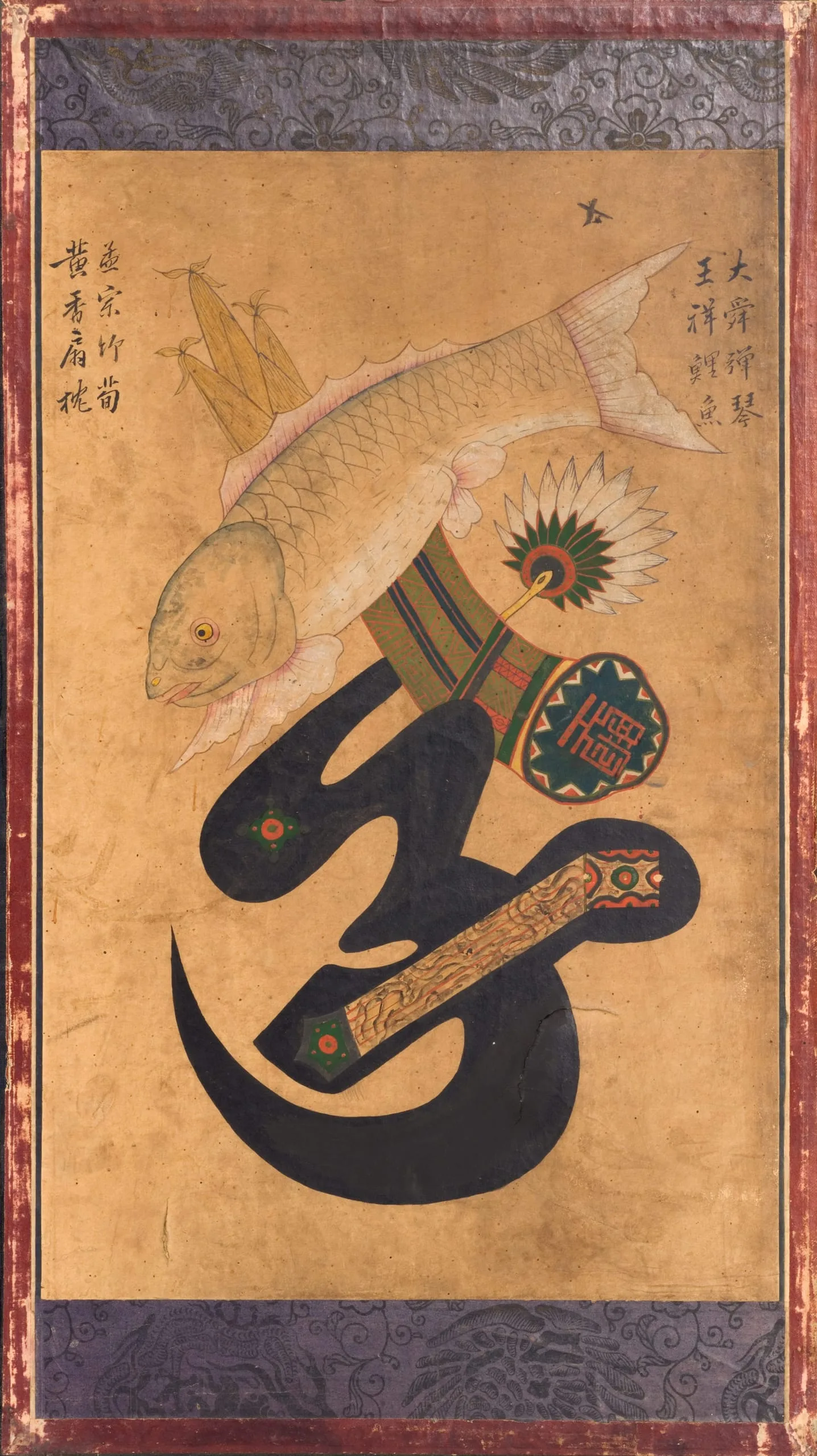
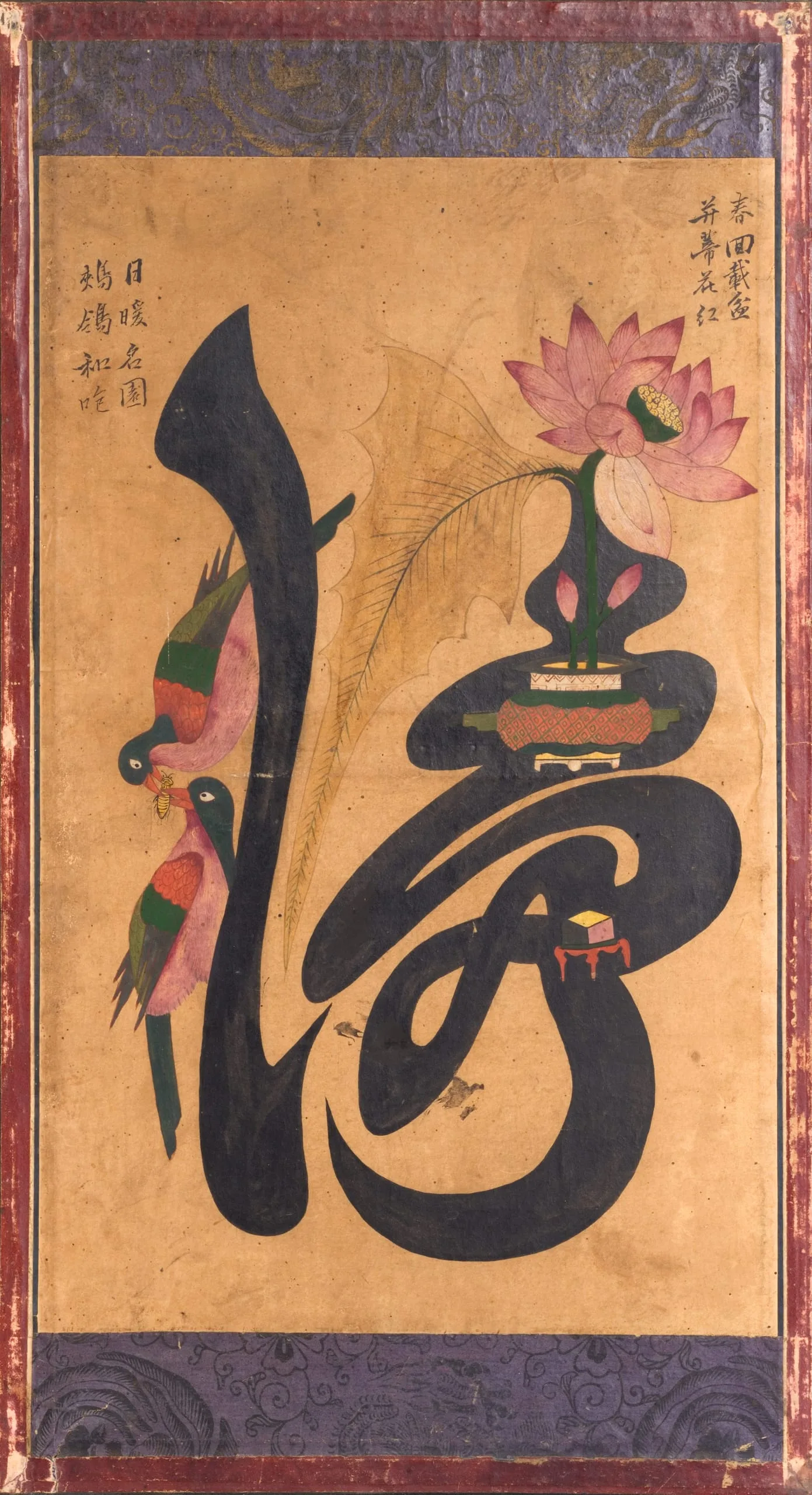
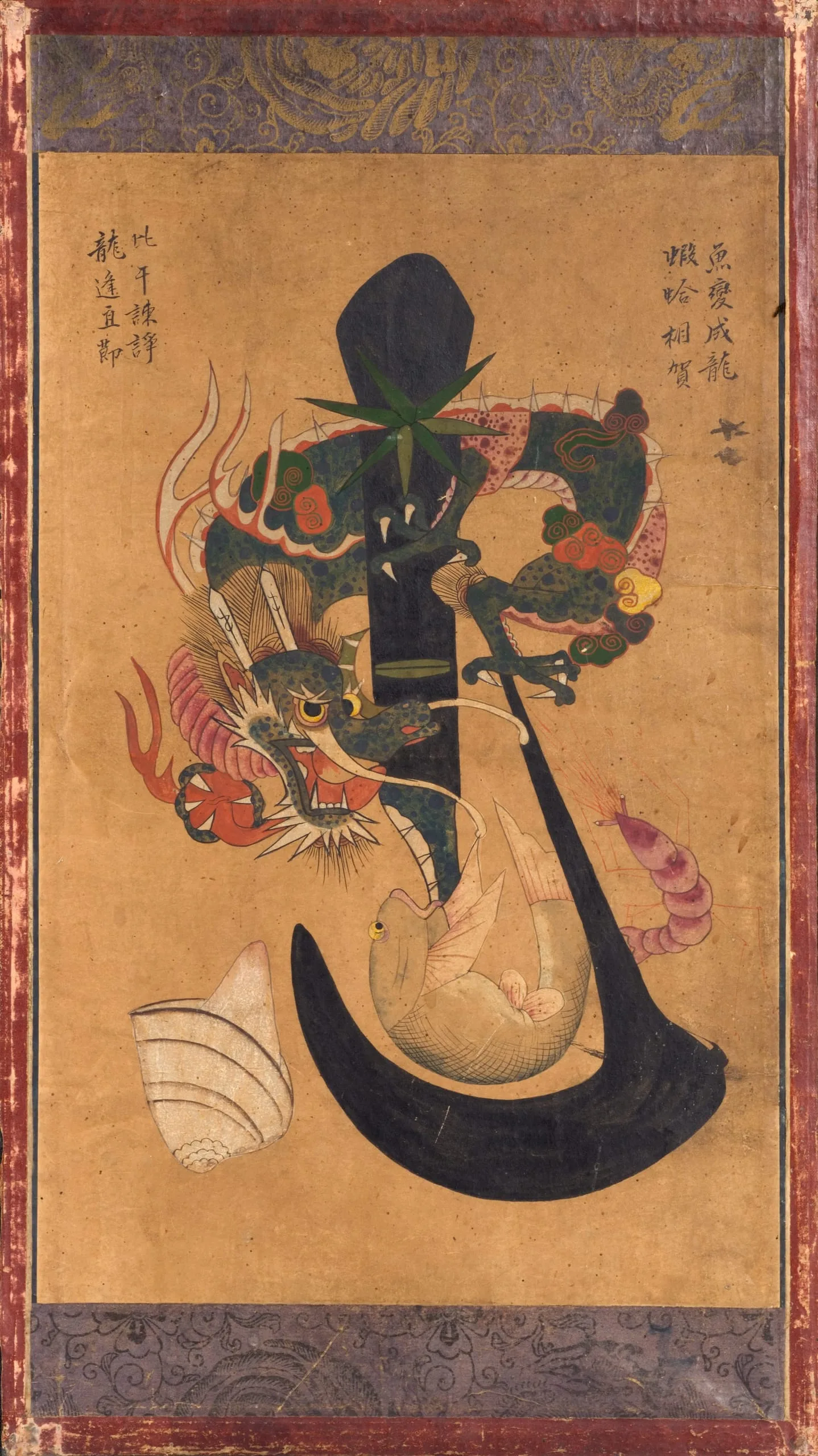
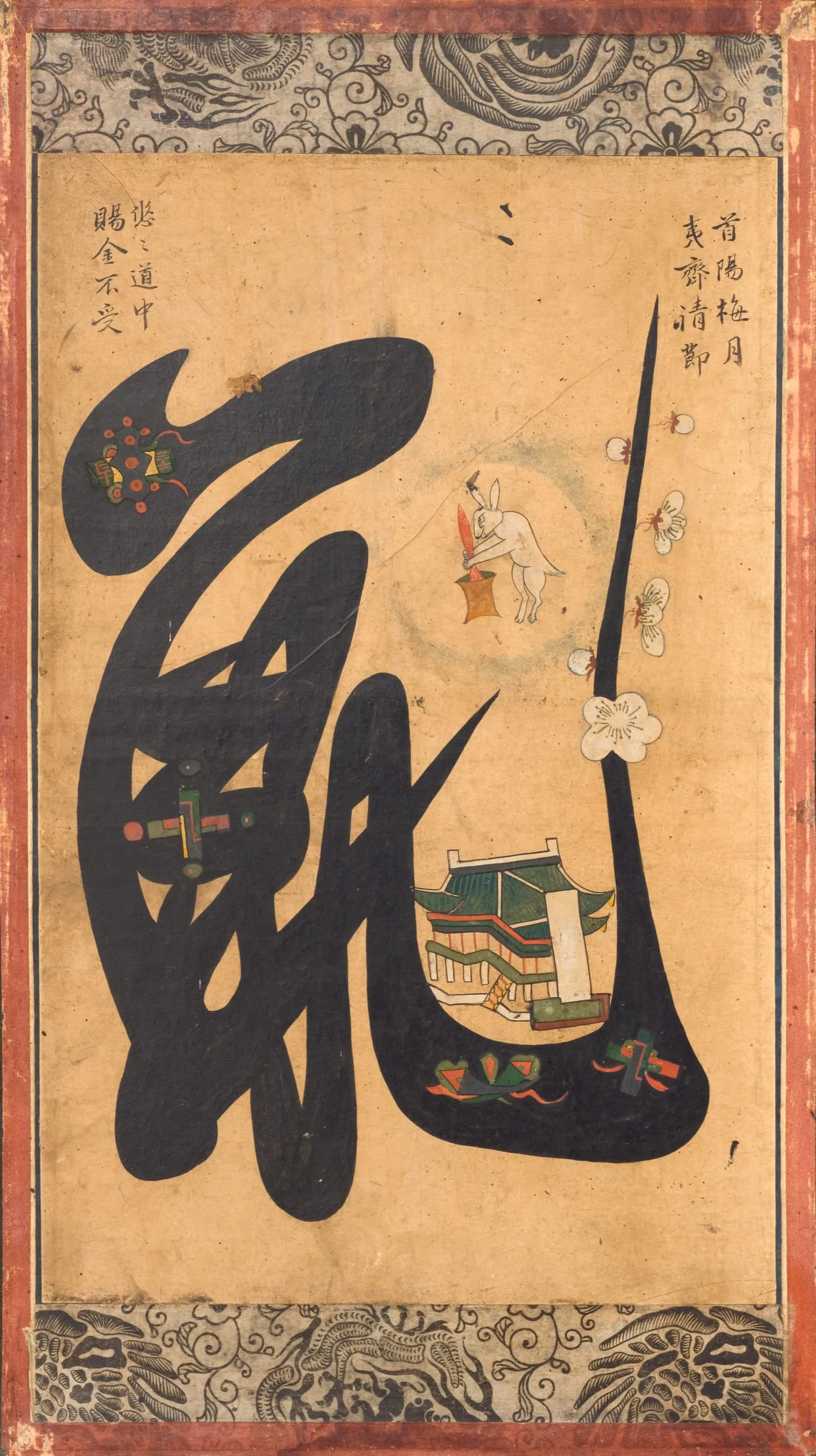
In pictorial ideographs, called Munjado, calligraphic paintings of Chinese characters are integrated with images that relate to the characters’ meaning. Sets featuring the eight Confucian virtues were popular, which demonstrates the importance of Confucian ideas and practices during the late Joseon period. Always appearing in the same order, the eight Confucian virtues are, from right to left, filial piety, brotherly love, loyalty, trust, propriety, righteousness, integrity, and sensibility. Often displayed in a child’s room, the images were didactic and intended to inspire proper values.
The pictorial illustrations generally refer to well-known historical stories or legends. Although the characters and their related stories are based on Chinese classics, the aesthetics and design elements are purely Korean. For example, the way in which the a single image is used in the composition as a signifier for a complex story is unique to Korea. In addition, sets featuring all of the eight virtues are distinctly Korean in taste: in China, the individual characters for longevity (shou) and fortune (fu) were consistently the most favored subjects and were usually presented in a hanging scroll format.
Although there are many known screens illustrating the eight virtues, LACMA’s example is distinctive because each panel also includes four lines from proverbs related to each virtue. The artist arranged the characters and their visual elements with great harmony, embedding the images with two different techniques: in some characters, the images completely replace a character stroke, while in others, the pictorial elements appear inside an existing stroke. In earlier screens, the related images were usually embedded within the character stroke, as seen in this example from the Leeum, Samsung Museum of Art (fig. 1). Because the LACMA screen combines the two styles, it can be dated to the nineteenth century.
The first character (hyo; 孝) represents filial piety, which was the highest virtue in East Asian culture (det. 1). Each of its several pictorial symbols suggests a different story of filial piety, which are also recorded in the inscription. A zither inserted in the horizontal stroke relates to the story of the ancient mythical Chinese king Shun. Before ascending the throne, Shun always obeyed his blind father and abusive stepfamily. Because of his good character, King Yao chose Shun as his heir. When King Yao married two of his daughters to King Shun, he also gave him a five-string zither as a present.[1] The fish on top of the character symbolizes the story of Wang Xiang, who, by lying on the ice of a frozen river, caught fresh carp in winter to give to his unkind stepmother, thus earning her respect.[2] The bamboo shoot represents Meng Zong, who cried in a winter bamboo grove because he could not find a bamboo shoot to feed his ailing, elderly mother, causing a bamboo shoot to sprout.[3] Finally, a fan resembling a lotus flower suggests the legend of Huang Xiang, who fanned his father’s pillow and bed in summer and warmed them with his body heat in winter.[4]
All the images illustrated within the second character, brotherly love (je; 悌), are from a poem found in the classic Chinese compilation The Book of Songs (Shijing).[5] In the poem “Cherry Tree,” the two birds and the vase of flowers in springtime signify ideal brotherhood (det. 2). The two birds are peacefully sharing a small morsel of food, effectively illustrating the lesson.
In the third panel, representing loyalty (chung; 忠), a carp turns into a dragon, reminding the viewer that, after passing an examination, an official should be loyal to the imperial authority (det. 3). A dragon is often used to indicate official success or promotion. The pairing of a shrimp and clam is a phonetic pun: when placed together, the two characters for shrimp and clam, hehua, are pronounced the same as the two characters that mean “harmony,” and therefore suggest the importance of being harmonious with the ruler.
The fourth character, trust (sin; 信), takes imagery from a single source, the story of the Queen Mother of the West.[6] In the garden of the Queen Mother, the peach trees only bore fruit once every three thousand years, and those who ate them became immortal. Dongfang Shuo was one such immortal. According to the tale of Emperor Wu of the Han dynasty, the emperor saw a blue bird in his imperial garden. Knowing that the bird was a messenger of the Queen Mother, the immortal Dongfang Shuo reported to the emperor that it was a sign that the Queen Mother would soon visit. Without fail, the Queen Mother appeared before the emperor. The peach blossoms, blue bird, and white bird holding a letter in this painting are symbols of trust (det. 4).
Among the teachings of Confucius, propriety (ye; 禮) might be the most frequently discussed and highly valued. The inscription on the fifth panel refers to “The Writing of Luo,” which said that the principles of civility were brought to the world by a tortoise in the Luo river. The inscription also refers to Confucius’ lecture on books and poetry that the learned man had given from an apricot tree podium in spring. The first part of the inscription references the legend of the ancient Chinese King Yu, who, inspired by the pattern on a tortoise’s back, wrote a book about principles and manners in governing the world. In this painting, the tortoise with a book on its back represents King Yu’s story, while a springtime tree and platform hint at Confucius’s teaching of proper conduct and etiquette (det. 5).
The sixth virtue is righteousness (eu; 義). The first two lines of the inscription are derived from the “Oath of Three Generals in the Peach Garden.” During the Three Kingdoms period in China, Liu Bei, Guan Yu, and Zhang Fei vowed to “unite their hearts and strengths, as well as to help each other in danger.” Being chivalrous brothers, they even agreed to die on the same day.[7] The peach blossoms in this painting symbolize their oath. The final two lines of the inscription, from a poem in The Book of Songs (Shijing), refer specifically to the righteousness between husband and wife. The two intimate birds at top are described in the poem[8] and signify a well-matched couple who respect each other (det. 6).
The seventh panel represents integrity (yeom; 廉). A crab was believed to know when to proceed or withdraw, just as a proper official should behave (det. 7). In addition, because a crab lacks intestines, it is a symbol of a lack of both corruption and greed. According to the inscription, the crab represents Zhu Dunyi, a Chinese scholar-official famous for his indifference to titles. Zhu Dunyi’s pen name was “Integrity Stream,” as was the name of his hometown. The inscription also records that the symbolism of the pine tree and chrysanthemum – both plants that thrive in the winter cold – is taken from the famous Chinese poem “Back Home Again Chant” by Tao Qian. A line in the poem, “Our three paths are grown over, but pines and chrysanthemums survived,” suggests that although the world is corrupt, one should not compromise in difficult times. The pine tree and chrysanthemums remain as they were, even as the other plants become tangled.[9] The boat with rocks is from the story of Lu Ji, who had to weight his boat with stones in order to sail home after he retired. Coins usually would have provided the weight, but he had none, having left with an unblemished service record because he accepted no bribes.
The eighth and final virtue is sense of shame (chi; 恥), which is usually illustrated by a story of two Chinese princes, Bo Yi and Shu Qi, who banished themselves to Mount Shouyang because they would not eat the grain of a dynasty they viewed as shameful; there they ate only bracken and starved to death.[10] The first two lines of the inscription read “plum trees and moon of Mount Shouyang; fidelity of Bo Yi and Shu Qi.” The plum tree, moon, and pavilion with two steles are all derived from this famous Chinese tale (det. 8).
Hunting in the Hills
The other side of the screen features a painting of Mongolian hunters in a rugged mountain landscape. In contrast to the didactic function of the eight virtues set, hunting scenes signified power and courage and were a popular subject for display in the quarters of military men. Such subjects were also believed to ward off evil fortune, a parallel to the vigorous hunters as they chase their prey.
Clearly identifiable as Mongolian from their costume, the hunters are chasing animals such as rabbits, deer, and birds with the help of an obedient, trained tiger (det. 9). In Korea, hunting scenes were executed as early as the Three Kingdoms period (220-265) and were found in wall murals in tombs. This example is from the Tomb of the Dancers in China (fig. 2). According to written records, royal families and their close officials regularly enjoyed hunting excursions during leisure time. However, by the late Joseon period, it is noteworthy that most folk paintings of hunting scenes depict Mongolians instead of Koreans, which suggests that during the later centuries, Koreans associated brutal hunting activities more with their northern neighbors.
Hunting in the Hills was apparently remounted in the early twentieth century and the original order of the ten paintings was lost. Typically, such hunting scenes were composed of one continuous narrative painting. Although no longer in logical sequence, it appears that the original painting included several distinctive scenes: a departure beginning the hunting excursion, a sunset, and a winter hunting scene. However, further research is needed to identify the original sequence of the set and possible sources of the narrative.
Footnotes
[1] Sima Qian, “History of the Five Early Emperors [Wu di ben ji]”, in Nienhauser, The Grand Scribe’s Records (Shi ji).
[2] See “Lying on Ice Seeking for Carp,” in de Bary and Bloom, Sources of Chinese Tradition, vol. 2, 140.
[3] See “Weeping on Bamboo Made Them Sprout,” in de Bary and Bloom, Sources of Chinese Tradition, vol. 2, 141.
[4] From “Wenyuan,” which appears in Later Han History (Hou han shu), included in Twenty Five Histories (Taibei: Yiwen yinshuanan, 1956-58), 2613.
[5] “Cherry Tree” [Chang di], in Waley, The Book of Songs (Shijing), 135-36.
[6] This well-known mythical character has appeared throughout Chinese literary history in many different guises. For further discussion, see Suzanne Cahill, Transcendence and Divine Passion: The Queen Mother of the West in Medieval China (Stanford: Stanford University Press, 1993).
[7] This story appears in the epic novel Romance of the Three Kingdoms, attributed to Guanzhong Luo (c. 1330-1400). For an unabridged English edition, see Moss Roberts, trans., Three Kingdoms: A Historical Novel (Berkeley: University of California Press, 2004).
[8] “The Ospreys Cry” [Guan ju], in Waley, The Book of Songs (Shijing), 5-6.
[9] Tao Qian, The Selected Poems of T’ao Ch’ien [Tao Qian] (Port Townsend: Copper Canyon Press, 1993), 33.
[10] Sima Qian, “Bo Yi,” in Nienhauser, The Grand Scribe’s Records (Shi ji),1-8.
Bibliography
de Bary, Wm. Theodore, and Irene Bloom, comp. Sources of Chinese Tradition: From Earliest Times to 1600, vol. 2. New York: Columbia University Press, 1999.
Nienhauser, William, trans. The Grand Scribe’s Records (Shi ji). Bloomington: Indiana University Press, 1994.
Waley, Arthur, trans. The Book of Songs (Shijing). New York: Grove Press, 1996.