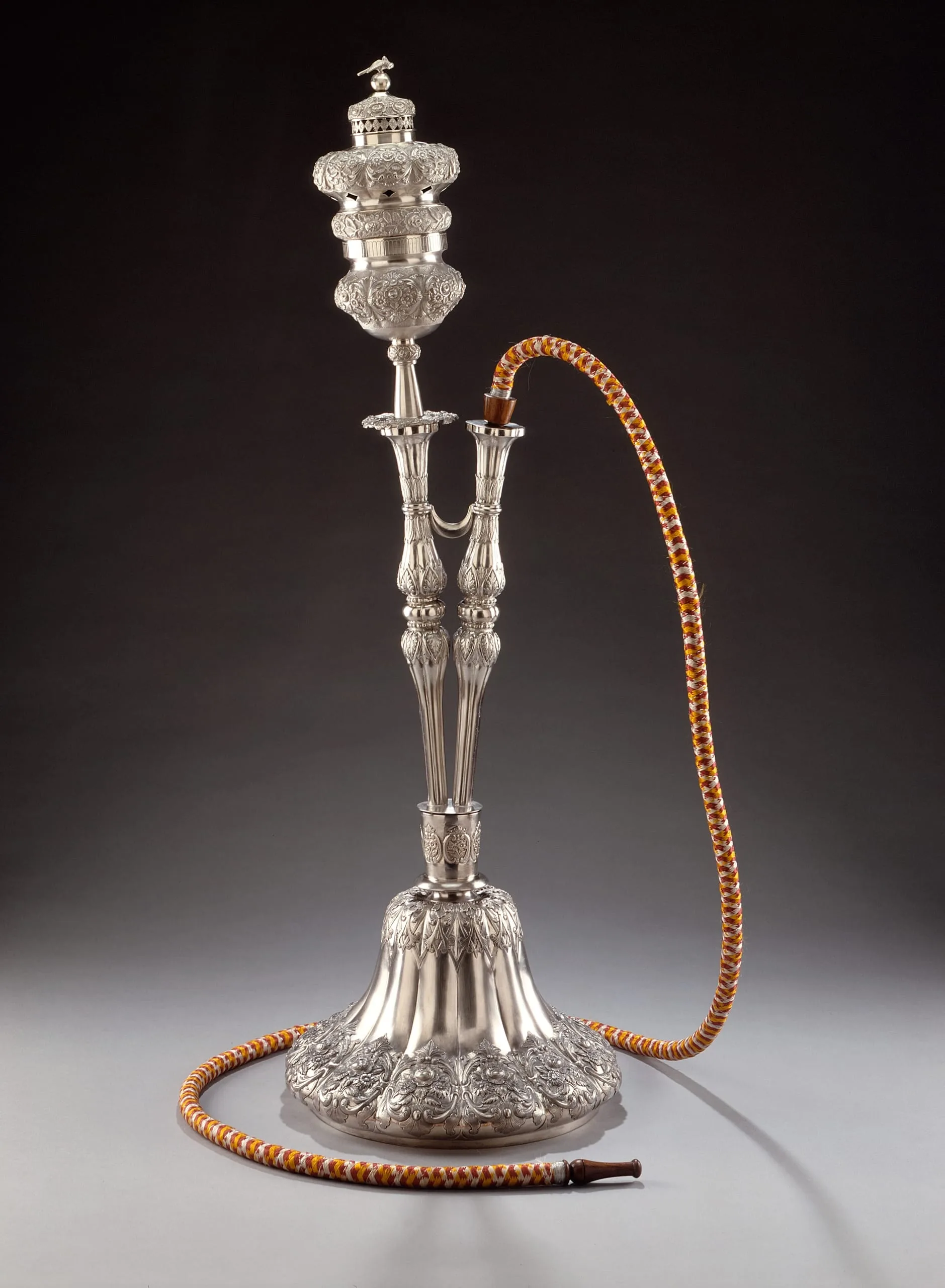
A hookah or water pipe is a smoking device that cools tobacco smoke by drawing it from the hot combustion bowl through cold water in a reservoir base; the smoker then inhales it through a long, sometimes porous tube fitted with a mouthpiece. Made of embossed and engraved silver, this elaborate hookah features a large reservoir base ringed around the bottom with burgeoning bouquets of three individualized flowers with common foliage set in cartouches formed by floral wands articulated with stylized acanthus leaves and shell motifs. A band of plain fluting above the floral cartouches demarcates and accentuates the pendant acanthus leaves and strapwork gracing the shoulder. Two ornate tubular stems extend through a fitting screwed into the mouth of the hookah. The primary stem connects to the separately cast combustion bowl and cover, with the secondary stem connecting to the (now-replacement) inhalation tube.
The practice of smoking tobacco was introduced into India in the late sixteenth century by Portuguese traders in the Deccan and reached the Mughal court in 1604 when one of Akbar's officers, Asad Beg, returned from Bijapur where he had acquired the habit along with numerous pipes and tobacco. Even though the Mughal Emperors Akbar (r. 1556-1605) and Jahangir (r. 1605-27) forbade smoking on the advice of their physicians and despite the subsequent heavy tax levied on tobacco until 1659 when it was abolished by the Emperor Aurangzeb (r. 1658-1707), smoking and the use of various types of hookahs spread rapidly through all levels of Indian society. From the late 17th century onward, apart from imperial Mughal portraits in which water pipes are not depicted until the early reign of Emperor Muhammad Shah (r. 1719-48), hookahs functioned as a stock pictorial motif indicating the sitter’s high status and refinement in paintings of nobles, courtiers, and "Indianized" Europeans.
A comparable silver hookah made in c. 1860-1865 by Hamilton & Co., Calcutta, and exhibited in the Paris Exhibition of 1867 is in the Victoria and Albert Museum, London (IS. 2510:1–3).