- Title
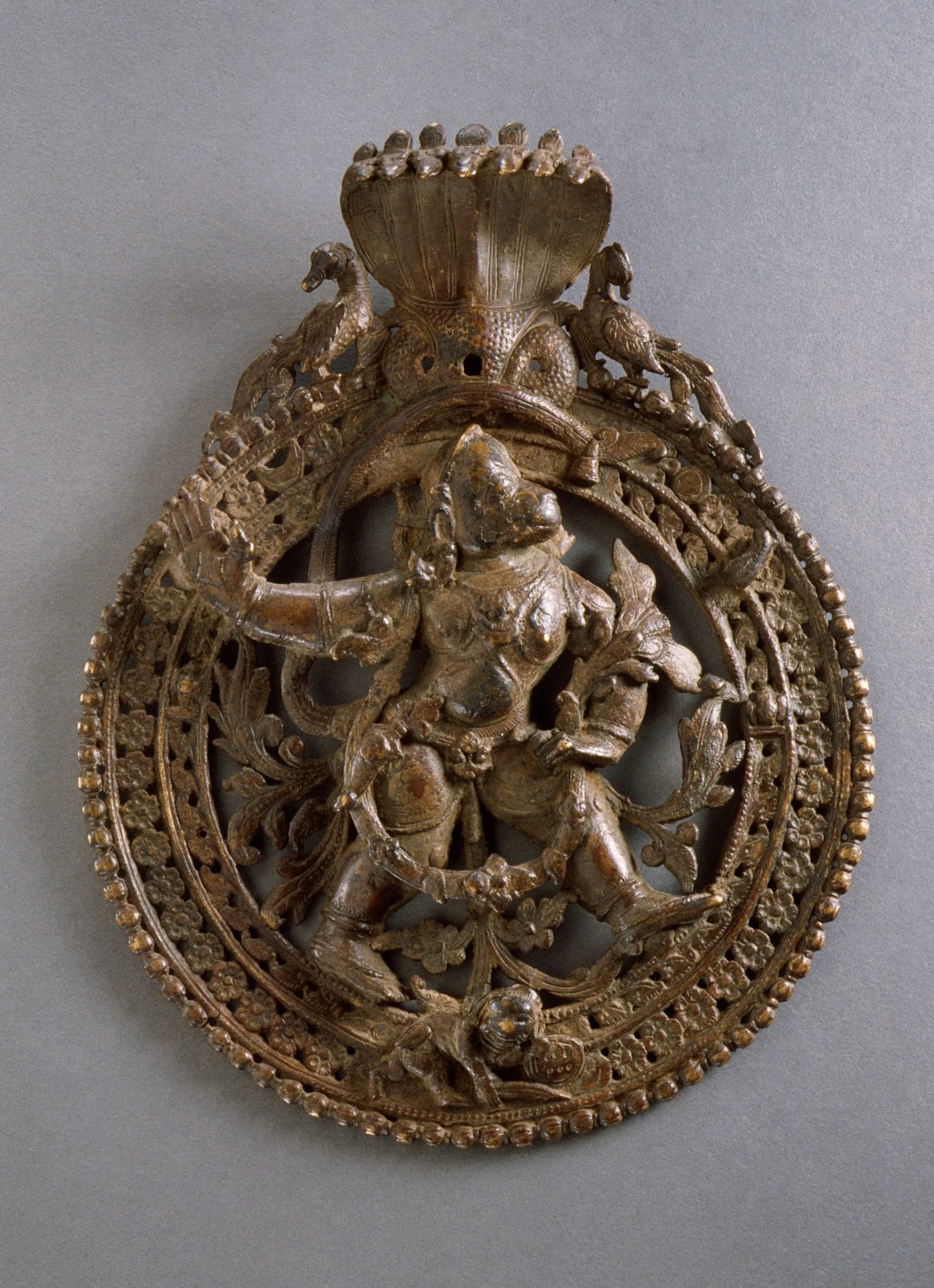
- Ascetic's Pectoral Plaque with Hanuman, The Divine Monkey
- Date Made
- 16th century
- Medium
- Copper alloy
- Dimensions
- 9 1/16 x 7 1/8 x 1 1/2 in. (23.01 x 18.09 x 3.81 cm)
- Accession Number
- M.87.160.1
- Curatorial Notes
Known as a bajrang bali (strong monkey), this distinctive type of pectoral plaque depicts Hanuman, The Divine Monkey. It is worn suspended around the neck by Vaishnava ascetics devoted to Hanuman, principally in Karnataka and Maharashtra. The basic form is that of an aureole or mandorla with concentric registers of design motifs. The inner band has swaying leaves or stylized flames. Open blossoms with six petals fill the outer band. The rim is a row of bead molding or bell replicas. The top of the mandorla is crowned by a rearing multi-headed cobra flanked by a pair of geese with long foliate tails. Hanuman is shown in the center of the mandorla in a conventionalized posture symbolizing flying. This interpretation is corroborated by the presence of the sun and moon, symbolizing his transit of the heavens, which are represented in the blossom register near the 1 o'clock and 11 o'clock positions respectively. The inner band has small depictions of Vishnu's conch and discus, shown vertically with flames on the sides and top, at the 3 o'clock and 9 o'clock positions respectively. At the bottom is a defeated demon warrior, presumably Kalanemi, who Hanuman vanquished during his search for the magical herb.
Hanuman is portrayed in the iconographic aspect of flying back from the Himalayas carrying a magical herb to heal the mortally wounded Lakshmana, Rama’s brother. The herb is a long flowering vine that starts from his left shoulder and forms a garland draped in front of his body.
- Selected Bibliography
- Pal, Pratapaditya. Indian Sculpture, vol.2. Los Angeles: Los Angeles County Museum of Art; University of California Press, 1988.