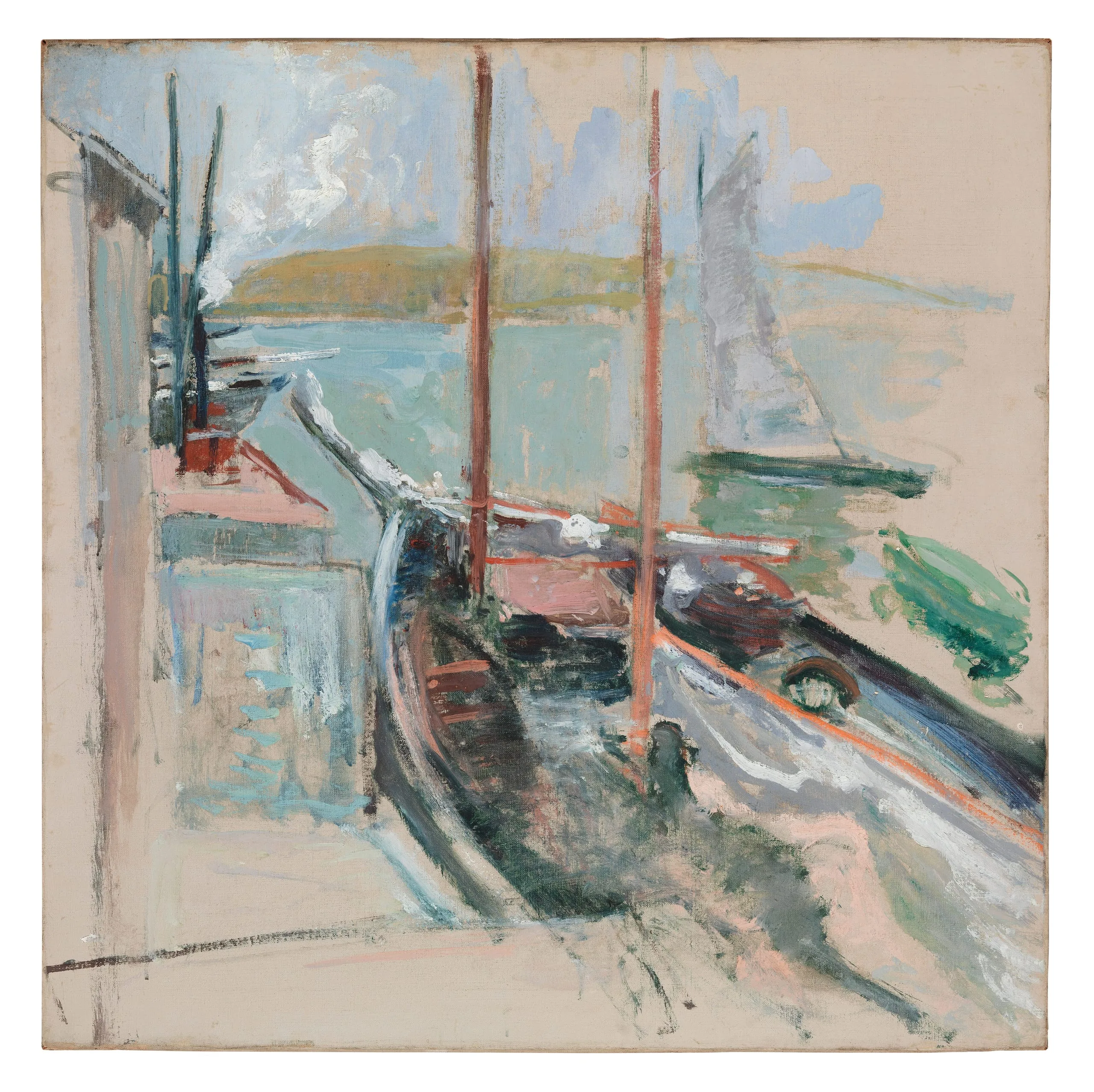
Throughout his career Twachtman was attracted to harbors and scenes of shipping, and he painted harbors in Venice; the New York area; Newport, Rhode Island; Bridgeport, Connecticut; and Gloucester, Massachusetts. It is on the basis of its style that this harbor view is identified as a scene in Gloucester, where, during the last three summers of his short life, Twachtman developed a distinctive, new manner. Gloucester was both a resort and an active fishing town. Twachtman had received one of his earliest, favorable critical notices for the freshness of the views he painted in 1879 of unpicturesque wharves and shipping in New York harbor. In Gloucester he painted the countryside, but also close-up scenes of the ordinary wharves and fishing fleet. In this painting he seems to have set up his easel on the roof of one of the low sheds along the wharves, with one of the larger buildings to his left and behind him. This viewpoint looks down upon the deck of a large ship. judging from the forward position of the two masts that are visible, this may be a three-masted vessel, presumably one of the large Italian barks that brought salt for processing the fish in Gloucester. Much larger than the two-masted fishing schooners, the barks were higher in the water, their decks also higher than the level of the wharves built for the schooners.
Twachtman used a high vantage point in some of the other paintings he did in Gloucester, producing a similarly high horizon line, which, together with the tilted-up foreground and square format of the canvas, tends to deny the illusion of spacial recession. The surface grid, which is suggested by the way the parallel masts intersect the top edge of the painting and the horizon line parallel to it, also contributes to an awareness of the picture’s surface and the denial of depth. Counteracting these formal features is another familiar in the Gloucester paintings, the powerful, thrusting diagonal into space, along the length of the bark. An increased consciousness of pictorial geometry, its clear expression, and its use for dramatic effect are characteristic of Twachtman’s more explicit picture-making in his Gloucester paintings.
The design of Harbor Scene, painted on Twachtman’s largest canvas size of the period, is so strong that it reads clearly and forcefully even though the painting remained unfinished. Stimulated by the momentary scene and interested in problems of pictorial design, he began numerous paintings in Gloucester that he did not carry to completion. One sees in these unfinished paintings, as well as in the finished ones, a vigor of paint handling not seen in Twachtman’s work since his early period in Munich. His classic paintings of the previous decade employed underpainting to produce very delicate effects of limited color and value. The Gloucester pictures were painted directly, with the direction and texture of the paint clearly visible. The color is stronger, the contrasts greater, and the action of paint application is a matter of separate interest. The vigor and exceptional skill of Twachtman’s brush command attention in Harbor Scene.