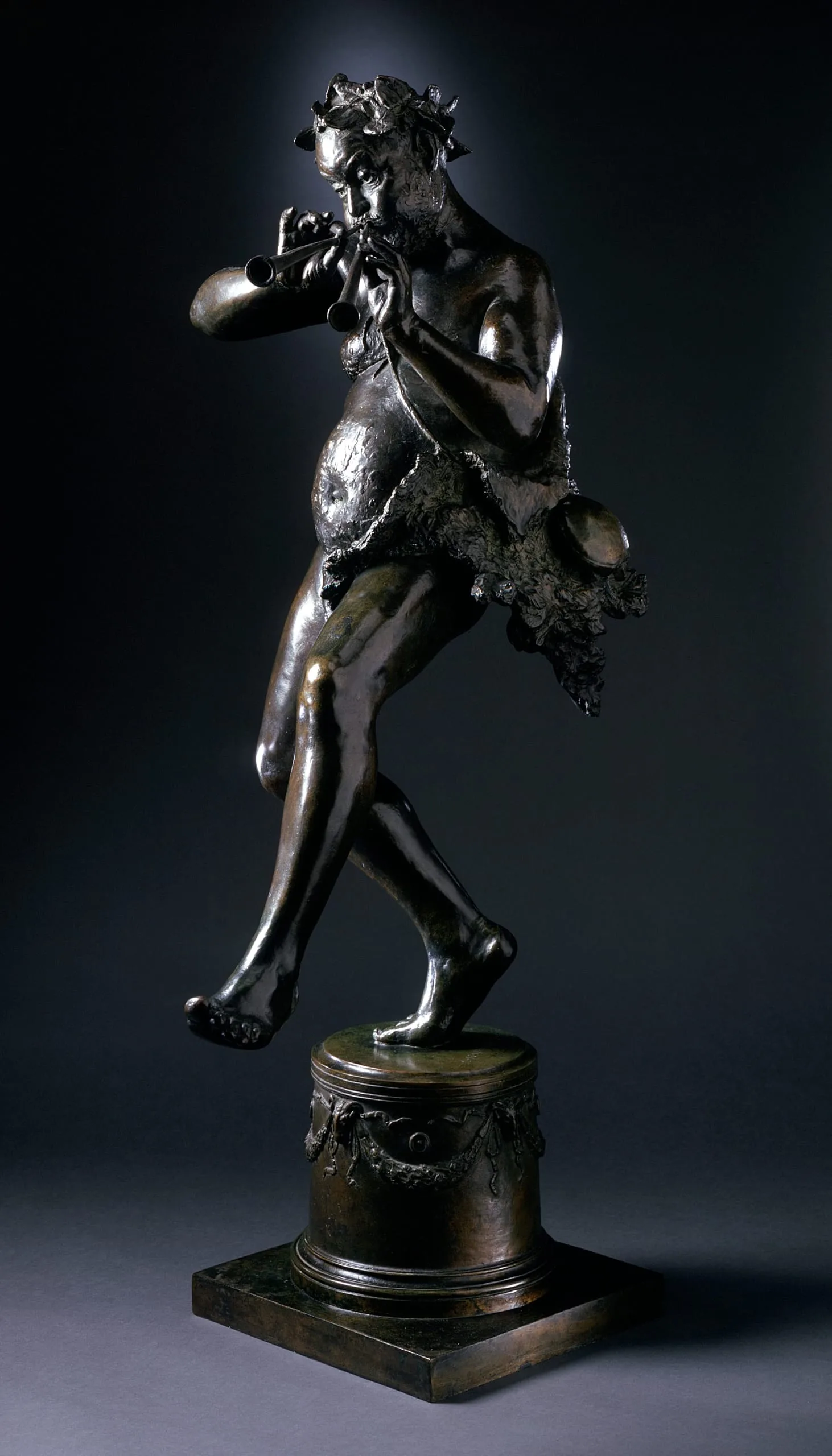
Niehaus had used his savings from his work as a stonecarver to go to Munich to study and similarly used the proceeds of his first important commissions to return to Europe, to spend two years in Rome, perhaps executing the commissions there and pursuing further his studies of the nude and the antique. He had a studio in the Villa Strohl-Fern, next to the Palazzo Borghese, where he modeled numerous figure studies in the manner of the antique. Of these apparently experimental works, only three survived: Caestus, modeled c. 1883-85 (casts of 1901, Metropolitan Museum of Art, New York, and National Museum of American Art, Smithsonian Institution, Washington, D.C.), The Scraper (Greek Athlete Using a Strigil), modeled c. 1883-85 (a cast at Brookgreen Gardens, Murrell’s Inlet, S.C.), and the museum’s Silenus.
Niehaus’s study of the ideal figure in light of the antique calls to mind the work of Adolf von Hildebrand (18471921) in Florence during these years, although Hildebrand’s influence among Munich-trained artists is thought to date from the exhibition of his work there in 1891. Until that decisive event, sculpture in Munich was shaped by an advanced, naturalistic movement with a somewhat rococo flavor. Niehaus’s early statues of Garfield and Allen are in this highly detailed, slightly agitated style. In the course of the 1880s this naturalistic trend culminated in such extreme manifestations as casts from life and tinted sculptures. A reaction among the younger artists led them to the simpler, stronger sculpture of antiquity, which they felt was animated by its coherent expression of the mechanism of movement.
The three surviving antique figures from Niehaus’s years in Rome show that he sought a simpler, more powerful style in which organic movement and balance informed every pare of the figure. When compared with the noble, somewhat abstracted figures of Hildebrand, those of Niehaus seem highly naturalistic; The Scraper’s great success at the World’s Columbian Exposition in Chicago in 1893 was due to what was regarded as its unconventional realism. At the same time, one can discern in all three sculptures a shift to the more compact sense of form and more disciplined reserve in modeling that were to characterize Niehaus’s subsequent work, suiting him particularly for monumental sculpture.
Sileni were Panlike woodland spirits resembling the satyrs. In Greek mythology, Silenus was the foster father and tutor of Dionysus and leader of the satyrs. He is traditionally depicted as a fat, drunken, old man, usually without the goat’s legs and tail but with the pointed ears, upturned nose, and full beard of a satyr, and with heavy brows and high, full cheeks. An earlier, probably original version of Silenus (unlocated, illustrated in Armstrong, Sculpture of Niehaus, p. 60) has these traditional features, derived from ancient prototypes, that are absent from the museum’s cast, except for the pointed ears. The earlier version differs in a few other details and in a finer, more naturalistic overall modeling. The pose, recalling the famous Dancing Faun from Pompeii (Museo Nazionale, Naples), remained the same. What appears to be a cast of this earlier version appears in a painting Inquisitive, 1893 (New York art market as of 1989), by Louis Charles Moeller (1855-1930).
Casts of Caestus bear the date 1901, and it seems likely that The Scraper and Silenus also were cast about that time, although each bears the mark of a different foundry and thus they were not from a single campaign of casting. They represented Niehaus in important exhibitions early in the century.