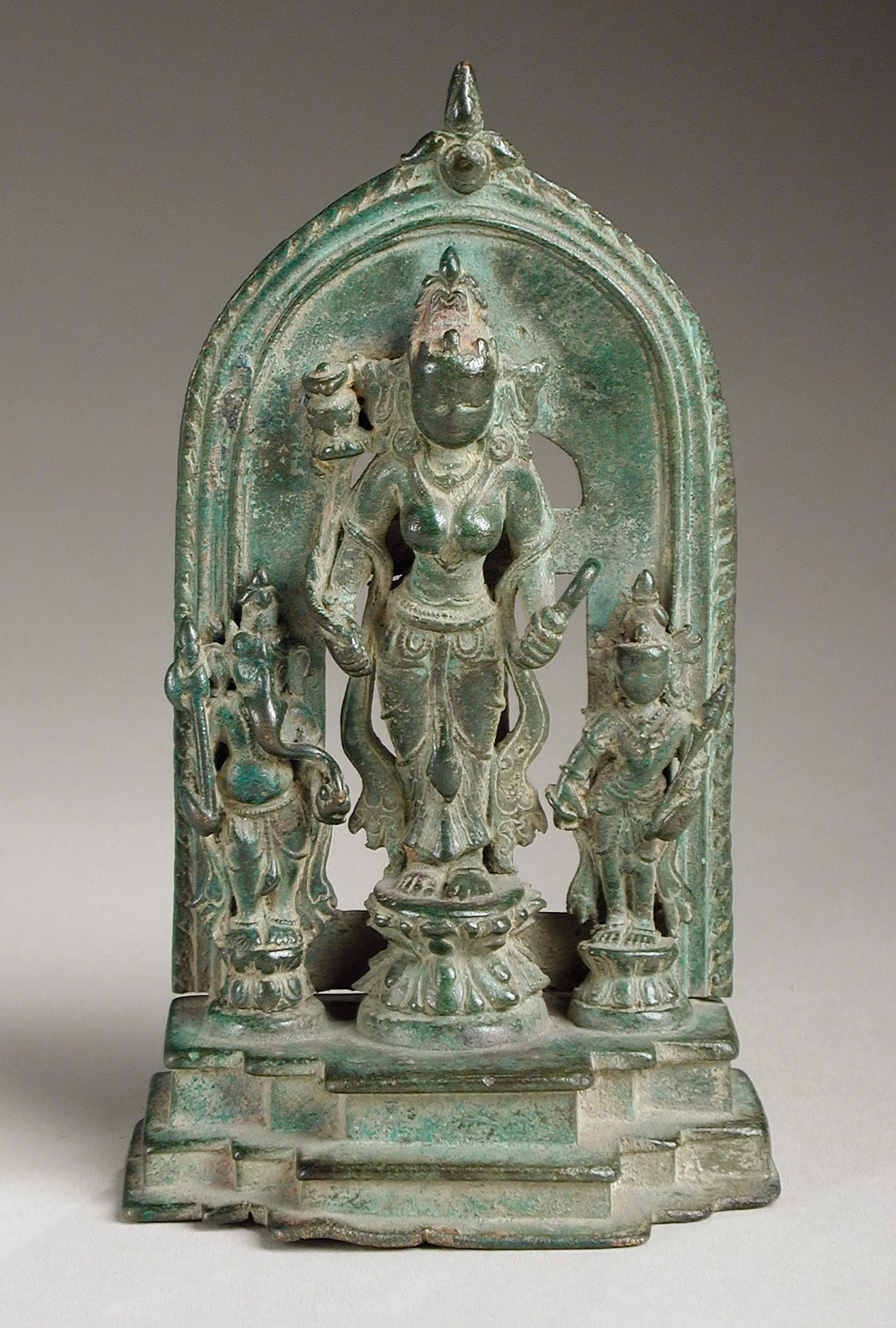
Lalita (Charming) is a gracious aspect of the Hindu goddess Parvati, the spouse of Shiva. She is crowned with a tiara and has an ascetic’s piled hair (jata mukuta) that streams out to the sides. The goddess is profusely ornamented, including an ornate hip belt (katibandha) with loops of pendant pearls and a long flowing scarf that billows around her ankles. She stands in a stiff, frontal pose (samapada sthanaka) on a double lotus base and stepped pedestal. Although typically depicted with four arms in Bengali and Bihari sculpture, in this Odia (Orissan) representation she has two arms. In her right hand, she grasps the stalk of an open lotus (padma) surmounted by a Shivalinga. In her left hand held at waist level, she carries a cosmetic stick (anjana-shalaka). Lalita is flanked by the smaller figures of Shiva’s sons, the elephant-headed Ganesha on her right and the youthful god of war Karttikeya on her left. Ganesha holds his battle axe with his right hand and, with his left hand, carries a bowl of sweetmeats (ladhus) from which he is eating with his trunk. Karttikeya holds his spear with his left hand and an indeterminate object in his right hand. The divine triad is exalted by a flaming aureola (prabhavali) with a finial in the form of a mango bunch.
See Gouriswar Bhattacharya, "A Special Type of Devi Figure from Bihar and Bengal," in Facets of Indian Art: A Symposium Held at the Victoria and Albert Museum on 26, 27, 28, April and 1 May 1982, ed. Robert Skelton et al (London: Victoria and Albert Museum, 1986), pp. 33-40.
A comparable representation of Lalita, albeit stone, four-armed, and attributed to Bengal, 11th century, in the British Museum, London (1872,0701.54).