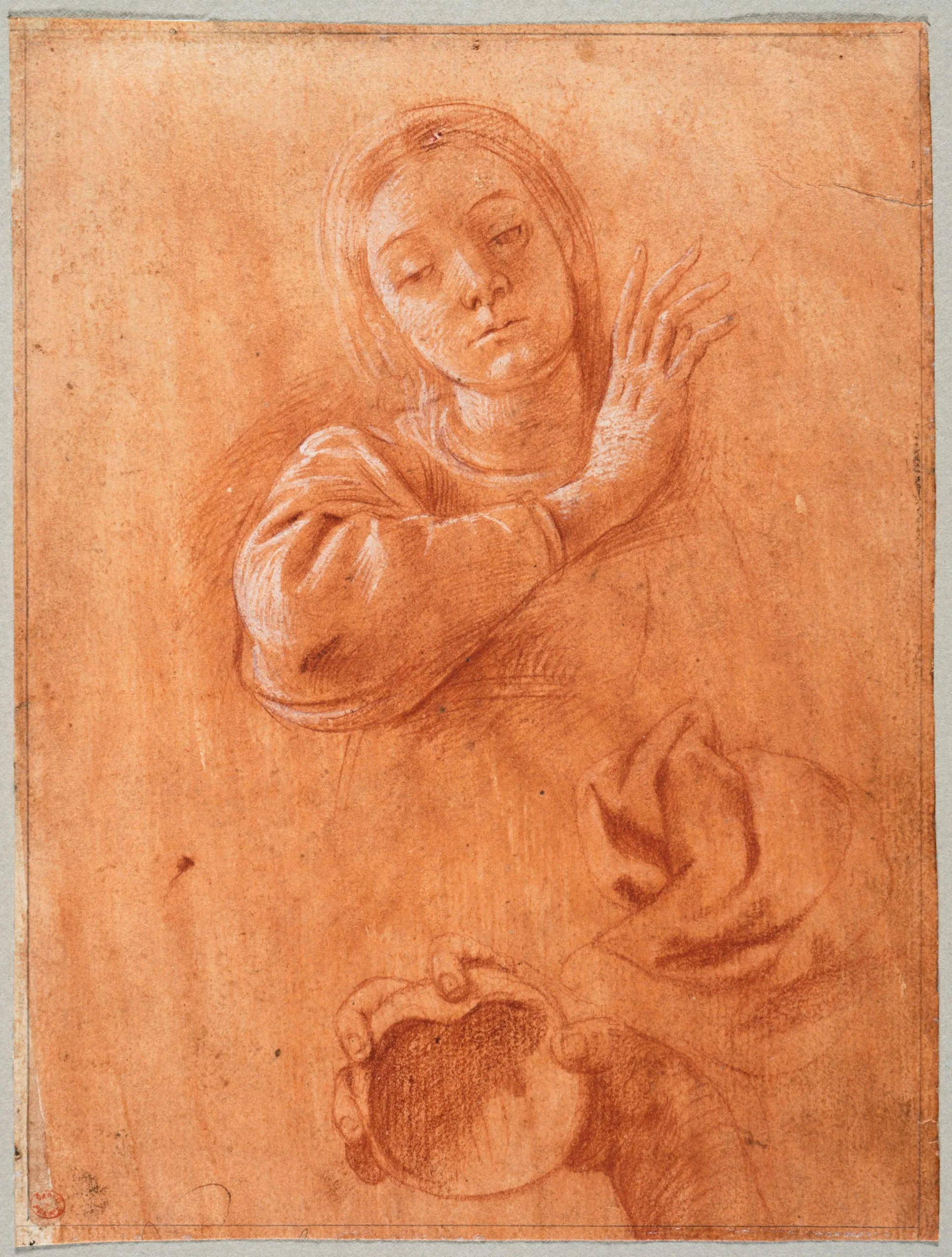
Tanzio was one of the principal artists of the Counter-Reformation in Lombardy and contributed several paintings to one of its key monuments, the Sacra Monte, in his hometown of Varallo. His compositions, which have the character of tableaux vivants, engage the viewer with their intense naturalism, and he used preparatory studies such as this one to render the details of expression and gesture found in his paintings.
LACMA acquired this sheet because of the close resemblance between the Virgin’s figure here and in Tanzio’s painting of about 1628−30, Adoration of the Shepherds with Saint Francis and Saint Carlo Borromeo, also in the museum’s collection (M.81.247). A nearly identical study of the female figure, in the same technique though on a smaller sheet, is in the Louvre. The Paris drawing has been related to another painting by Tanzio, documented to 1628, depicting the Virgin and Child flanked by the two saints. Because of the similarity in the Virgin’s position in the two canvases, as well as the unknown relationship between the Los Angeles and Varallo paintings, it is impossible to speculate for which painting the present drawing was first employed. A study for the figure of Saint Francis, with the same unknown relationship between drawing and painting, is in the Morgan Library & Museum.
The coloristic effects here are characteristic of Tanzio’s work as a draftsman, a good sampling of which was included in the graphics section of the 1973 exhibition Il Seicento lombardo in Milan. All but two of the drawings in that exhibition were executed in the same technique as LACMA’s sheet—red and white chalk on paper washed with red chalk. Also like this drawing, they are detailed studies of individual figures, heads, and limbs.
Adapted from Bruce Davis, Master Drawings in the Los Angeles County Museum of Art (1997)