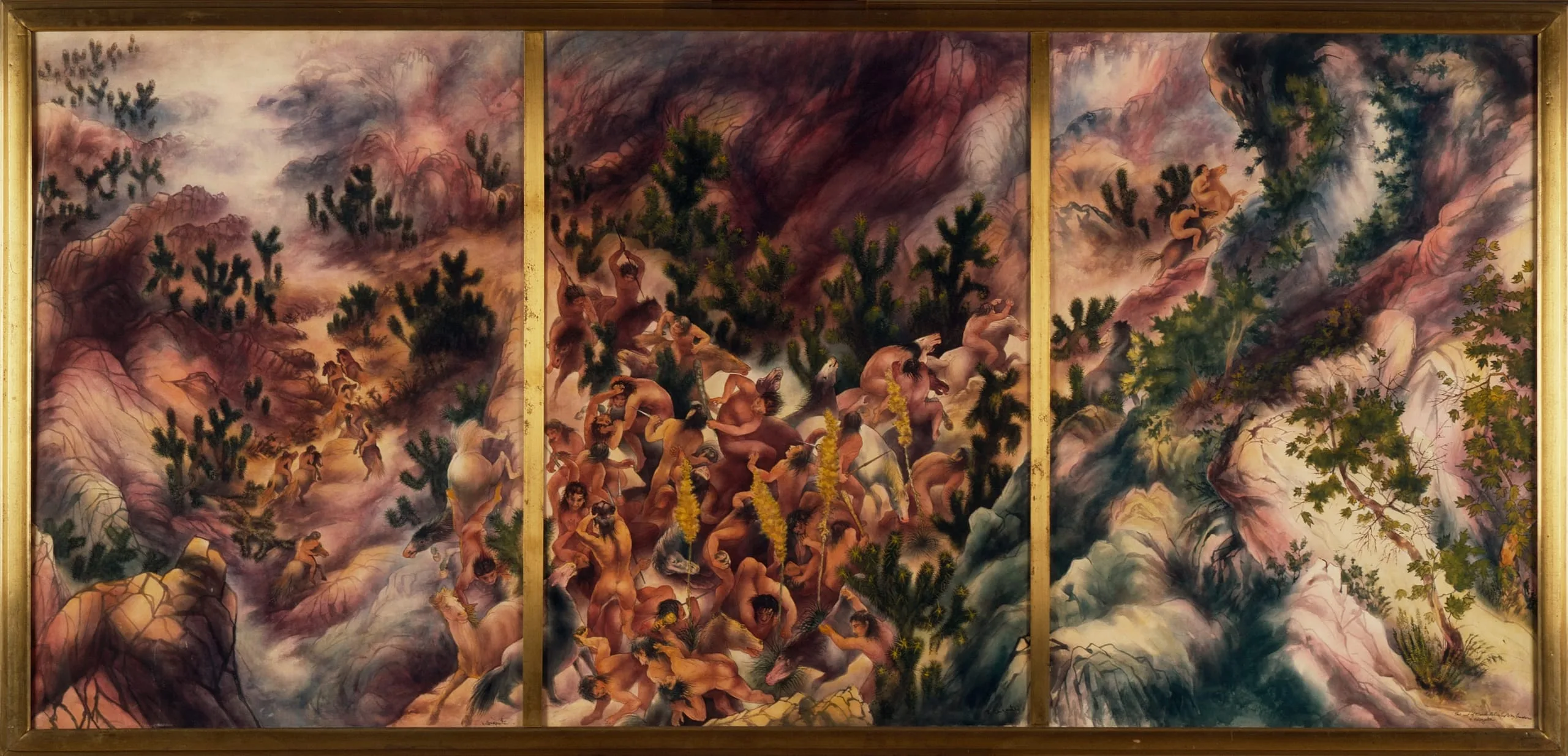
In 1934 Brigante was injured in an industrial accident and prevented from working directly from nature for several years. During his convalescence he produced thousands of sketches of the figure and used them, along with earlier landscape studies, as the basis for two large works, the museum’s Nature and Struggling Imperious Man and the smaller Early Western Activities, 1937 (private collection). In both Brigante used his favorite medium of watercolor for a purpose that differed from that of his earlier, small-scale works. No doubt inspired by mural painting, which experienced a revival in the late 1920s and was further encouraged by the federal art projects of the 1930s, Brigante viewed his multipaneled, large-scale watercolors as murals and consequently intended them to convey a more elaborate story or theme than was possible in a single image.
Nature and Struggling Imperious Man is the grandest and the most significant painting of Brigante’s early decades. In its philosophic view of nature and calligraphic composition the mural foreshadows his multi-paneled, oriental-inspired ink landscapes of the 1970s. In 1942 Stanton Macdonald-Wright compared this nine-panel work with the long handscroll format of Chinese Song dynasty painting. Brigante’s work shares with much of Song painting a "high distance" viewpoint and also interprets the mountain formations as twisting linear rocky outcroppings, which the Chinese refer to as "dragon veins." However, while Brigante’s later works are devoid of man, here the human figures are crucial. In his two murals from the 1930s Brigante returned to the figure for the first time in several years, and there are so many figures in this painting-more than two hundred-that they seem to swarm over the landscape. The subject of Nature and Struggling Imperious Man is primitive man’s constant struggle to dominate or at least find some harmonious existence with implacable nature and his fellow man, so Brigante set the tiny figures in an almost overwhelming landscape of mountains, valleys, and desert.
Unlike typical murals of the period, this painting is not a simple narrative of consecutive scenes but instead consists of vignettes set in a single panoramic landscape, which obscures somewhat the episodic nature of the work. Read from left to right, the scene shows: a primitive village of tipis, the inhabitants of which are going about their daily search for food; a group of figures setting out from a village into the mountains, where they are ambushed by members of their own tribe; and a lone figure emerging from the savage fight to ride quietly through an idyllic valley and then come upon a fortress village under attack.
Brigante’s employment of watercolor for a mural painting was likely unique, for such large-scale work is usually the domain of the less fragile mediums of oil and fresco. The artist desired to invest watercolor with a new importance and dignity. To this end he experimented with glazing and repeated tonal applications of the medium to achieve a greater luminosity and depth of color. His success was attested by critics of the day, who repeatedly praised his brilliant coloring. As one stated, the cycle is a tour-de-force of watercolor painting (Archiv. Am. Art, Nick Brigante Papers, microfilm roll 1357, fr. 111).