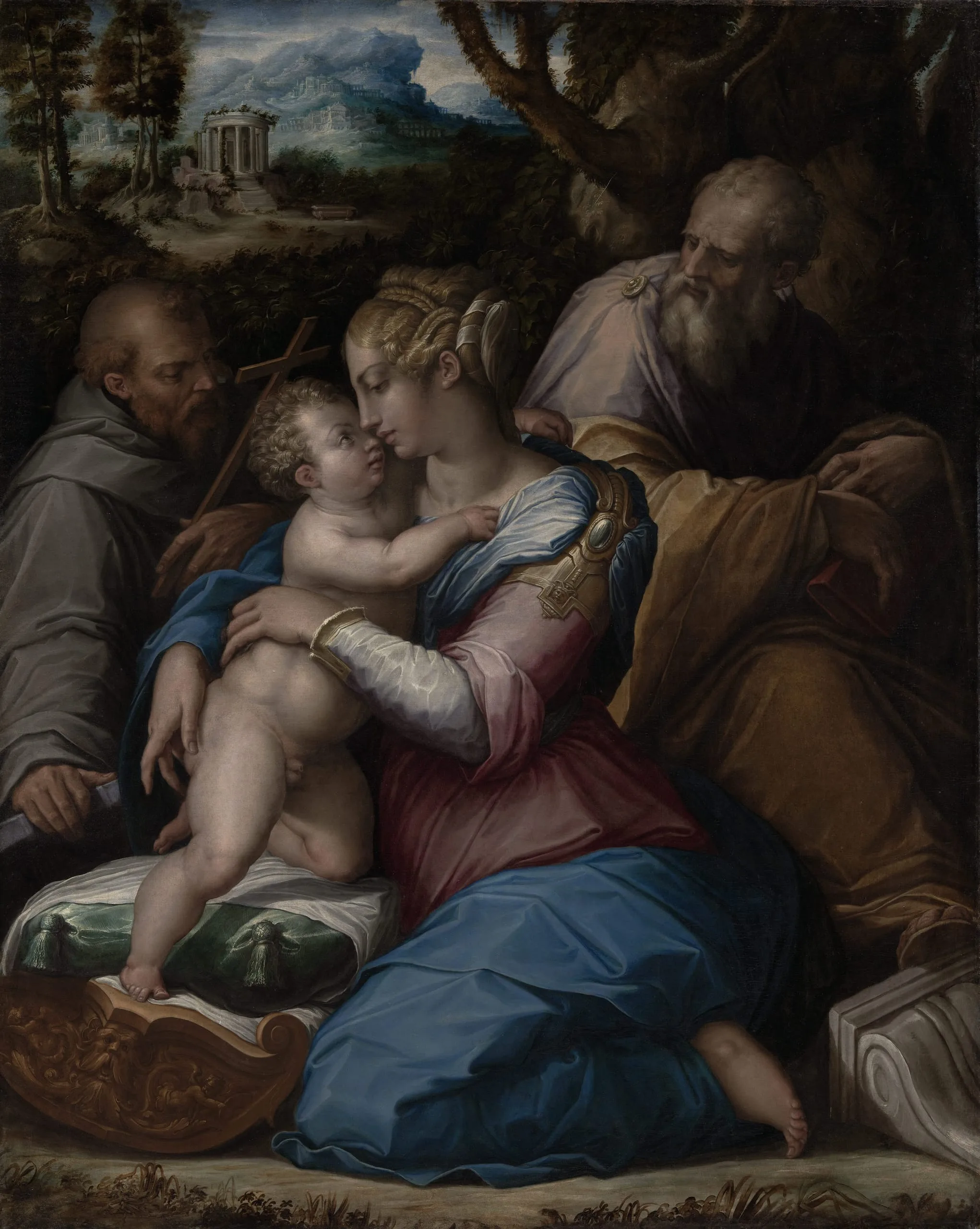
Giorgio Vasari’s artistic ingenuity is often overshadowed by his authorship of the profoundly influential Lives of the Artists, first published in 1550. This renowned compilation of artist biographies solidified Vasari’s reputation as an art historian. Yet the adept conveyance of emotions and ingenious references in Holy Family with Saint Francis attest to his competence as a painter as well. It is a rare example of his work in oil, as he predominantly worked in situ on frescoes. This painting is based on a composition designed by Raphael in 1518, but it differs vastly in its imagery and mood. Vasari’s Holy Family exudes solemnity and intimacy, with allusions to Christ’s final days of suffering, as recounted in the gospels. The Madonna embraces the infant Christ, the elongation of his body accentuated by his outstretched leg. The cradle, resembling a coffin, signals his eventual entombment. Saint Francis gently rests his wooden cross on the back of Christ’s head, referencing the episode of Christ carrying the cross. The saint’s firm grip on the slab of stone hints at Christ’s resurrection. Joseph hovers somberly, his foot pressing against a fallen marble volute. This architectural fragment ties the foreground to the background, where the idyllic cityscape references the ancient world in the distance.
Vasari completed this painting during a brief visit to Venice, where he stayed with the Florentine banker Francesco Leoni. The Holy Family was likely commissioned by Leoni and displayed in his private chapel in Venice. It is also plausible that Vasari based Leoni’s patron saint, Francis, on Leoni’s own likeness. These clever details—producing a harmonious combination of biblical stories, ancient architectural cues, and contemporary references that personalize the commission—underscore Vasari’s inventiveness as a painter.
2024