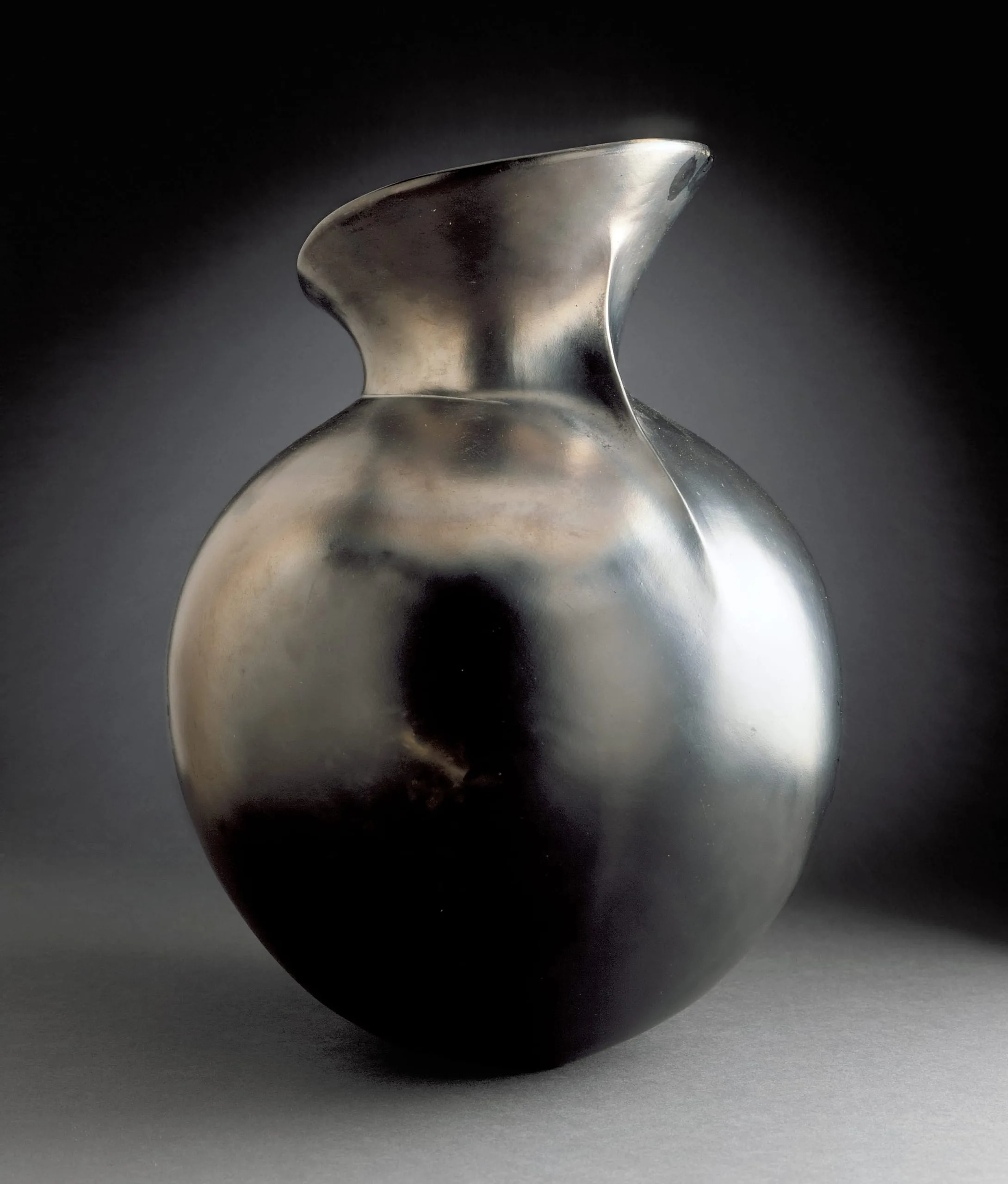
Bulbous forms and burnished surfaces characterize Dame Magdalene Odundo’s ceramic work. Her swollen shapes have often been described using anthropomorphic analogies, and especially compared to the pregnant female body, the preeminent vessel of life. Untitled epitomizes the way her work resembles a physical body, but also traditional vessels for carrying food and water. Handbuilt from successive coils of terracotta clay, it was rubbed with stones to achieve a smooth texture and fired multiple times to yield the silky black surface. Odundo works almost exclusively in rounded, closed vessel forms such as this one. “The vessel is present from birth to death,” she explains. “We’re brought in through a vessel and leave in a vessel. I think that’s why the idea of embodiment, and representing an individual, has also been so poignant when thinking about and appreciating the pot as a universal object.”
Over a long career, Odundo has found vital sources of inspiration in museums. As a student, visits to the Fitzwilliam in Cambridge, England, to see classical Greek pottery and objects from the ancient Kerma civilization were transformative. She also had decisive learning experiences with living ceramists, including studying for three months with Nigerian potter Ladi Kwali, who taught her how to coil-build a pot (when the prevailing technique was wheel-throwing). She had a pivotal visit in the United States with the Pueblo potter Maria Martinez, whose burnishing and firing techniques would influence her own.
Bobbye Tigerman
2024