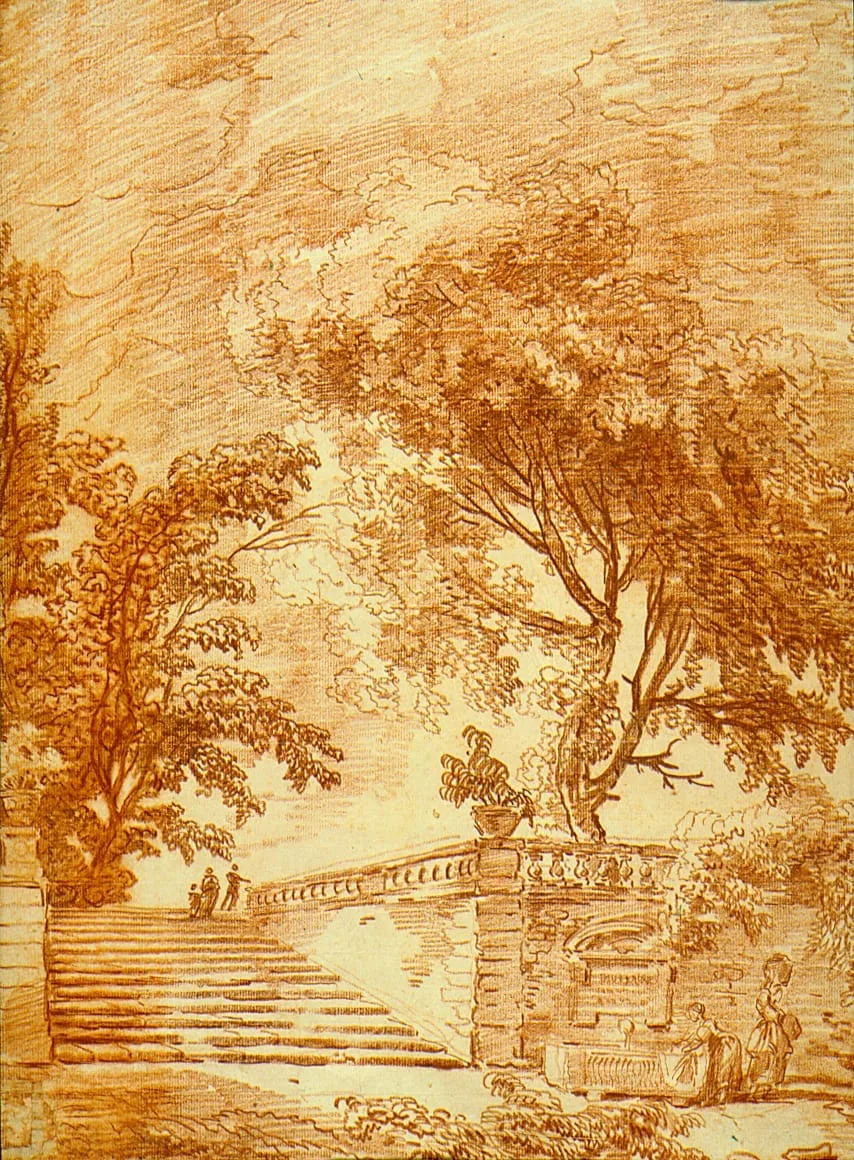
In 1754 the painter Hubert Robert traveled to Italy with the diplomatic mission of Count de Stainville, the French ambassador to Rome. For the next eleven years he studied, painted, and drew the decaying ruins of the monuments of classical antiquity. Robert was strongly influenced by Giovanni Battista Piranesi's architectural drawings and sometimes fanciful reconstructions of Roman buildings. Robert found a responsive audience among his contemporaries, who saw in his depictions of Rome's past grandeur a melancholy but noble perspective from which to contemplate their own mortality.
The artist returned to Paris in 1765 and put his fascination with picturesque ruins to good use. In addition to his career as a painter, he became a landscape designer and by the 1770s was in great demand to construct gardens in the newly fashionable naturalistic manner.
This drawing, done in the red chalk Robert favored, shows a fountain and stairs leading to a formal terrace. The figures establish the scale in this graceful and imaginative setting, where towering trees with arching branches replace the formal symmetry and stonework of traditional baroque gardens. Foliage of varying density is rendered in Robert's rapidly executed saw tooth line and characteristically vigorous and assured hand.
Robert was a forebear of later romantic artists who painted real and imaginary landscapes, and his work marks the progression of the genre from a relatively minor position in academic eighteenth-century art to one of the most important themes in French painting of the nineteenth century.