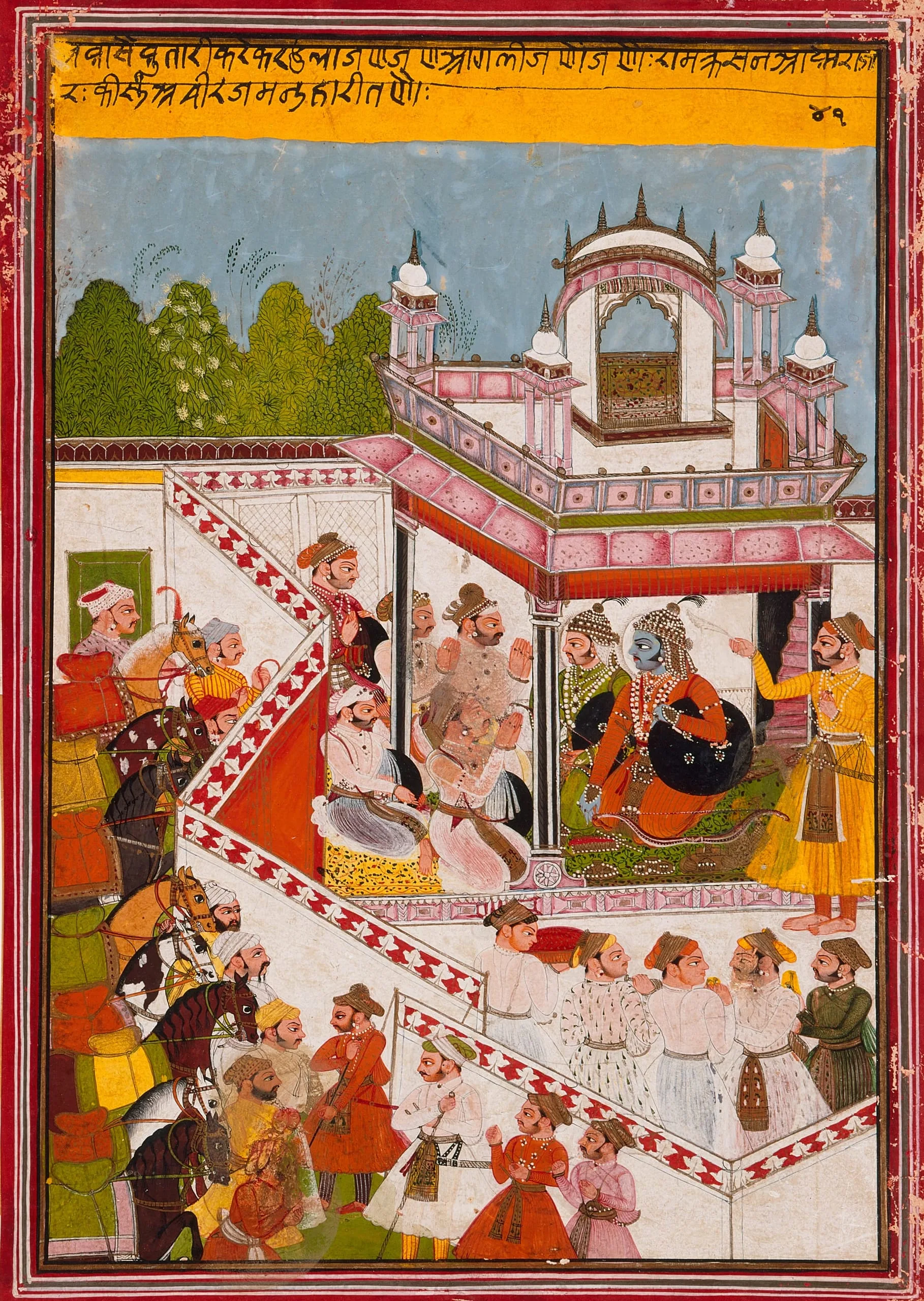
This finely detailed painting likely represents the grand court assembly (darbar) held in honor of Prince Rama and his brother Lakshmana upon their triumphant return from their unjust fourteen-year exile. See the Ramayana (6:116) in Robert P. Goldman, Sally J. Sutherland Goldman, and Barend A. van Nooten, trans., The Ramayana of Valmiki: An Epic of Ancient India., Vol. 6. Yuddhakanda (Princeton: Princeton University Press, 2009), pp. 487-494.
The dark-skinned Rama and light-skinned Lakshmana sit on a floral carpet in a palace pavilion. They are both nimbate befitting their divinity and both dressed in battle gear indicating their warrior status. An attendant behind him waves an honorary white handkerchief (chaila vikshepa). Seated before the honored brothers are various dignitaries with their hands held in the gesture of veneration (anjali mudra). On the terrace beneath them are attendants bearing gifts such as delicacies on a tray under a silk cover and a wine carafe (surahi). Outside of the tent encloser are palace guards with batons and the grooms with horses of the dignitaries.
The Braj-Bhasha inscription in the yellow header reads, From the circle of the assembly, arranged side-by-side, were the respected honorable participants, and [those placed] in front, person by person. These beautiful sovereigns—the Rama-and-Krishna-like manifestations (Rama krasana)—sit in glory, who are as magnificent as King Manu [of whose lineage comes the sage] Harita. Folio 41. (Translation by Google. subject to verification.)