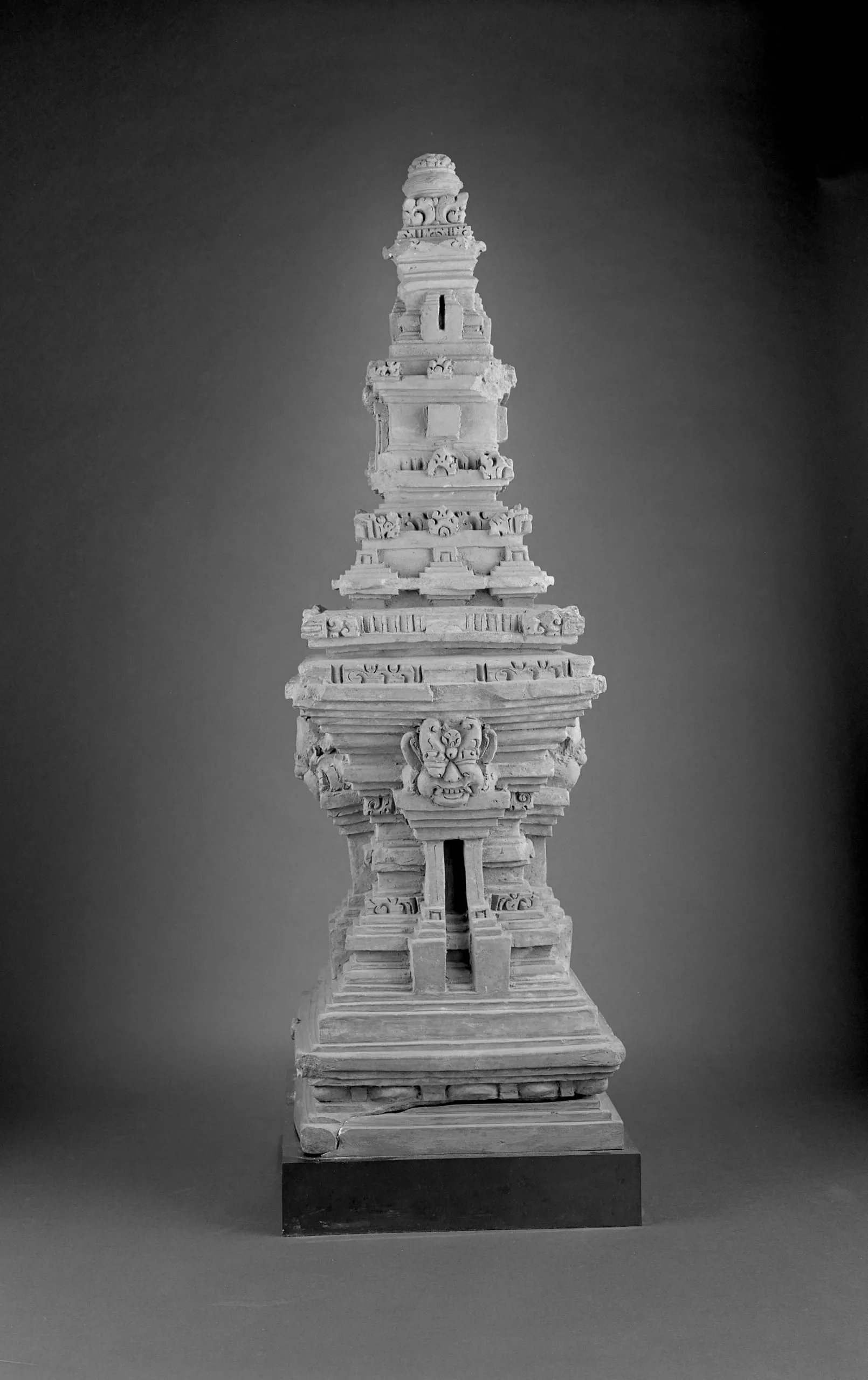
Numerous miniature temples or architectural models made of earthenware have been found in Eastern Java. The exact function of these objects has yet to be determined, but it is likely they were votive temples.
The LACMA votive temple (chandi) has a single-celled shrine raised on a stepped square base. Above the lower entrances on each side are apotropaic demonic masks known as a kala head (kala [time, death, or black] shiras). The separately fashioned pyramidal superstructure of tapering tiers and one upper entrance is adorned with foliate motifs. It is a miniature version with minor variations in the superstructure of the renowned Chandi Penataran (or Panataran) in Eastern Java dated by inscription to 1369.
The kala heads resemble and may be derived from the Indian "Face of Glory" (kirttimukha). They may also relate to the Chinese gluttonous creature (taotie) and the Tibetan zipac or zeeba. Kala heads are typically represented to ward off danger, but they can also be used as a decorative motif. They are portrayed in a variety of media, see M.78.10.1 and M.91.232.1 (copper alloy), M.78.87.1 (stone), and M.91.300.1 (earthenware). Central Javanese representations usually lack a lower jaw, but Eastern Javanese depictions typically feature both jaws.
The kala head on the LACMA chandi has the standard bulging eyes, horns, fangs, fierce expression, and a lower jaw.
A comparable but much smaller Eastern Javanese earthenware chandi is in the Wereldmuseum, Leiden. See H. R. A. Muller, Javanese Terracottas: Terra Incognita (Lochem, The Netherlands: Tijdstroom, 1978), pp. 70 and 103, pl. 125. Similar miniature temples found in Trowulan are in the Museum Majapahit, Trowulan.