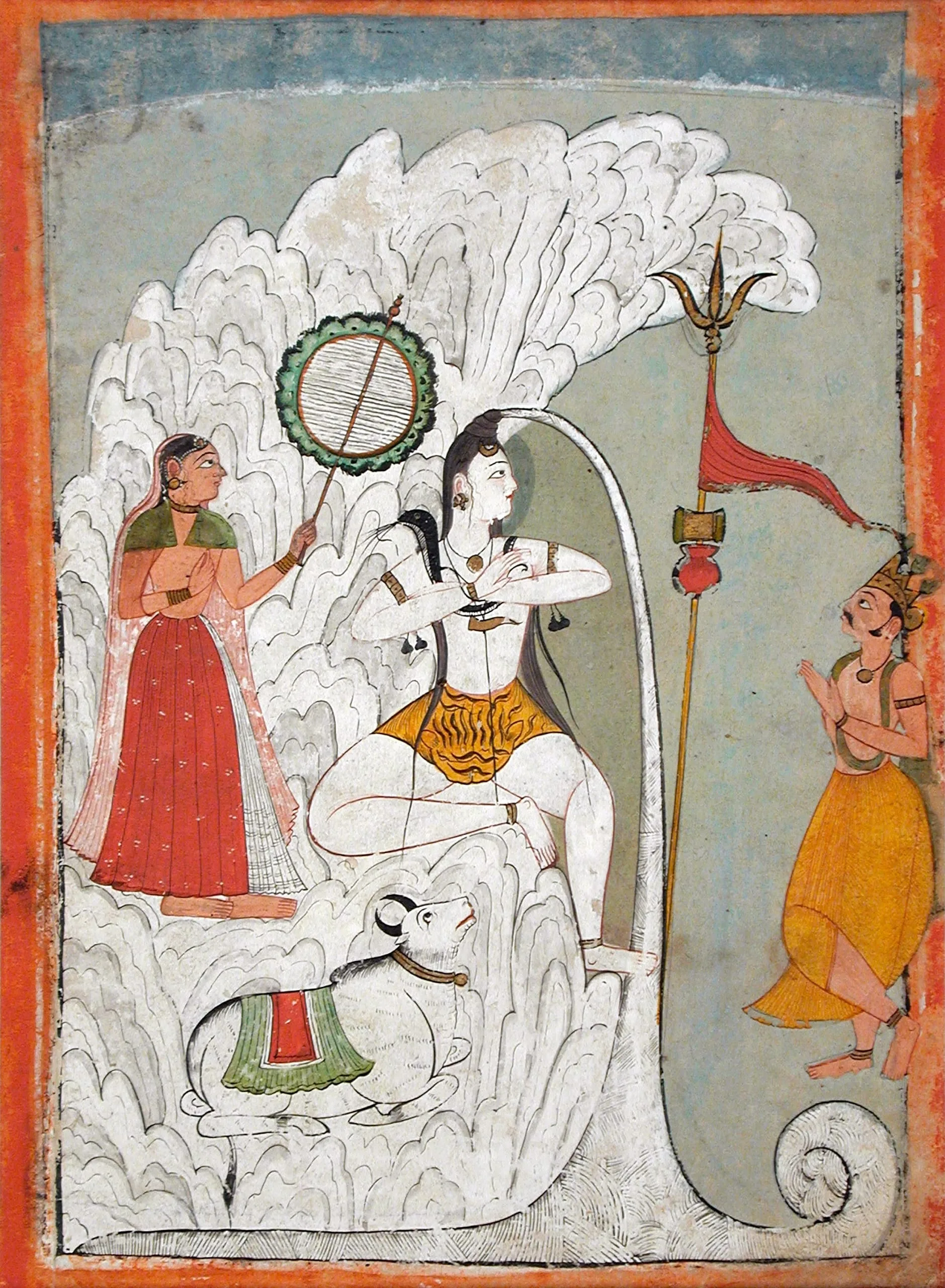
This painting is from a series of some eighteen folios from a Bhagwanji-Narainji manuscript made for the now-submerged Vaishnava monastery at Bathu, an offshoot of the Pindori (or Pandori Dham) monastery in the Gurdaspur district of Panjab. It primarily consists of sayings of the early 17th-century Mahant (Chief Priest) Narainji, who was a disciple of Mahant Bhagwanji. See Usha Bhatia, "Re-discovery of the Dispersed Bathu Manuscript," in B. N. Goswamy, ed., Essays in Honour of Karl J. Khandalavala (New Delhi: Lalit Kala Akademi, 1995), p. 63, fig. 13.
The Hindu god Shiva sits in the lalitasana (royal ease) posture on Mount Kailasa. Shiva’s arms are crossed in the svastika (auspicious) position. From his matted hair cascades the Ganges River, which Shiva facilitated in its descent from heaven. Shiva is accompanied by his wife, Parvati, who holds an honorific sunshade (kiraniya), and his bull mount, Nandi. Raja Jagat Singh of Nurpur (r. 1618-1646) stands before Shiva paying homage.
Additional folios from this dispersed series are in the Bharat Kala Bhavan, Varanasi; Chandigarh Museum; Chhatrapati Shivaji Maharaj Vastu Sangrahalaya, Mumbai; National Museum, New Delhi; and private collections.