LACMA

ShopMembershipMyLACMATickets
LACMA
Los Angeles County Museum of Art
5905 Wilshire Blvd.
Los Angeles, CA 90036
info@lacma.org
(323) 857-6000
Sign up to receive emails
Subscribe
© Museum Associates 2025

Museum Hours

Monday

11 am–6 pm

Tuesday

11 am–6 pm

Wednesday

Closed

Thursday

11 am–6 pm

Friday

11 am–8 pm

Saturday

10 am–7 pm

Sunday

10 am–7 pm


  • About LACMA
  • Jobs
  • Building LACMA
  • Host An Event
  • Unframed
  • Press
  • FAQs
  • Log in to MyLACMA
  • Privacy Policy
© Museum Associates 2025
Collections

Unknown
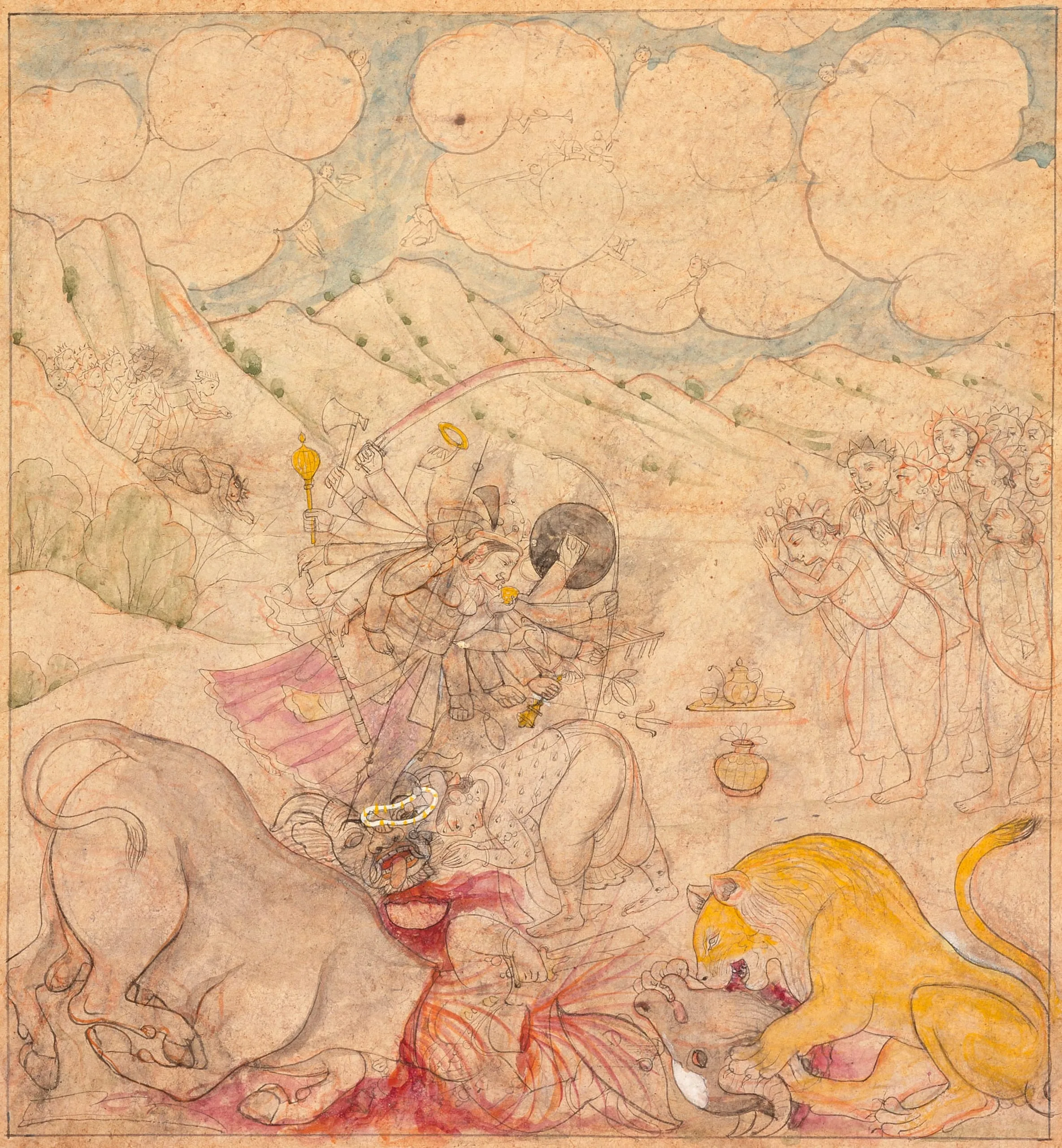
Durga Slaying the Buffalo Demon, Folio from a Devimahatmya (Glory of the Goddess)circa 1780

Not on view
Ink and watercolor drawing on tan paper depicting a multi-armed deity riding a lion in combat with a buffalo demon, with crowned onlookers to the right and mountains in the distance
Artist or Maker
Unknown
Title
Durga Slaying the Buffalo Demon, Folio from a Devimahatmya (Glory of the Goddess)
Place Made
India, Himachal Pradesh, Guler
Date Made
circa 1780
Medium
Ink and opaque watercolor on paper
Dimensions
9 3/4 x 9 in. (24.76 x 22.86 cm)
Credit Line
Gift of Paul F. Walter
Accession Number
M.86.345.8
Classification
Drawings
Collecting Area
South and Southeast Asian Art
Curatorial Notes

Dating from circa 550 CE, the Devimahatmya (Glory of the Goddess) is a devotional text of 700 Sanskrit verses that extol the Goddess (Devi) as the supreme power and creator of the universe. The verses were interpolations to the earlier Markandeya Purana dating from circa 250 CE and then extracted as a stand-alone text. The Devimahatmya describes the Goddess in her various aspects triumphing over the demons Madhu and Kaitabha, Mahishasura, Dhumralochana, Chanda and Munda, Raktabija, and Shumbha and Nishumbha.

This unfinished or preparatory drawing illustrates the climax of Chapter 3, “The Slaying of Mahishasura.” After the demon Mahishasura had assumed his sequential manifestations as a buffalo, lion, warrior with a sword, and elephant, each of which was defeated by the Goddess, Mahishasura resumed his buffalo form and then began to revert to his true demonic form. As his head emerged from the buffalo’s mouth, the Goddess jumped on his neck and beheaded him (Devimahatmya 3:39-42). The Goddess’s lion mount maws the buffalo’s decapitated head. The Goddess is drinking one of several cups of wine, which she drank to energize herself during the battle. Beside her is tray with a ewer and wine cups, and a lota with a lotus. The thousand-eyed Indra bows in reverence. The gods and celestial divinities herald the auspicious event.

See also its series mate M.77.154.29.
Selected Bibliography
  • Pal, Pratapaditya. The Classical Tradition in Rajput Painting. New York: The Gallery Association of New York State, 1978.