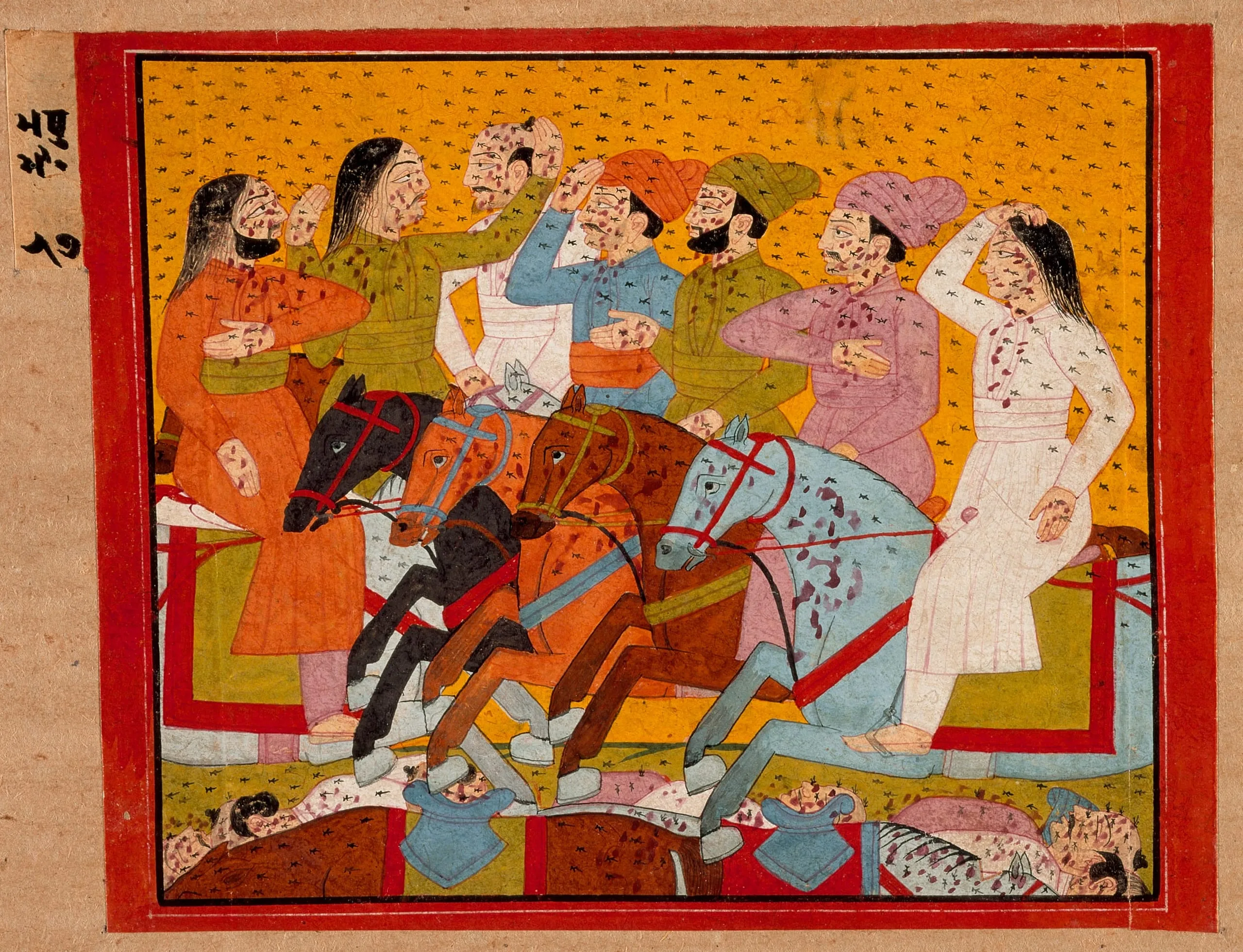
This painting illustrates an incident from the Madhumalati-varta (The Story of Madhu and Malati) written by the Rajasthani poet Chaturbhujdas in c. 1500. It is a fairly standard example of the secular romance genre of Hindi poetry. The crux of the story involves the trials and tribulations of the forbidden young lovers, Madhu, a minister’s son, and Malati, a princess. This rendition of the tale is distinct from the original 8th-century Sanskrit drama by Bhavabhuti and the 16th-century Sufi version by Manjhan, neither of which includes The Attack of Bees episode.
The lengthy text on the reverse is written in a mixture of takri and sharada scripts. It does not describe The Attack of Bees depicted on the obverse. Rather, it narrates the storyline leading up to The Attack of Bees incident. This indicates that the text on the reverse was to be read while its corollary painting in the series was being viewed. Subsequent verses of the published text describe The Attack of Bees: “. . . like Tiddi [locust] eats/destroy the harvest field, one each [soldier attacking Madhu] thousands of bees glued and their sting was as painful as burnt by pieces of coal fire. You like a swan brighten [the city of] Kataka . . .” (Madhumalati-varta 517-520) (Translation by Naval Krishna.)
Intriguingly, the painter seems to have been inspired by the poet’s simile of the bees appearing like a swarm of locust and, accordingly, represented the bees with a more elongated physical form reminiscent of locust.