- Title
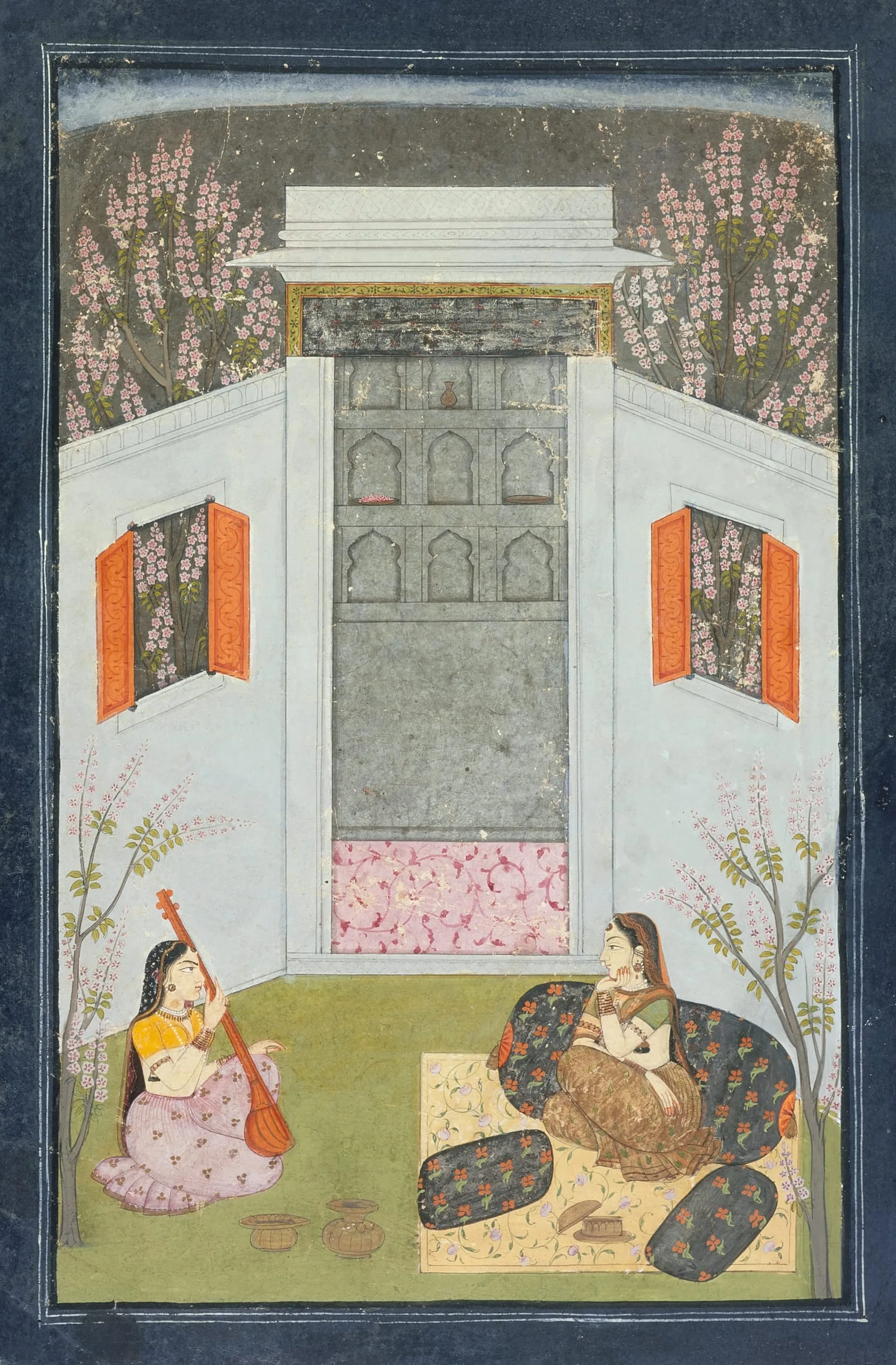
- Patamanjari Ragini, Fourth Wife of Bhairava Raga, Folio from a Ragamala (Garland of Melodies)
- Date Made
- circa 1780
- Medium
- Opaque watercolor, gold, and silver on paper
- Dimensions
- Image: 9 1/4 x 5 7/8 in. (23.5 x 14.92 cm); Sheet: 11 x 7 3/8 in. (27.94 x 18.73 cm)
- Accession Number
- M.86.345.7
- Curatorial Notes
Patamanjari Ragini is the fourth wife of Bhairava Raga in the predominant ragamala (garland of melodies) classification system generally known as the Rajasthani system. It is an early morning melody associated with Autumn (September–November). The melody’s name is derived from the Sanskrit prathama manjari (first blossom). Patamanjari Ragini is envisioned as a courtly woman distraught by the absence of her lover and sitting dejectedly with her head supported by her hand. She is being consoled by a confidante, who is occasionally shown singing or, as is the case here, playing a drone instrument (tambura). They are seated in a palace courtyard rendered symmetrically in linear perspective. See also M.77.154.8 and AC1999.127.26.
The harmonious visual symmetry, cool palette, and lyrical flowering trees are closely akin stylistically to the garden setting in a portrait of Raja Amrit Pal of Basohli (r. 1757-1776) by the artist Ranjha (active circa 1778-1827) attributed to circa 1780 (M.80.223.1). Ranjha (circa 1750-1830) was the fourth son of the celebrated artist Nainsukh of Guler (circa 1710-1778, active circa 1730-1778). He was born in Guler and later migrated to Basohli, where an imported Guler/Kangra painting style was fostered under Raja Amrit Pal.
- Selected Bibliography
- Pal, Pratapaditya. The Classical Tradition in Rajput Painting. New York: The Gallery Association of New York State, 1978.