- Title
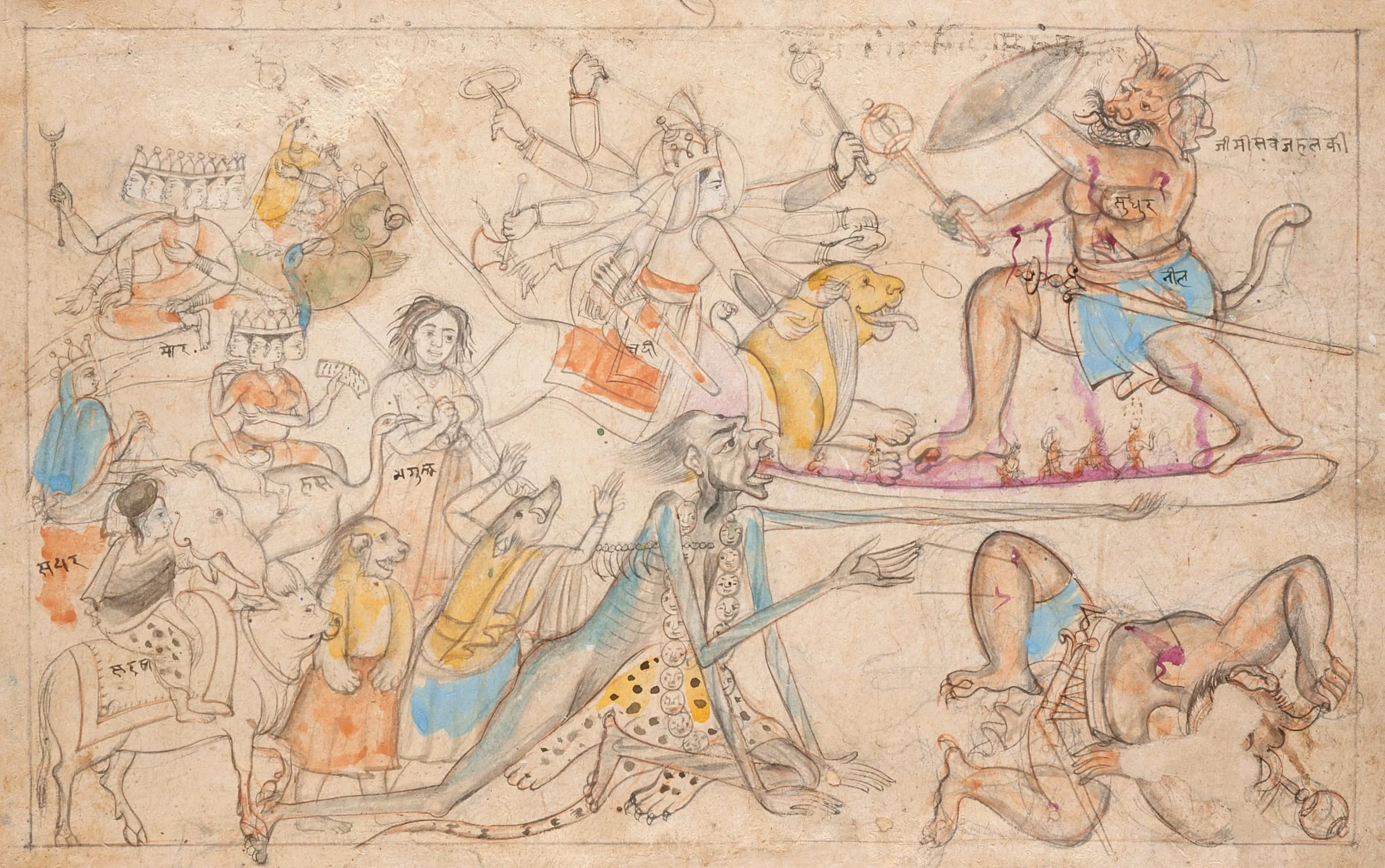
- The Goddess Fighting Titans, Folio from a Devimahatmya (Glory of the Goddess)
- Date Made
- circa 1800-1825
- Medium
- Ink and opaque watercolor on paper
- Dimensions
- Sheet: 6 7/8 x 10 5/8 in. (17.46 x 26.99 cm); Image: 6 x 9 3/4 in. (15.24 x 24.76 cm)
- Accession Number
- M.86.345.10
- Curatorial Notes
Dating from circa 550 CE, the Devimahatmya (Glory of the Goddess) is a devotional text of 700 Sanskrit verses that extol the Goddess (Devi) as the supreme power and creator of the universe. The verses were interpolations to the earlier Markandeya Purana dating from circa 250 CE and then extracted as a stand-alone text.
This preparatory drawing likely illustrates the climax of Chapter 7, “The Slaying of Chanda and Munda.” After seeing the Goddess in her form of Parvati and being overwhelmed by her beauty, they reported their encounter to their demonic overlord Shumba, who sought to marry the Goddess. She responded that she would only marry someone who defeats her in battle. Shumba was incensed by her refusal and sends Chanda and Munda and their armies to kidnap her. When the demons attacked the Goddess, her face turned dark from anger and the horrific goddess Kali emerged from her brow. The emaciated Kali devoured the armies by capturing them with her lolling tongue and grinding them to dust with her teeth. Chanda and Munda then assailed the Goddess, who furiously beheaded them. Here, Chanda has been slain and Munda charges at the Goddess. Joining the fray behind her are several Mother Goddesses, including Vaishnavi on Garuda, Kaumari on a peacock, Brahmani on a swan, Indrani on an elephant, and Maheshvari on a bull. There are color notations and labels for some of their mounts. Comparable renditions are in the Metropolitan Museum of Art, New York (1997.390 and 2008.359.11).
- Selected Bibliography
- Pal, Pratapaditya. The Classical Tradition in Rajput Painting. New York: The Gallery Association of New York State, 1978.