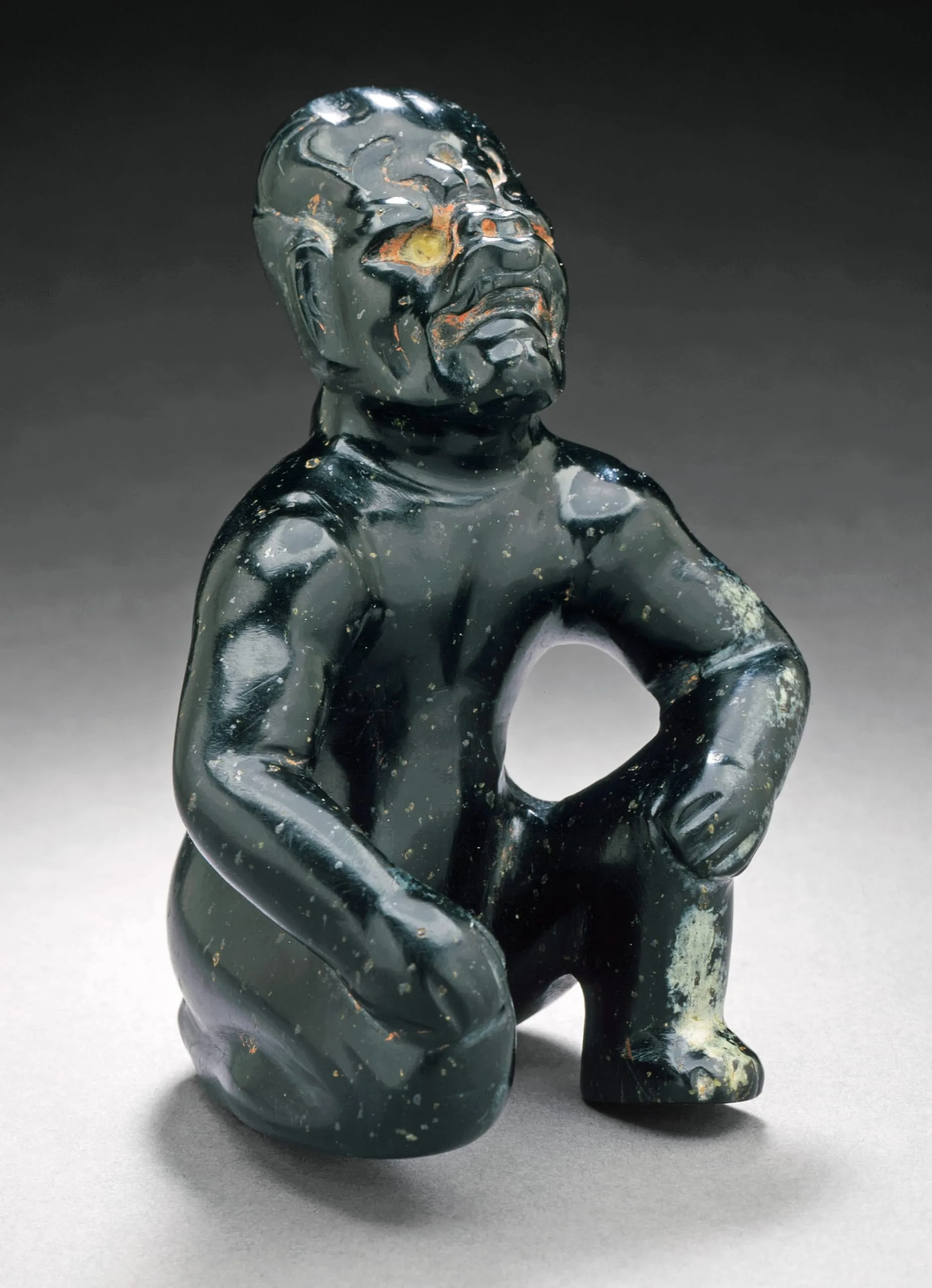
The Olmec civilization, which flourished in the coastal lowland states of Veracruz and Tabasco between 1200 and 400 B.C., provided the philosophical, political, and artistic foundations upon which later Mesoamerican civilizations were based. The brilliant conception and superb craft of Olmec style art and architecture, found at the great ceremonial complexes of San Lorenzo, La Venta, and Tres Zapotes, include pyramids, monumental stone sculptures, and exquisitely carved jades. The legacy of the Olmec style is found throughout Mesoamerica, as far south as Costa Rica, in monumental and portable art.
This powerful figure, portraying both human and jaguarian features, represents a shaman or a divine ruler undergoing transformation to a supernatural state. The figure does not wear a mask but actually is, beneath his human form, a jaguar: the skin and hair on the head have been peeled back to expose his feline nature. The supernatural qualities of the figure were originally enhanced by glowing eyes, inlaid with pyrite.
The Olmec cosmos was divided into three realms: the watery underworld, on which the earth floats; the terrestrial level, where people live and crops grow; and the celestial realm of the birds and heavenly bodies. Shamans gained access to these worlds through meditation and ingestion of hallucinogens, transforming and transporting themselves between earthly and supernatural worlds. Jaguars, who live in caves and are equally at home on land and in water, were associated with acts of transformation because of their ability to move between the cosmic realms of earth and the watery Underworld.