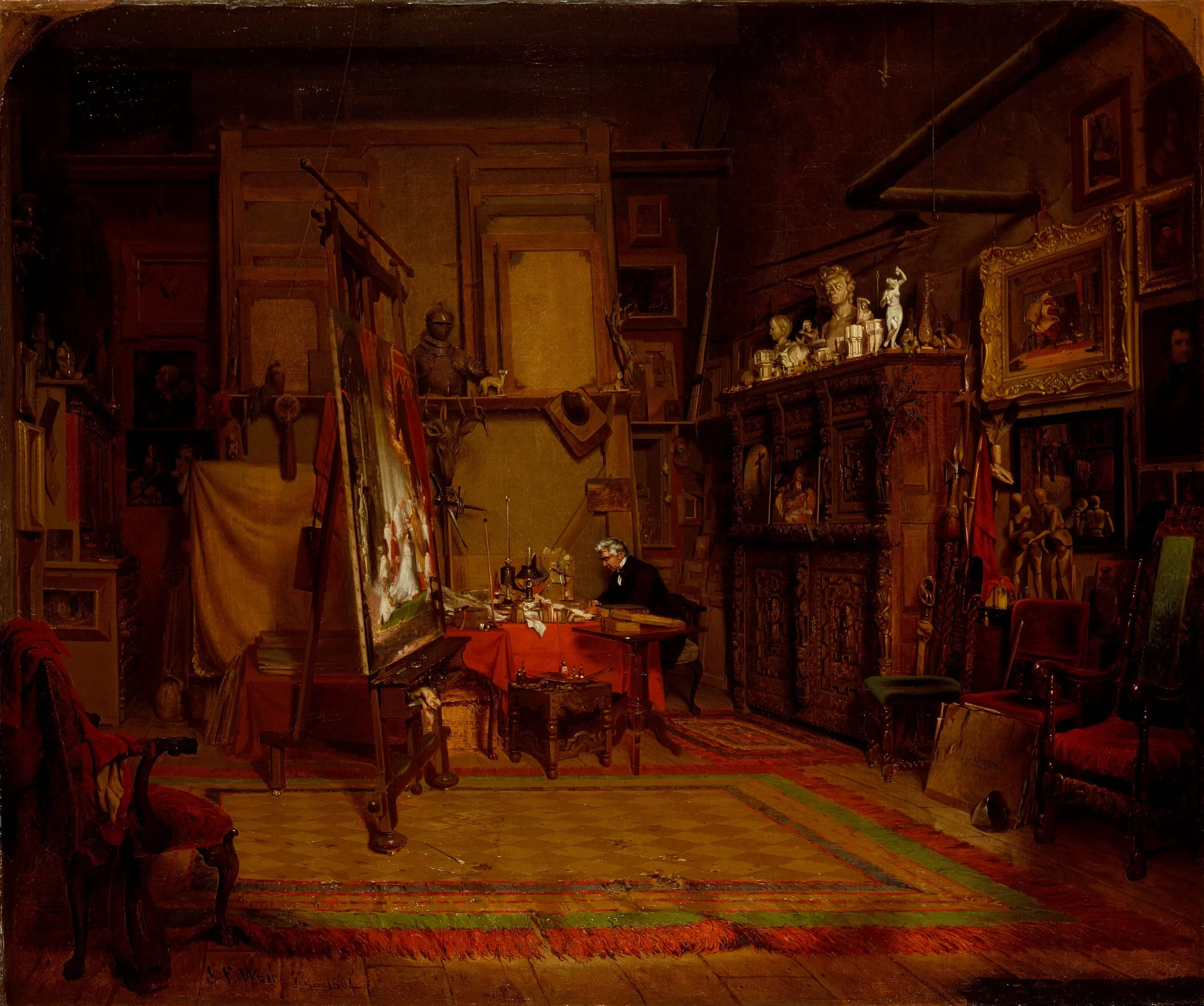
Weir seems to indicate in his published Recollections that he began An Artist’s Studio in West Point during the summer of 1862 and returned during the summer of 1863 to finish it, but in an early manuscript of the recollections he wrote that he carried the unfinished canvas with him when he moved to New York in 1861 to set up his own studio in the Tenth Street Studio Building. In a manuscript list of some of his works Weir indicated that An Artist’s Studio was painted in 1863 and 1864.
He intended to exhibit the picture for the first time in the spring exhibition of the National Academy of Design in 1864, but the artist SANFORD R. GIFFORD, a friend and neighbor in the Tenth Street Studio Building, admired it enough to borrow it first for an exhibition and reception at the Athenaeum Club. Its favorable reception at the exhibition of the National Academy of Design was Weir’s first great success, causing his election as an associate member of the academy. Even though he raised the price, Weir sold it soon afterward.
Robert Weir had introduced his son to the world of art and to numerous leading artists, so it seems appropriate that a painting of the distinguished artist in his studio at West Point should have been John Ferguson Weir’s introduction to the National Academy of Design and the art world of New York. The young Weir had served what he considered an apprenticeship in that studio and wrote of it in the same manuscript draft of the Recollections: "Brought up in an artist’s studio, surrounded with what was actively related to the practice of art, with opportunity for gaining such knowledge of the past as the collections and library of the house inspired, it only needed a strong incentive to get from this what was requisite in the way of preparations in following one’s bent. At any rate, the results of this experience supplied my equipment when eventually I struck out in the swim and found myself in the Tenth Street Studios." The significance the subject had for the young Weir is reflected in the fact that he painted the studio in other works, The Artist’s Studio, 1864 (Yale University Art Gallery, New Haven, Connecticut), The Studio, 1864 (art market 1976), and The Morning Paper, 1868 (Metropolitan Museum of Art, New York). What apparently is a study for the right side of the museum’s painting is preserved in the West Point Museum. An inventory made in 1914 indicates that he still had at that time two paintings and oil sketches of the interior of a studio, as well as two photographs thought to be of the interior of his father’s studio (New Haven, Yale University, John Ferguson Weir Papers, "Professor Weir’s Portfolio, Case in Lobby to Store-room, March 1914," pp. 4, 5).
An Artist’s Studio depicts Robert Weir writing in his studio, surrounded by his own paintings, drawings, and artist’s equipment, as well as antique furniture, armor, and other artifacts assembled by him, for he was conscientious about the accuracy of the details of his history paintings. The very size of the studio, a space of two stories open to the roof, recalled his most famous history painting in that the studio was an addition to his original stone quarters that was built to enable him to paint The Embarkation of the Pilgrims, 1843, for the rotunda of the Capitol in Washington. Two studies for that painting can be seen on the left side of the back wall, the upper one a study for the figure of John Robinson, the pastor, and the lower one a study for those of Miles Standish and his wife. His most recent success, Taking the Veil, 1863 (Yale University Art Gallery, New Haven), is represented as on the large easel in the center of the room. It had been a critical triumph when exhibited in February 1863 in Goupil’s gallery in New York and later, by April of that year, in his son’s Tenth Street studio. The other recognizable images depicted are also ones that had special meaning for Robert Weir: the version of his celebrated painting Saint Nicholas of 1837 (unlocated; one of numerous replicas or later versions, dated 1838, New-York Historical Society) that can be seen near the upper right-hand corner of The Artist’s Studio, and the large bust near it, on top of the cabinet, a replica of a bust of 1840 by Shobal Vail Clevenger (1812-1843) of Washington Allston (1779-1843), esteemed as the greatest American artist of the romantic period. Propped up on the cabinet is an oil sketch of what looks like a Deposition, perhaps a study for the painting, Evening of the Crucifixion, which Robert Weir exhibited at the National Academy of Design in 1864 (unlocated). The cabinet had been used as a background in the artist’s painting, The Microscope, 1849 (Yale University Art Gallery, New Haven).
Although surrounded by evidence of his artistic activity and success, Robert Weir is shown writing at his book-lined desk rather than painting. Father and son shared the ideal of the artist as a man of wide reading and a resultingly deep knowledge and rich imagination. An artist of the romantic period thought of himself as a poet, rather than primarily a craftsman, his chief effort being conceptual.
Although the painting’s dramatic shadows suggest this lofty realm of the imagination, An Artist’s Studio was developed in terms of clear spatial progression and firm drawing. Henry T. Tuckerman in 1867 praised Robert Weir’s Taking the Veil for its architectural truth and correct drawing (Tuckerman 1867, p. 214), but these qualities were developed much further in his son’s An Artist’s Studio. Robert Weir’s instruction to the cadets in military draftsmanship must have emphasized perspective drawing and clear rendering of details. The son he trained was exceptionally strong in both these areas. At the same time, the painting’s highly detailed quality reflects the taste of the 1860s, as seen in the work of his neighbors in the Tenth Street Studio Building.
The entry for the painting in the catalogue of the National Academy of Design’s exhibition included the following poem:
"I well remember how the light, the pale, pure north light, fell
On all within that lofty room, and clothed with mystic spell
A massive oaken cabinet, and many a curious chair
Bright armor of the olden time, and relics quaint and rare.
"I marked them well, --the gathered books, the painter’s treasures all:
Here was the resting-place of day, whatever might befall;
The inner shrine of one whose brow the stamp of genius bore,
And who the laurels of his fame with childlike meekness wore.
"Oh, many a slowly-waning hour this silent room alone
Had seen the dreaming artist sit, like statue carved in stone;
Absorbed in patient watchfulness of all that Fancy brought,
Gleanings of gladness or of gloom from out the fields of thought."