LACMA

ShopMembershipMyLACMATickets
LACMA
Los Angeles County Museum of Art
5905 Wilshire Blvd.
Los Angeles, CA 90036
info@lacma.org
(323) 857-6000
Sign up to receive emails
Subscribe
© Museum Associates 2025

Museum Hours

Monday

11 am–6 pm

Tuesday

11 am–6 pm

Wednesday

Closed

Thursday

11 am–6 pm

Friday

11 am–8 pm

Saturday

10 am–7 pm

Sunday

10 am–7 pm


  • About LACMA
  • Jobs
  • Building LACMA
  • Host An Event
  • Unframed
  • Press
  • FAQs
  • Log in to MyLACMA
  • Privacy Policy
© Museum Associates 2025
Collections

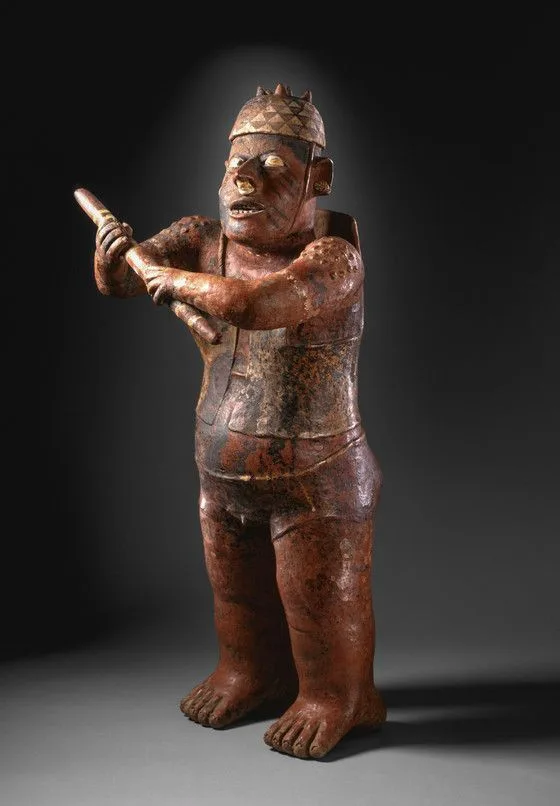
Standing Warrior200 BCE–400 CE

On view:
Geffen Galleries, Pacific Connections in the Ancient Americas
Ceramic standing figure with reddish-brown slip, stocky build, raised arms gripping a cylindrical object, inlaid eyes, and a diamond-patterned headdress with spikes
Unknown, Standing Warrior
Title
Standing Warrior
Culture
Jalisco
Place Made
Mexico, Jalisco
Date Made
200 BCE–400 CE
Medium
Slip-painted earthenware
Dimensions
37 1/2 × 16 × 17 in. (95.25 × 40.64 × 43.18 cm)
Credit Line
The Proctor Stafford Collection, purchased with funds provided by Mr. and Mrs. Allan C. Balch
Accession Number
M.86.296.86
Classification
Ceramics
Collecting Area
Art of the Ancient Americas
Curatorial Notes
This large, hollow figure comes from the present-day state of Jalisco, located on the Pacific coast of West Mexico. Between 200 B.C. and A.D. 500, the inhabitants of Jalisco and the nearby states of Nayarit and Colima constructed elaborate underground shaft-and-chamber tombs, which are unique in Mexico. Among the various burial offerings placed in these tombs were large, hollow ceramic figures and vessels, and such smaller objects as stone implements, shell trumpets, and obsidian mirrors. Because little monumental architecture and no writing systems from this region have survived, our knowledge of these ancient cultures comes from the burials and their contents. Unfortunately, few burials have been excavated by archaeologists, therefore, much historical information about the people of ancient West Mexico has been lost.
This warrior figure, which may have served as a tomb guardian, is the largest known example of funerary sculpture from West Mexico. Made in one piece, it is a tour de force of firing. The figure wears a caplike helmet with spikes; a stiff, leather vest; and short trousers. He raises a painted rod, possibly a club or baton signifying his rank. The red-slipped brown clay and polychrome decoration, protruding stomach, and pellets of clay on the figure's shoulders, representing scarified tissue, characterize the El Arenal Brown type of West Mexican sculpture.
Selected Bibliography
  • Muchnic, Suzanne. LACMA So Far: Portrait of a Museum in the Making. San Marino, California: Huntington Library, Art Collections, and Botanical Gardens, 2015.
  • Mexico en el Mundo de las Colecciones de Arte: Mesoamerica. Vol.2. Mexico: Secretaría de Relaciones Exteriores, 1994.