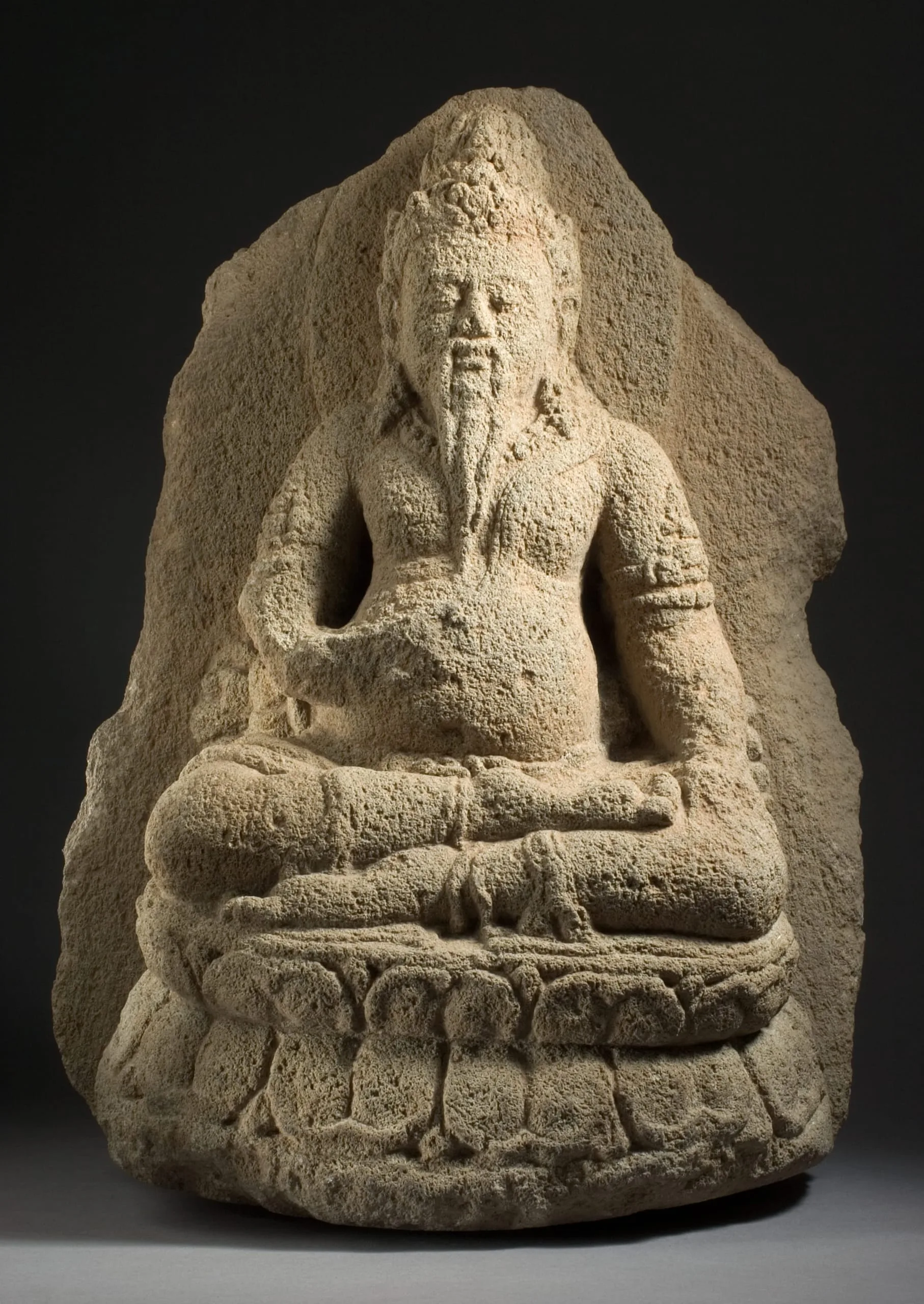
The revered Hindu sage Agastya is believed to have been born in the 7th century in the ancient holy city of Banaras (modern Varanasi) in north India. In his early life, he was a great sage and religious ascetic. Then, after marrying a beauty queen and having a large family in order to fulfill a prophecy enabling his ancestors to go to heaven, Agastya moved to south India, where he and his descendants are credited with being responsible for the introduction of Hinduism and the worship of the important god Shiva. Agastya is also believed to have taught south Indians medicine and grammar, invented the eloquent Tamil language of south India, and even written a treatise on making religious images for temples. He is included among the luminary Seven Seers (Sapta Rishis) and associated with Canopus, the brightest star in the southern Indian sky. His biography was later further embellished by being merged with the mythological exploits of another great sage, also named Agastya, whose divine origins and momentous deeds had been praised in the even more ancient Vedic (proto-Hindu) literary works. He is also traditionally credited with several hymns in the seminal Rig Veda (circa 1500–1000 BCE). Agastya is thus said to have had a miraculous birth, had mastery over mountains (hence, the literal meaning of his name as the "Mover of Mountains"), and once even swallowed the entire ocean to expose a hoard of demon terrorists. This magical feat enabled him to travel to Cambodia and Indonesia, where he is recorded in ancient inscriptions and textual references as having founded numerous temples dedicated to the great god Shiva. His representations are frequently found at temples as a divine attendant to Shiva or as a guardian (dikpala) of the southern direction. He was one of the most venerated divinities during the Indianized period of Indonesian history.
Agastya is generally represented as an elderly sage with a long beard down to his chest. He is short in stature (vamana), potbellied (tundila), and wears the Brahmanical sacred thread (yajñopavita) over his left shoulder. Standing representations of Augusta typically portray him holding a staff or Shiva’s trident (trishula) and an ascetic’s water pot (kamandalu). Seated depictions usually show him holding a rosary (akshamala) and a mendicant’s begging bowl (patra) or water pot. In the LACMA image, Agastya is nimbate and follows the standard seated iconography. His hands are now damaged, so the original attributes cannot be determined. He sits in the lotus position (padma asana) on a double lotus base. See also M.2005.30.