- Title
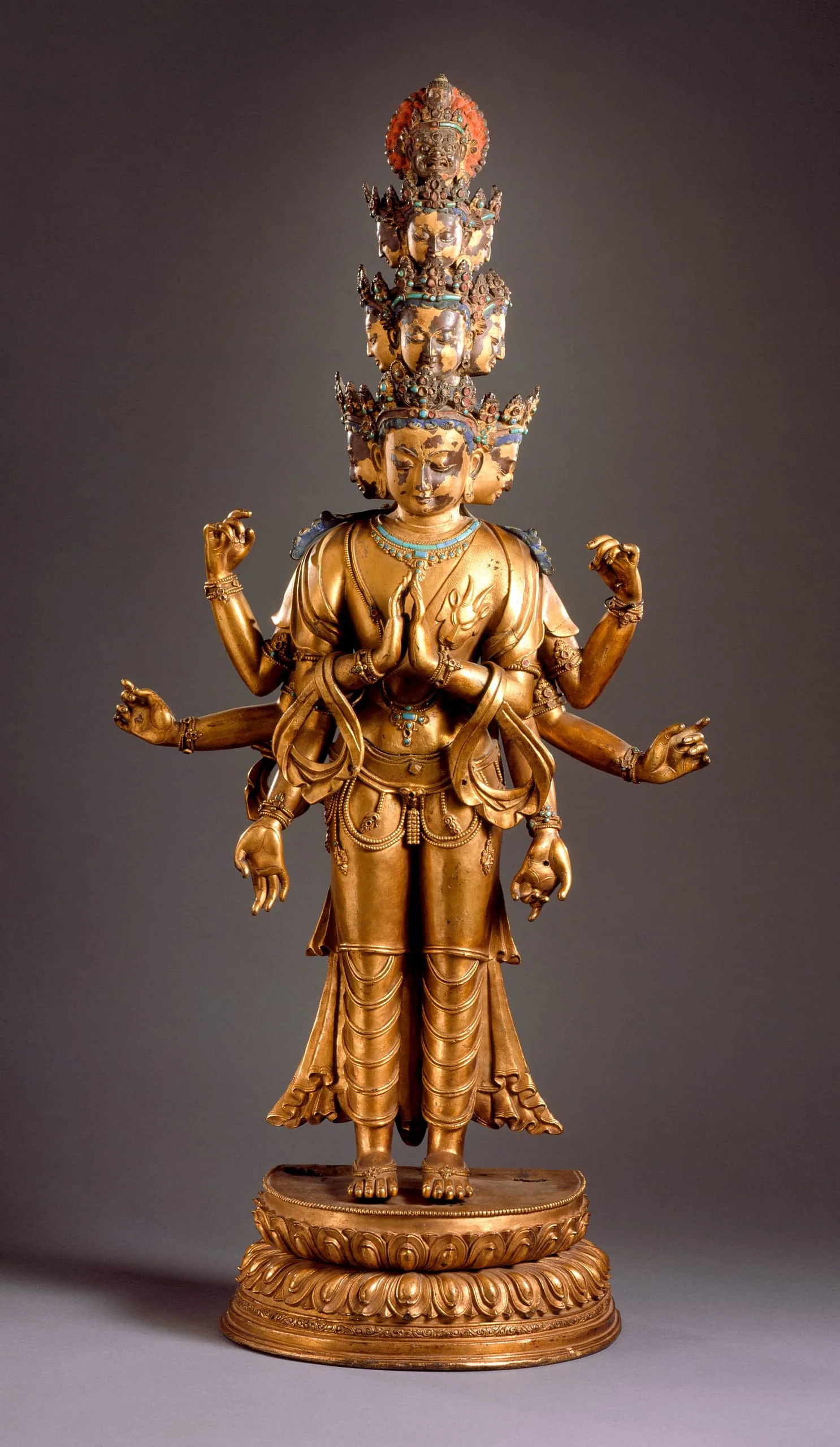
- Eleven-Headed Avalokiteshvara
- Date Made
- 16th century
- Medium
- Gilt brass inlaid with turquoise and other gemstones; cold gold paste and paint
- Dimensions
- 30 1/4 x 14 3/4 x 6 7/16 in. (76.8 x 37.46 x 16.35 cm)
- Accession Number
- M.86.220.2
- Curatorial Notes
Avalokiteshvara, the Bodhisattva of Compassion, is represented here in his cosmic form with eleven heads emphasizing his watchful nature and six arms. Eight of the eleven heads represent the cardinal directions and their intermediate points, while the remaining three symbolize the zenith, nadir, and center. The eleventh head at the top represents the Buddha Amitabha, of whom Avalokiteshvara is considered to be an emanation. He symbolizes the universal compassion of all Buddhas. Apart from Amitabha, the ten heads represent Avalokiteshvara’s attainment of each of the ten Bodhisattva stages and also symbolize his watching over beings throughout the ten directions of space. All of the heads have benign faces except for the penultimate head, which is wrathful. He has eight arms, five of which are now missing their separately cast attributes. This lower left hand likely once held a water pot. His two primary hands are held in the gesture of adoration (anjali mudra). His lower right hand is held in the gesture of charity (varada mudra). He stands on a lotus base. The top of the base has two lug holes at the rear sides, which indicates there was originally a detachable nimbus and aureole (prabhavali).
- Selected Bibliography
- Pal, Pratapaditya. Art of Tibet. Expanded edition. Los Angeles: Los Angeles County Museum of Art, 1990.
- Reedy, Chandra L. Himalayan Bronzes: Technology, Style and Choices. Newark: University of Delaware Press, 1997.
- Little, Stephen, and Tushara Bindu Gude. Realms of the Dharma: Buddhist Art across Asia. Los Angeles: Los Angeles County Museum of Art, 2025.