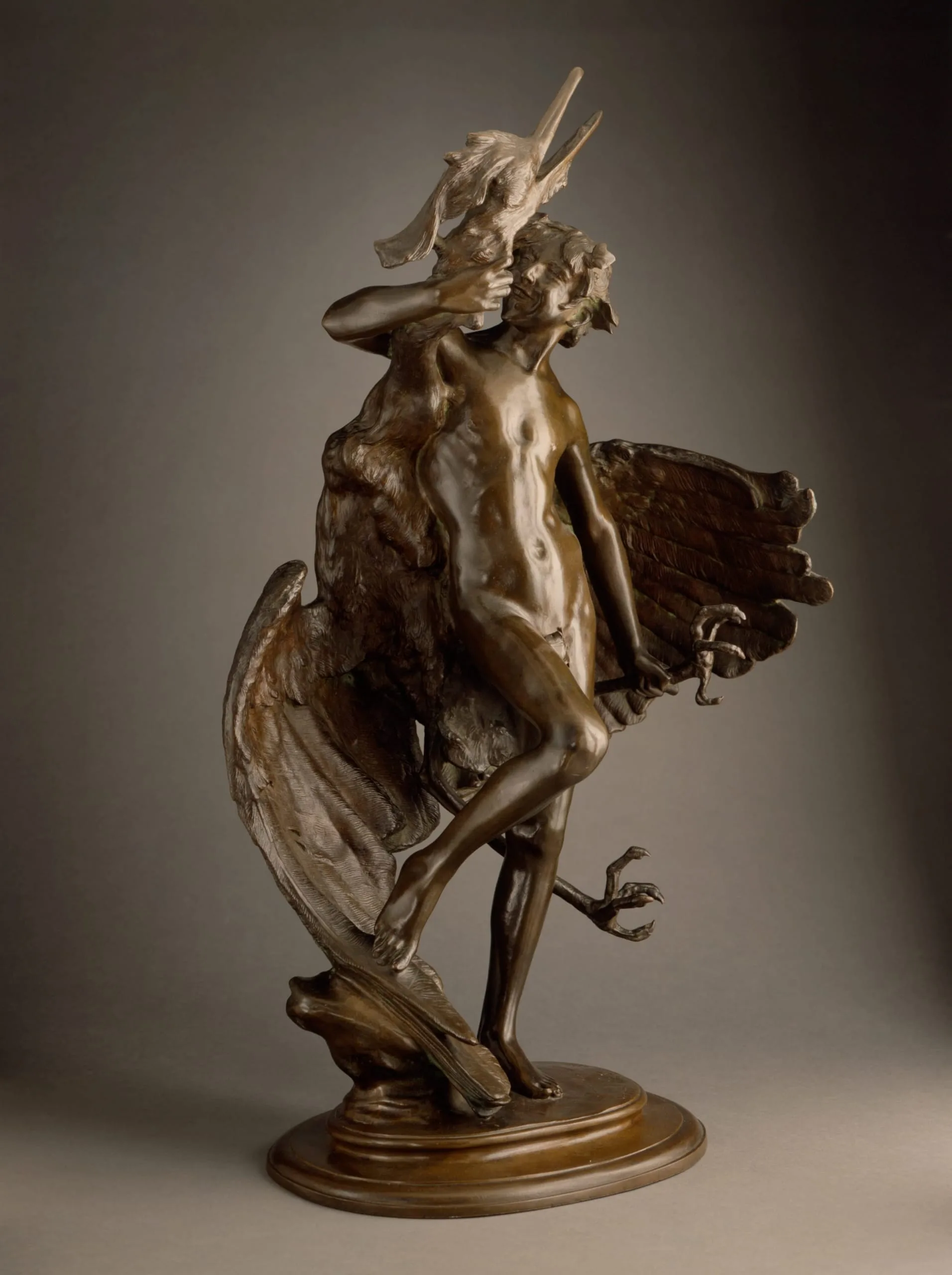
According to a handwritten list of MacMonnies’s sculptures in the artist’s papers, he originally modeled this group in 1890 as a lifesize statue for a fountain for a country house in Massachusetts. This commission for the garden of Joseph Hodges Choate’s home, Naumkeag, in Stockbridge was obtained through the architect Sanford White. The statue was to be set into an exterior niche, the shape of the niche determining the curve of the bird’s wings.
MacMonnies’s lively imagination invented numerous such unusual subjects, although this one at least recalls traditional images such as Ganymede and the eagle and the youthful Hannibal fighting with the eagle. The figure, both in its realistic representation of a nude adolescent and in its general pose, recalls that of Mercié’s David, 1878 in bronze (Musée d’Orsay, Paris) and, of course, that sculpture’s source in Donatello’s famous bronze of the same subject in the Bargello, Florence. The intensity with which the details of the bird’s feathers are observed might seem to reflect further study of the character of quattrocento sculpture. At the same time, the sense of a specific model’s unidealized face and anatomy and of almost excessive liveliness are characteristics of the nudes of MacMonnies’s other master, Falguière. Cortissoz’s characterization of MacMonnies and his circle as "Neo-Renaissance temperaments strengthened through appreciation of modern French craftsmanship" ("An American Sculptor," p. 18) captures the spirit of this sculpture.
The inventive subject provided material for a richly organized play of positive and negative forms and of curves and countercurves. The forms of boy and bird, distinct in the lower part of the sculpture, are brought into close combination by the way the boy’s proper left arm follows the curve of the wing and his other arm is entwined with the bird’s curving neck. The large curve of his arms is set in equilibrium to the curve of the wings. The play of forms and sense of movement contribute to the sense of liveliness that was characteristic of MacMonnies’s sculptures of the early 1890s.
The Young Faun and Heron exhibited in Paris at the 1890 Salon was in plaster and was probably for the life-size fountain statue. It and another 1890 fountain commission, Pan of Rohallion (formerly home of Edward D. Adams, Sea Bright, N.J.), contributed to MacMonnies’s early reputation and led to the important commission of the colossal figures for the Barge of State at the 1893 World’s Columbian Exposition.
Examples of the half-life-size statuette were favorably received when exhibited in 1891 at the annual exhibition of the Society of American Artists in New York, in 1892 in Saint Louis, and later in 1895 and 1896 in Boston, Philadelphia, and New York. Little of the casting history of the statuette is known. It seems to have been cast, in unknown numbers, by at least two foundries: a proof cast in the Metropolitan Museum of Art, New York, and a finished cast in the Cleveland Museum of Art were by Gruet Fondeur, Paris, while the museum’s example was made by Jaboeuf & Rouard, also of Paris.