- Title
- Ritual Implements for a Fire Ceremony
- Date Made
- 18th century or earlier
- Medium
- Steel, gilt copper, and silver; inlaid with coral and turquoise; wood case
- Dimensions
- Ladle (assembled): 28 1/8 x 4 1/4 x 1 1/2 in. (71.44 x 10.8 x 3.81 cm); Spoon (assembled): 22 3/4 x 2 5/8 x 1 1/2 in. (57.79 x 6.67 x 3.81 cm); Case: 20 1/2 x 5 3/8 x 2 3/4 in. (52.07 x 13.65 x 6.99 cm)
- Accession Number
- M.86.190.1a-g
- Curatorial Notes
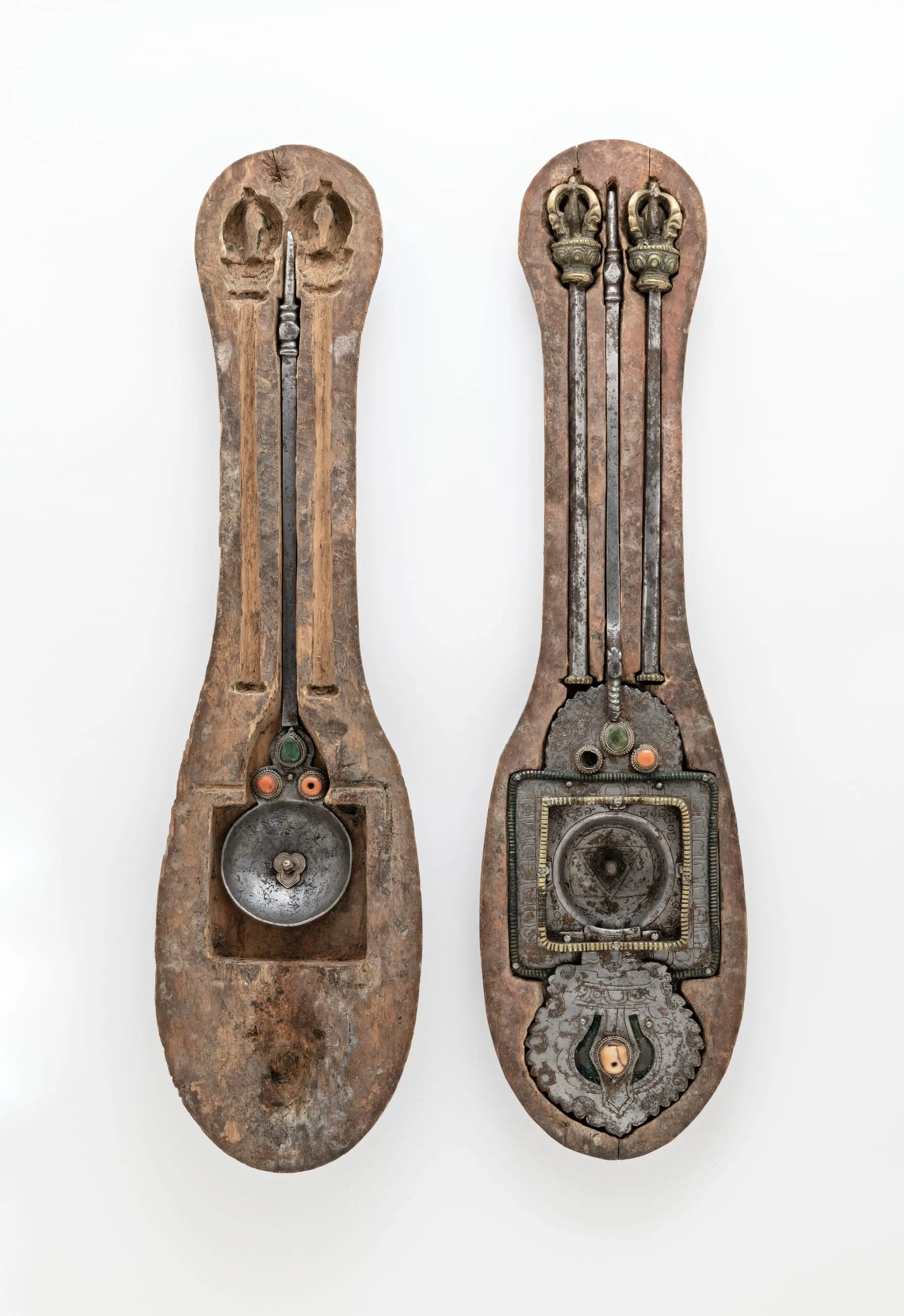
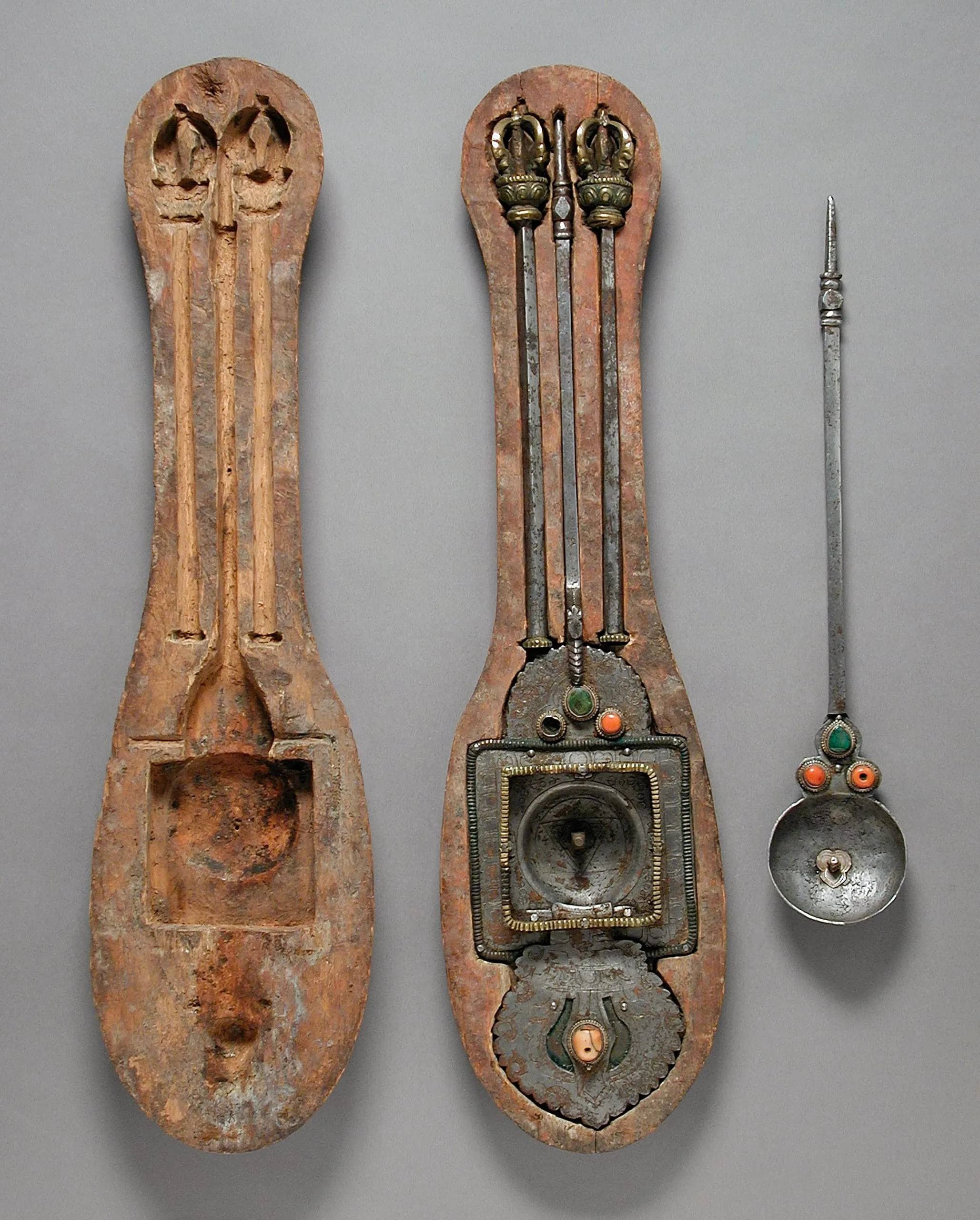
The sacrificial or votive ritual of offerings made to a consecrated fire (homa) is derived originally from Vedic (proto-Hindu) sacramental practices. It was later performed under Hindu and Buddhist auspices in the Himalayan regions. This set of ritual implements was used in a Buddhist context, as indicated by its five-pronged thunderbolt (vajra) finials. The set consists of a round ladle to pour the oblations and a square receptacle with a circular bowl to receive them. The interior of the receptacle bowl has a triangular (trikona) geometrical mandala (yantra) that is the visual equivalent of a mystical prayer (mantra). Both implements have long handles made in two parts that when separated all fit inside the single wooden carrying case.
- Selected Bibliography
- Pal, Pratapaditya. Art of Tibet. Expanded edition. Los Angeles: Los Angeles County Museum of Art, 1990.
- Little, Stephen, Tushara Bindu Gude, Karina Romero Blanco, Silvia Seligson, Marco Antonio Karam. Las Huellas de Buda. Ciudad de México : Instituto Nacional de Antropología e Historia, 2018.
- Little, Stephen, and Tushara Bindu Gude. Realms of the Dharma: Buddhist Art across Asia. Los Angeles: Los Angeles County Museum of Art, 2025.