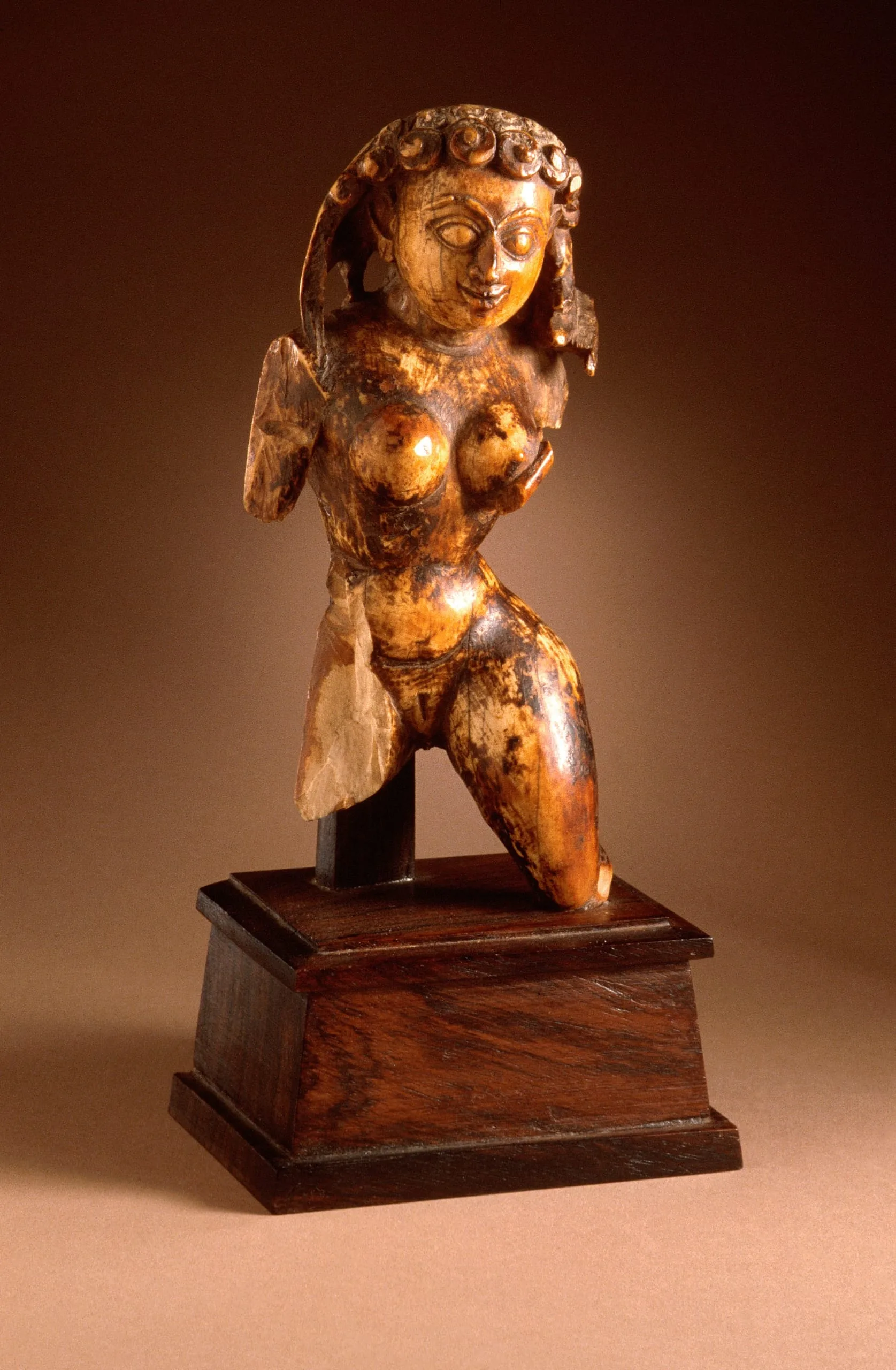
Cherubs, generally known also as winged infant putti, are supernatural celestial entities often portrayed in Greco-Roman and Christian art. They were assimilated into the South Asian artistic pantheon of demigods in the early centuries of the common era in the sculpture of Gandhara (for example, see M.89.159.3), and reintroduced in Mughal painting by the early 17th century (for example, see M.80.6.6). Ivory representations of cherubs from Madurai, often shown in flying postures with one leg bent back at the knee, are common accessory figures in larger compositions (for example, see M.80.232.8a-d) and as independent subjects in free-standing sculptures or as deeply cut reliefs presumably meant for embellishing furniture. This cherub was originally a musician judging from the remnants of a stringed instrument visible beside left breast and hair. She has the conventional facial features of Madurai cherubs, namely a distinctive hairstyle with large curls, wide-open almond-shaped eyes with prominent eyebrows, and the body of a plump toddler. Male and female Madurai cherubs are known, as well as loving couples (mithuna). A number of extant examples are now in the Minakshi Sundareshvara Temple Museum, Madurai.