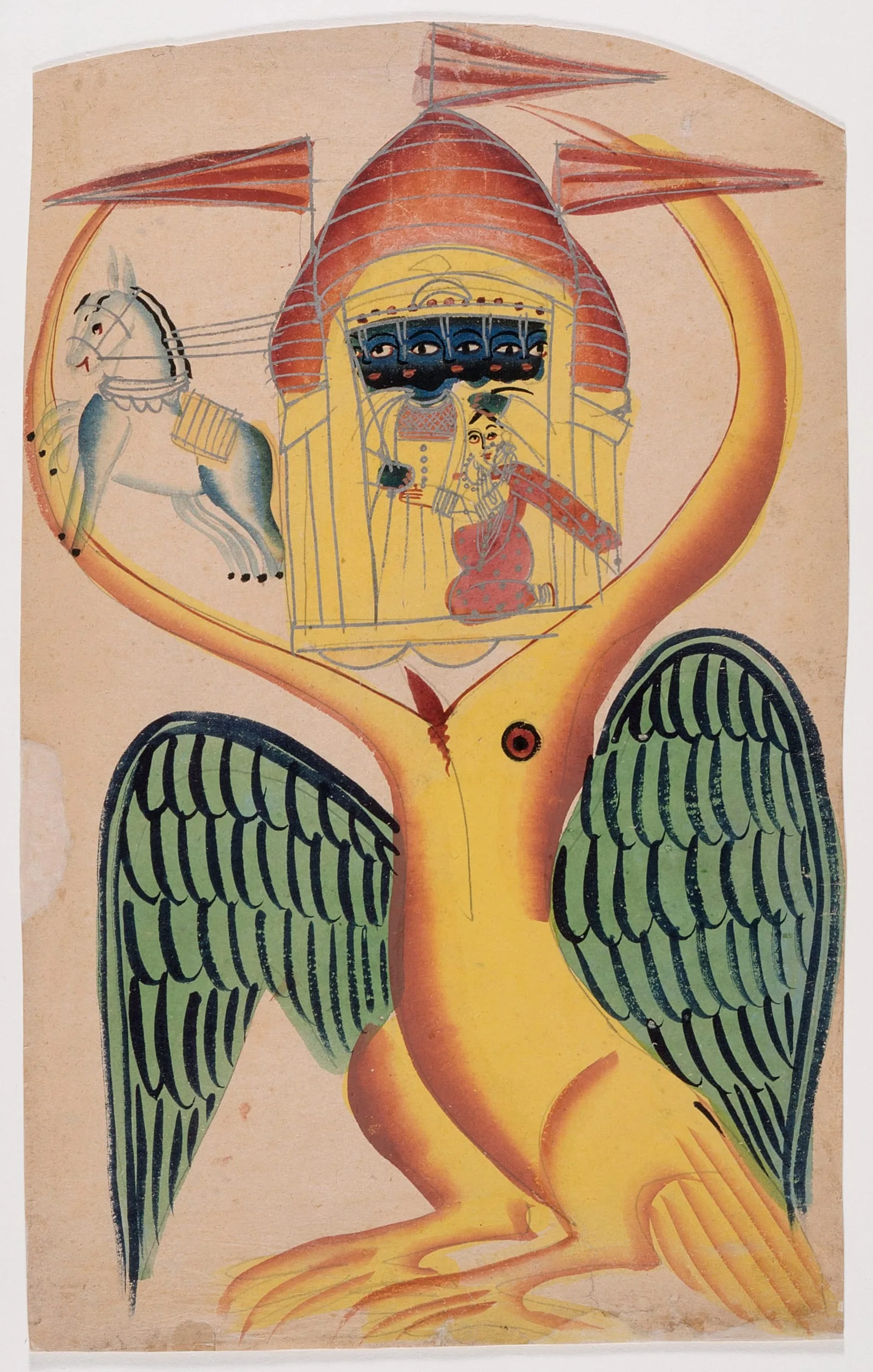
The Ramayana narrates the epic saga of the valiant Prince Rama and his dutiful wife, Princess Sita, who was abducted by Ravana, the arrogant ten-headed King of Lanka (probably modern Sri Lanka), during Rama's unjust fourteen-year forest exile. The Vaidehisha Vilasa (The Story of Sita), is a vernacular recension of the Ramayana written in the early 18th century by the Odia (Oriya) court poet Upendra Bhanja (1670-1740). A key idiosyncratic event occurs in the Vaidehisha Vilasa when Jatayu, the King of Vultures, valiantly tries to prevent Sita’s abduction by swallowing Ravana’s chariot in his beak, an act that is not narrated in the Sanskrit Ramayana ascribed to the legendary poet Valmiki or the Hindi Ramacharitmanas (Holy Lake of the Deeds of Rama) composed by Tulsidas (1511-1623) in 1575. But Jatayu was no match for the powerful Ravana and was mortally wounded in a fierce battle. Before he died, Jatayu was discovered by Rama and his brother Lakshmana, who were searching for Sita after having returned to their hermitage to find her missing. Jatayu told the brothers of Sita's kidnapping by Ravana. Rama rewarded Jatayu for his loyalty by performing his funerary rites so that he could ascend to heaven, which no vulture had ever attained. Jatayu’s heroic attempt was immortalized by Odishan (Orissan) and Bengali artists, who portrayed the deed in dramatic fashion by depicting Jatayu in larger-than-life proportions engulfing Ravana, his horse-drawn ariel chariot, and the captive Sita.