- Title
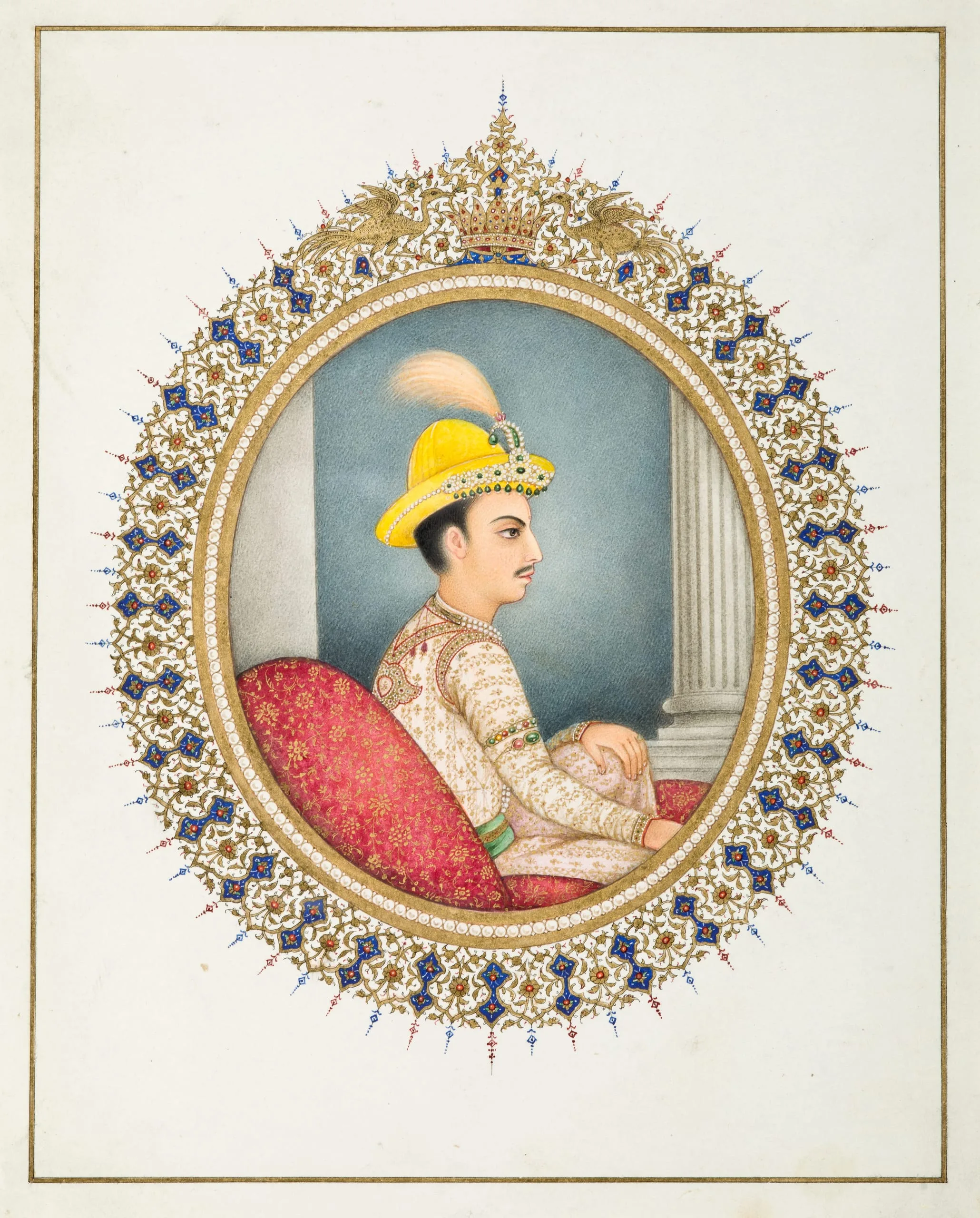
- King Girvan Yuddha Bikram Shah of Nepal (r. 1799-1816)
- Date Made
- circa 1815
- Medium
- Opaque watercolor and gold on paper
- Dimensions
- 8 1/4 x 6 1/2 in. (21 x 16.5 cm)
- Accession Number
- M.76.129
- Curatorial Notes
Girvan Yuddha Bikram Shah (or Girvan Juddha Bikram Shah) was the fourth King of Nepal (r. 1799-1816). He was born in 1797 and ascended the throne at age one and ½ under the regency of his stepmother Queen Tripurasundari (or Lalit Tripura Sundari Devi, 1794-1832) and Prime Minister Bhimsen Thapa (served 1806-1837). See M.91.134 and M.91.206. He was reportedly a devout Hindu and well educated. He died of smallpox at age nineteen in 1816.
In this portrait presumably painted a year or two before his death, Girvan Yuddha Bikram Shah is realistically portrayed here as an adolescent. He wears the broad-brimmed turban hat favored by kings and important personages in the unified Kingdom of Nepal during the early Shah dynasty (1768–2008). It is adorned with a feather plume (kigal) and a combined jigha (plume-like ornament similar to an aigrette) and sarpati (horizontal tripartite ornament) made of diamonds, pearls, and emeralds. He wears a long pearl necklace and bejeweled armlets over a white coat (jama) with gold flowering vine scrolls and embroidered designs reminiscent of a Chinese cloud collar. The composition and ornate border crested by a crown and two birds of paradise derive from Mughal and Iranian album traditions. The detail of the column treated as a framing device reveals the assimilation of European portraiture in South Asia during the 19th century.
A comparable portrait of Girvan Yuddha Bikram Shah is in the National Museum of Asian Art, Washington (F1907.218).
- Selected Bibliography
- Pal, Pratapaditya; Dehejia, Vidya; Slusser, Mary Shepherd; Fisher, Robert E.; Brown, Robert L. Arts of Asia 15 (6): 68-125 (November- December 1985).
- Pal, Pratapaditya. Art of Nepal. Los Angeles: Los Angeles County Museum of Art; University of California Press, 1985.