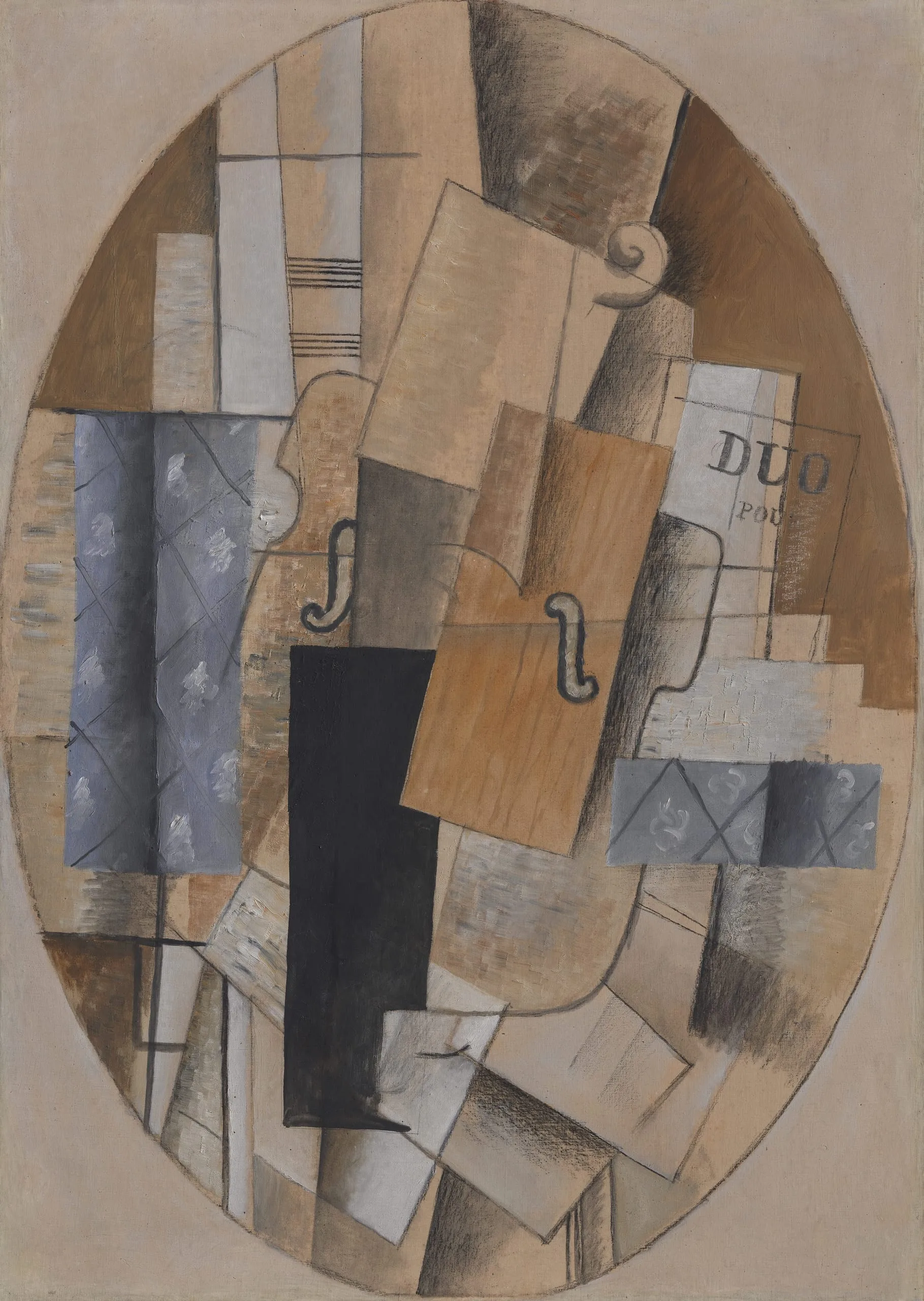
Together with Pablo Picasso, Georges Braque invented Cubism. Their paintings from the years 1909 to 1914 seemed to grow one from the other, indicating the close relationship between the artists. Cubism was an art of everyday life tied particularly to the cafes of Paris; the works include vestiges of real-life referents (wood-grain paper, newspapers, packages of tobacco, and so forth).
Still Life with Violin is a transitional work between the two phases of Cubism, the Analytic and the Synthetic. (The terms were coined by the artists' zealous Parisian dealer, Daniel-Henry Kahnweiler.) Braque incorporated the hallmarks of Analytic Cubism in his fragmentation of form into multiple shifting planes and in his use of a restrained palette of browns and grays. His depiction of wood grain signals the rise of Synthetic Cubism, in which the fragmented planes are simplified, flattened out through a lack of shading, and combined into often patterned forms that give the illusion of recognizable objects. The wood-grained rectangle in Still Life with Violin conjures up an image of a violin's gleaming wood surface; the S-scrolls suggest sound holes; and the horizontal bars suggest a sheet of music. Braque's use of the oval format, which he devised in 1909, is characteristic of his Cubist works, as is his inclusion of snippets of floating typography such as the one here reading "Duo pour" (duet for). For the Cubists, form took primacy over subject matter.