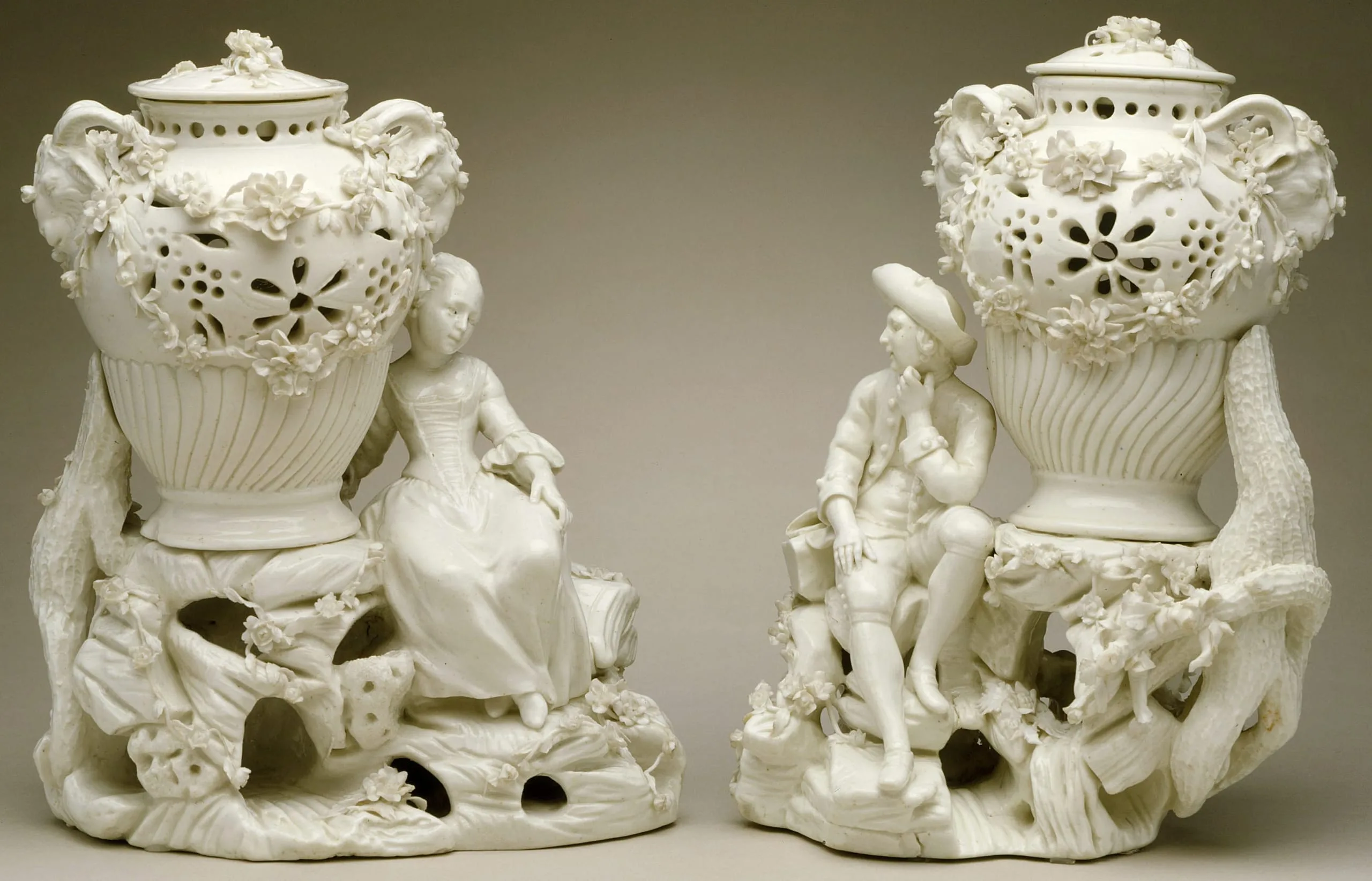
The imagery of these delicate vases evokes a central decorative and social conceit of the eighteenth century. Here a refined and elegant couple, comfortably dressed in costumes of the period, perch on naturalistic rocks and indulge in what seems to be a well-mannered flirtation. This is the world of ease and intimacy, painted by the rococo artists Antoine Watteau, François Boucher, and Jean Honoré Fragonard, in which the cultured and educated classes of France created gardens of controlled rusticity—an artful grotto here, a wild area there—in contrast to the extreme formality of seventeenth-century gardens, architecture, and the ceremonies and manners of aristocratic life.
Much of French eighteenth-century art celebrates this new ease. The creator of this charming pair of vases has incorporated the rococo notion of elegant entertainment (fête galante) into a functional design. The flower-draped neoclassical urns were designed to hold sweet-scented potpourri; their pierced decoration is thus also practical.
Although each vase is self-contained and compositionally balanced, they are meant to be seen as a pair. The two skillfully modeled figures speak across the space between them. Although porcelain figures were extremely popular in the mid-eighteenth century, most were poorly composed and weakly modeled. Together with Johann Joachim Kändler of Meissen and Franz Anton Bustelli of Nymphenburg, Nicholas Lecroux of Tournay was among the few modelers to take the making of porcelain figures beyond the genre of craft and into the realm of fine arts.