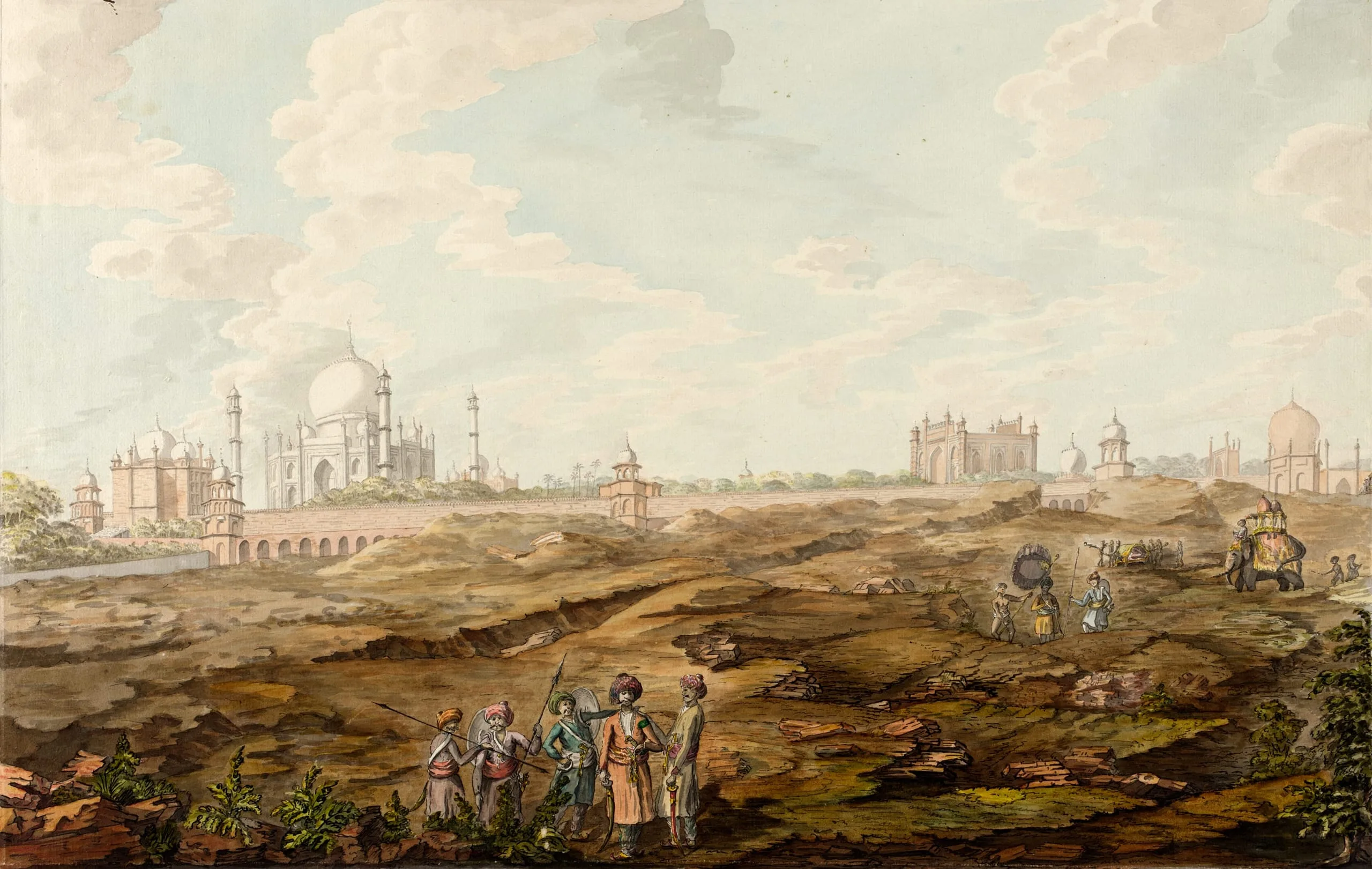
The world-famous Taj Mahal (Crown of the Palace) was built in Agra in 1632-1643 by the Mughal Emperor Shah Jahan (r. 1627-1658) as a mausoleum for his beloved wife, Mumtaz Mahal (1593-1631). Despite its iconic majesty, it is unexpectedly absent in contemporaneous Mughal illustrations. One extremely rare representation attributed to circa 1640 is in a folio from the Late Shah Jahan Album, now in San Diego Museum of Art (1990.353). In it, the Taj Mahal is compositionally emphasized by being centered in the far distance. It shimmers in the atmospheric haze but is immediately recognizable. By the late 18th century, popular interest in the grand edifice by European visitors had stimulated demand for general views of it and for details of his brilliant hardstone inlay.
This view of the Taj Mahal complex is from the rocky plain beyond the adjacent Yamuna River, which is the private route Shah Jahan took by boat to visit the tomb. Flanking the Taj Mahal on the left is the rest-house (mihman-khana) and on the right is the mosque. On the far right is the courtyard (jilo-khana) with its grand gateway and octagonal pavilions. In the foreground on the right is a royal procession on its way to the mausoleum. Turbaned members of the entourage stand in the lower center.
This panoramic depiction of the Taj Mahal may have been inspired by the watercolors of the British artists Thomas Daniell (1749-1840) and his nephew William Daniell (1769–1837), who had painted the monument in 1789.