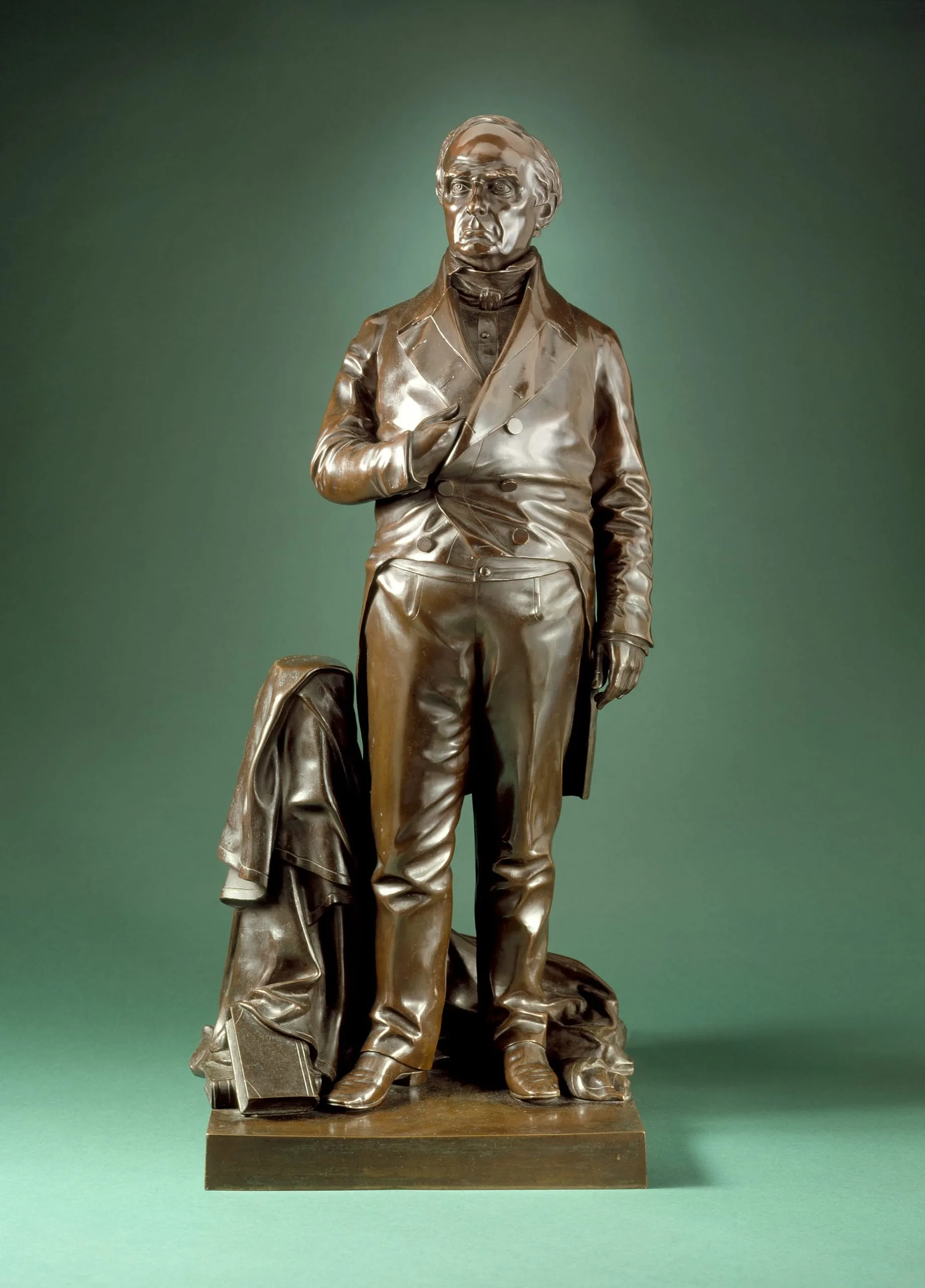
Thomas Ball’s first success as a sculptor was his cabinet-sized bust of the "Swedish Nightingale," Jenny Lind, which he modeled in 1851. He was overwhelmed by the demand for plaster copies of his bust. Although he had procured a patent for his design, eventually it was pirated and the market flooded with replicas. This was the period when American artists began to exploit the expanding middleclass market for inexpensively reproduced images that absorbed the lithographs from the firm of Currier and Ives, for instance, and the plaster sculptures of JOHN ROGERS. Early in this trend and at the upper end of quality, Thomas Ball’s Daniel Webster and Henry Clay have the distinction of having been the first volume-cast art bronzes produced in this country.
Their large editions and their medium of bronze both reflect the towering stature of the two great statesmen, Webster, the Yankee orator of legendary ability, and Clay, the idolized senator, secretary of state, and three-time presidential candidate. Both of the great men died in 1852. Since childhood, Ball had been resolved to one day paint a portrait of Webster. He tried to model a cabinet-size bust but considered it a failure and destroyed it. It was Webster whom he took as the subject of his first life-size bust in 1852. He must have worked from prints or photographs, because, with the bust already in progress, he had only a brief glimpse of the man as a procession escorted him through Boston. As it happened, Ball finished that bust (Boston Athenaeum) just two days before Webster’s death on October 24, 1852. It naturally attracted considerable attention, and Ball soon had orders for nearly a hundred casts of it. Declared to be a faithful likeness, it was the model for all of Ball’s subsequent sculptures of Webster. His next project was a small full-length sculpture of the same subject, his first attempt at the full figure. His inexperience with armatures caused the first to tip over and crash to the floor. Managing to salvage the figure’s head, he began again. The resulting sculpture was an immediate success. On the first day Ball exhibited it, he received an offer of five hundred dollars for the sculpture and the right to reproduce it. Ball later remarked that the shrewd art dealer, C. W. Nichols, must have made five thousand dollars out of it.
Presumably Ball received a more appropriate sum from Nichols when he also assigned to him the patent for the companion figure of Henry Clay that the artist completed in 1858, shortly after returning to Boston from his Italian sojourn. Ball felt it was not as successful as his statuette of Webster, but Senator Edward Everett wrote a letter in praise of its fidelity, both in likeness and the carriage of the figure, and most today would find the statuette produced by the more experienced sculptor to have a greater delicacy of line and a more convincing sense of life in the figure. Nichols produced plaster copies of both sculptures (example of Webster in New Hampshire Historical Society, Concord; example of Clay in Rhode Island Historical Society, Providence) and examples in Parian ware are known (one of Webster in Chicago Historical Society and of Clay in Yale University Art Gallery, New Haven, Conn.). The bronze casts of Daniel Webster and Henry Clay are inscribed with the name of the Ames Manufacturing Company as founders. A long-established cannon and ironwork foundry, the Ames Manufacturing Company in 1851, at the urging of the sculptor Henry Kirk Brown (1814-1886), made its first attempts at casting works of sculpture. The firm enjoyed a prominent role as an art bronze foundry over the next half-century. One of the first works not by Brown to be cast by the Ames foundry, Daniel Webster was offered both in a model with drapery and in one without (proof cast, Malcom Stearns, Jr.; see American Figure Sculpture in the Museum of Fine Arts, Boston Boston: Museum of Fine Arts, 1986], p. 96 for listing of examples in public collections). It was the first sculpture to be not only cast but also patinated by the foundry. The quality of its chasing indicates how thoroughly professional the foundry had become in just two years. In 1874-76 Ball created an heroicsized enlargement of his statuette of Webster for New York’s Central Park.
Although they were among the very first sculptures to be cast in bronze in this country, Daniel Webster and Henry Clay (example in Newark [NJ.] Museum) belong in style to the neoclassical movement that dominated American sculpture until well past the middle of the last century. Like the white marbles or plasters of that movement, they are compact, with simple, polished surfaces. They even retain the truncated pillar brought next to a marble figure to help support the weight of the stone but which is not necessary with highly ductile bronze and in these cases was cast separately. Their classicism, though, is the more detailed and realistic later phase of the style.