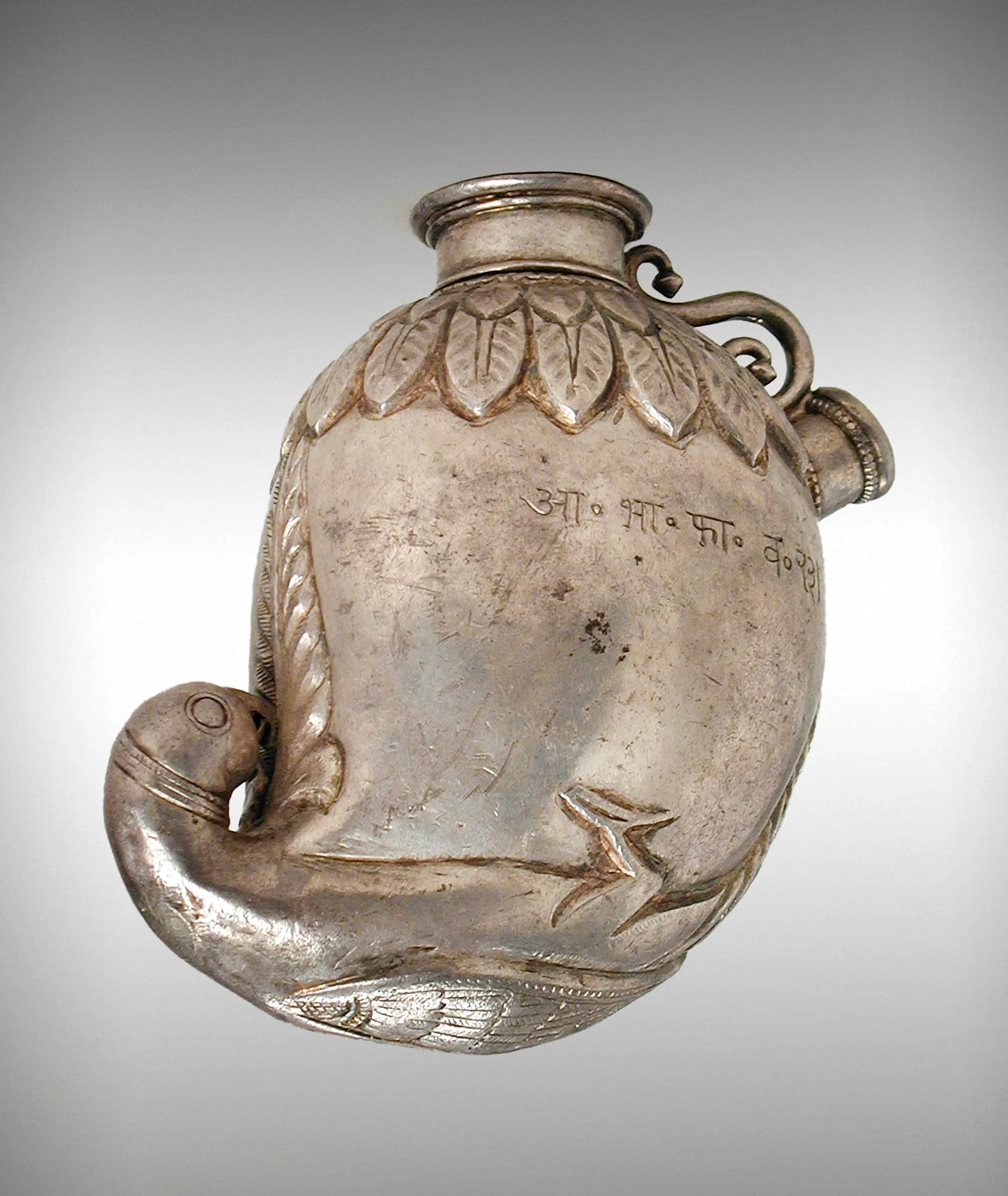
This ingeniously designed hookah base in the form of a mango and parrot combines two of the most popular visual memes in the South Asian metalworking tradition. The kidney-shaped outline is derived from the asymmetrical contours of a mango. Here, however, the mango’s laterally protruding base is replicated by an upside-down parrot grasping the bottom of the mango. The parrot’s upcurved-head pecks at a cordate-shaped mango leaf that extends upward on the side of the mango. The parrot’s tail parallels the design on the other side by following the upward curve of the mango. A double row of pendant pointed leaves forms a collar around the vessel’s shoulders. Set amidst the foliate collar is the spout for the now-missing inhalation tube. It has a S-curved handle attached to it and the vessel’s plain neck. The wide mouth surmounting the hookah base was for the vertical tube connecting to the combustion bowl. The vessel body bears an inventory number inscribed in Devanagari script, "Aa. Bhraa. Phaa. Va. 23."
Mango-shaped hookah bases were meant for portable use, as their rounded bottom would cause them to topple over if set on the floor. Their typically small size suggests they were made for use by women at court. Hookahs were fashioned from a wide range of both costly and mundane materials. Their presence in paintings of nobles, courtiers, and "Indianized" Europeans functioned as a stock pictorial motif indicating the sitter’s high status and refinement.