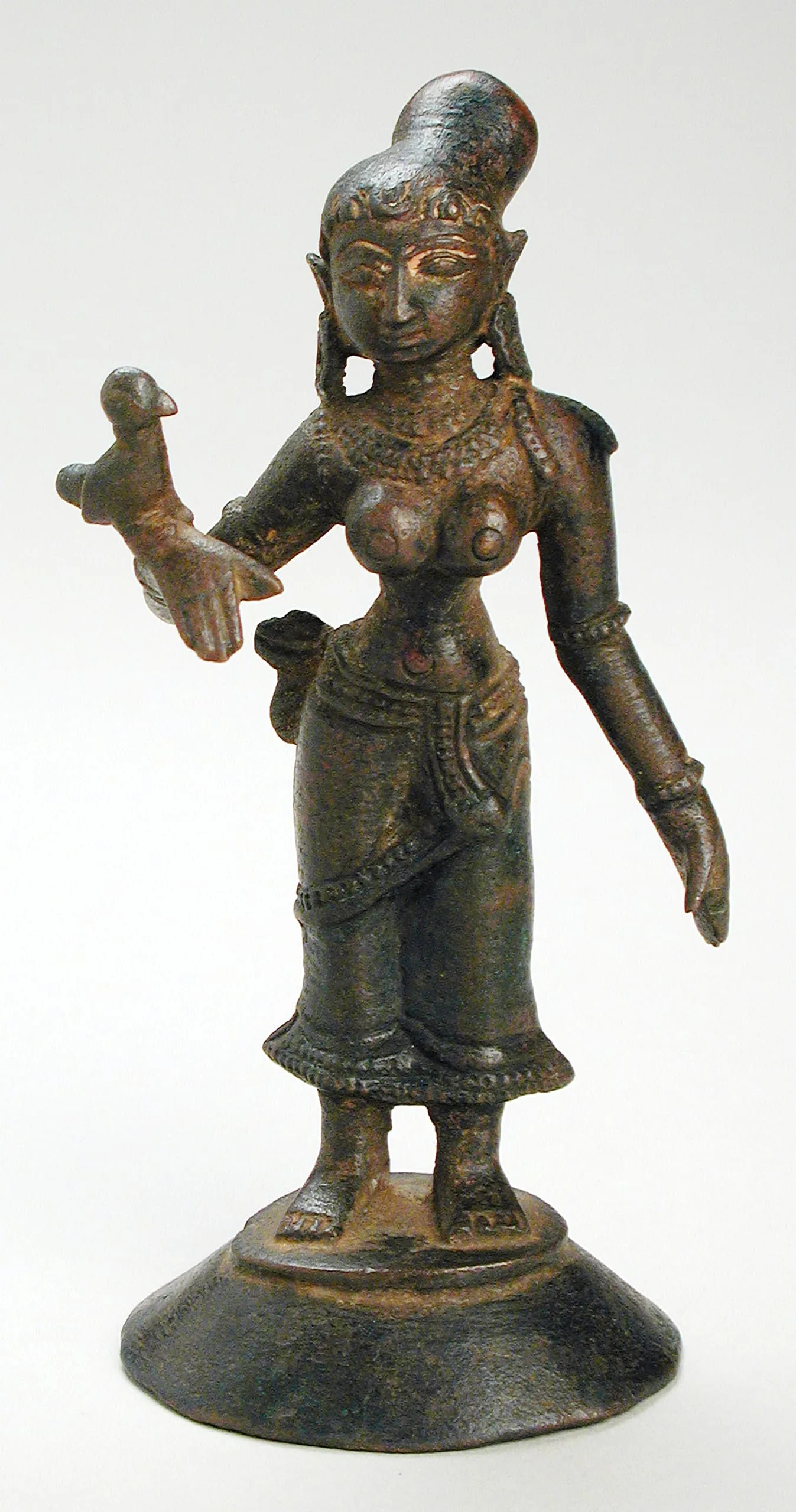
Andal (She Who Rules) was born as a girl named Kotai in 785 in Srivilliputhur, Tamil Nadu. According to religious lore, she was found under a tulasi plant in the garden inside the Srivilliputhur Andal Temple by her foster father Periyalvar, one of the renowned twelve poet-saints (Alvars) of Tamil Nadu. Kotai grew up as an ardent devotee of Krishna, an avatar of Vishnu, the Hindu God of Preservation. As a young girl she helped her father make floral garlands to be offered to Vishnu and would secretly try on the garlands to see how she would look as Vishnu's bride. When Periyalvar discovered what he considered this defilement of the garlands, he made a replacement one for Vishnu. But Vishnu appeared in a dream and demanded Periyalvar offer him Kotai’s original garland. Kotai was then renamed Andal because she had first shared the garland with Vishnu. When she was fifteen and had reached marriageable age, after refusing to be wed to a human, Periyalvar took Andal to the Ranganathaswamy Temple in Srirangam where she was reunited with Vishnu as his bride. Andal is regarded as an avatar of the earth goddess Bhumi, the secondary consort of Vishnu, and is the only female Alvar. She is credited with composing the Tiruppavai (The Sacred Vow), a poem of thirty verses in praise of Perumal (a form of Vishnu), and the Nachiyar Tirumoli (Sacred Sayings of the Goddess), a poem of 140 verses expressing Andal’s love for Vishnu.
Andal is portrayed as a young woman. Her ornamented hair is braided and wound round the head as a bun in the dhammilla fashion (see also M.70.69.2 and M.80.6.5). She carries a parrot on her right forearm. It represents the divine sage Sukha Brahma Rishi, who took the form of a parrot to serve as Andal’s confidante to convey her messages of love to Krishna.