- Title
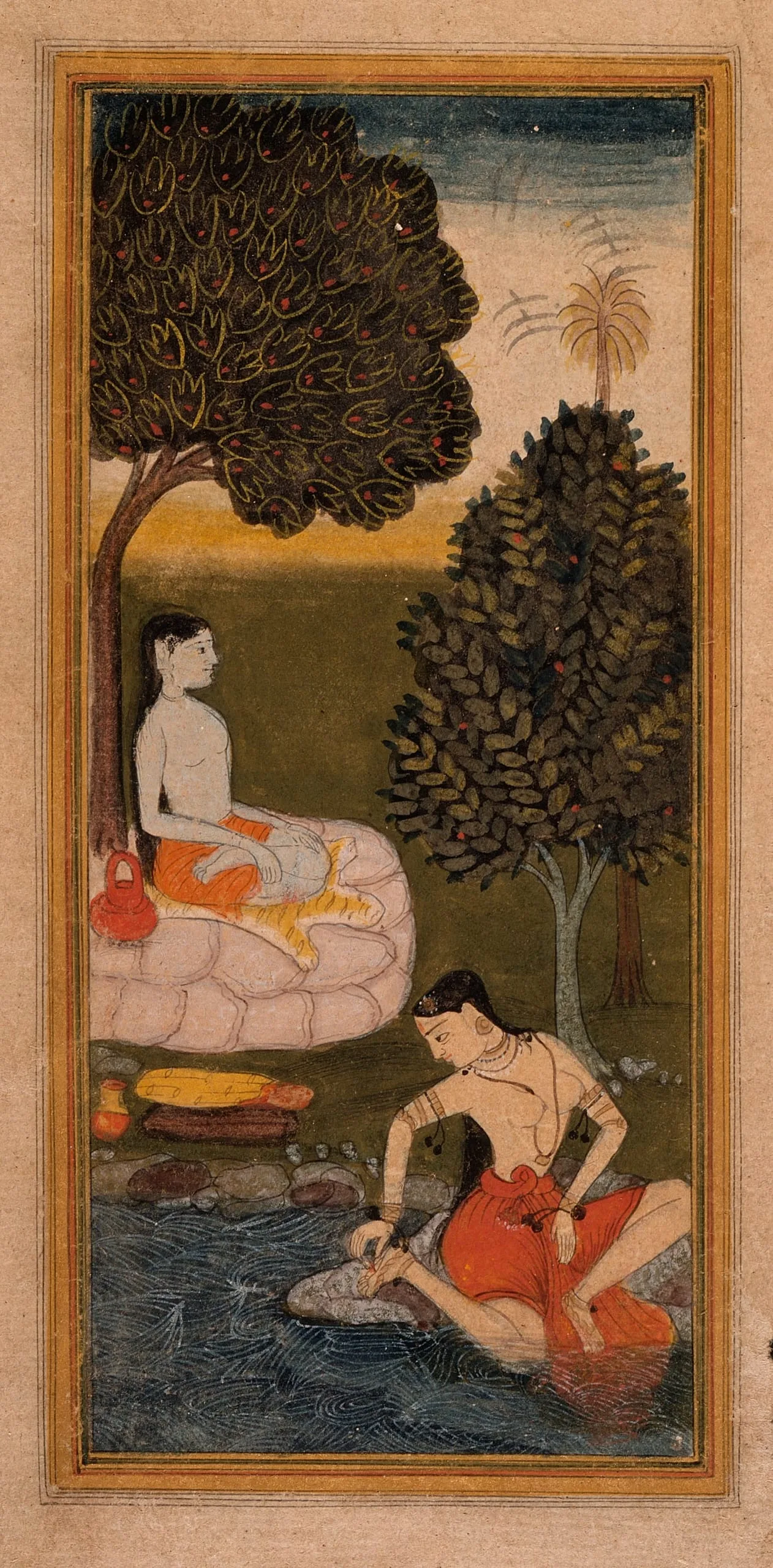
- The Sage Shuka and the Celestial Nymph Rambha (recto), Text (verso), Folio from a Rambha-Shuka Samvad (The Dialogue between Shuka and Rambha)
- Date Made
- circa 1600
- Medium
- Opaque watercolor, gold, and ink on paper
- Dimensions
- Sheet: 11 1/8 x 5 1/4 in. (28.26 x 13.34 cm); Image: 8 1/2 x 3 7/8 in. (21.59 x 9.84 cm)
- Accession Number
- M.86.61.2
- Curatorial Notes
This folio is from a dispersed Sanskrit manuscript of the Rambha-Shuka Samvad (The Dialogue between Shuka and Rambha). Shuka (or Shukadeva) was the son of the legendary poet-sage Vyasa and was the narrator of the Bhagavata Purana (Ancient Stories of the Lord). (See M.71.49.2.) Rambha was a beautiful apsaras (celestial nymph) who emerged with other apsarasas, goddesses, etc. from the primordial Churning of the Ocean of Milk (Samudra Manthana). Because of her incomparable beauty, Rambha was often tasked by Indra, the king of the gods, to temp great sages with pleasures of the flesh so that their intense spiritual meditation did not upset the order of the cosmos. Rambha attempts to lure Shuka away from his meditation, but the young anchorite is unswayed. Their conversation in the 39 verses of the Rambha-Shuka Samvad constitutes a philosophical discourse between Rambha’s seductive suggestions and Shuka’s steadfast counter arguments to stay focused on his meditation. The opening folio from this manuscript is in the San Diego Museum of Art (1990.778).
In this painting, Shuka is shown meditating under a tree seated on a tiger skin. The resolute sage stares straight ahead, ignoring the topless Rambha who is bathing by a stream and picking a thorn from the sole of her foot. The text on the reverse consists of verses 17 and 18, and two commentaries numbered 11 and 12.
- Selected Bibliography
- Pal, Pratapaditya. Indian Painting, vol.1. Los Angeles: Los Angeles County Museum of Art, 1993.