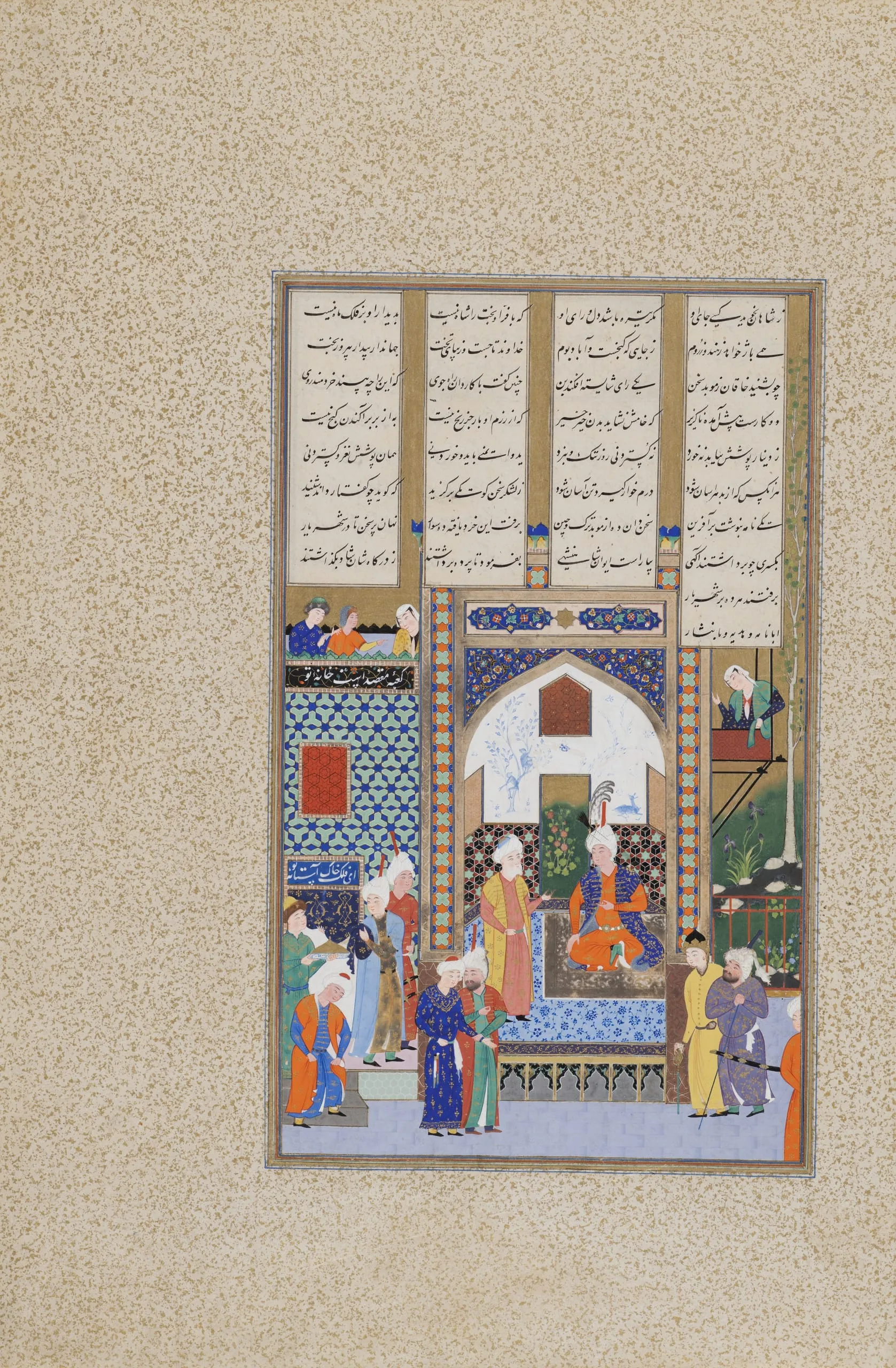
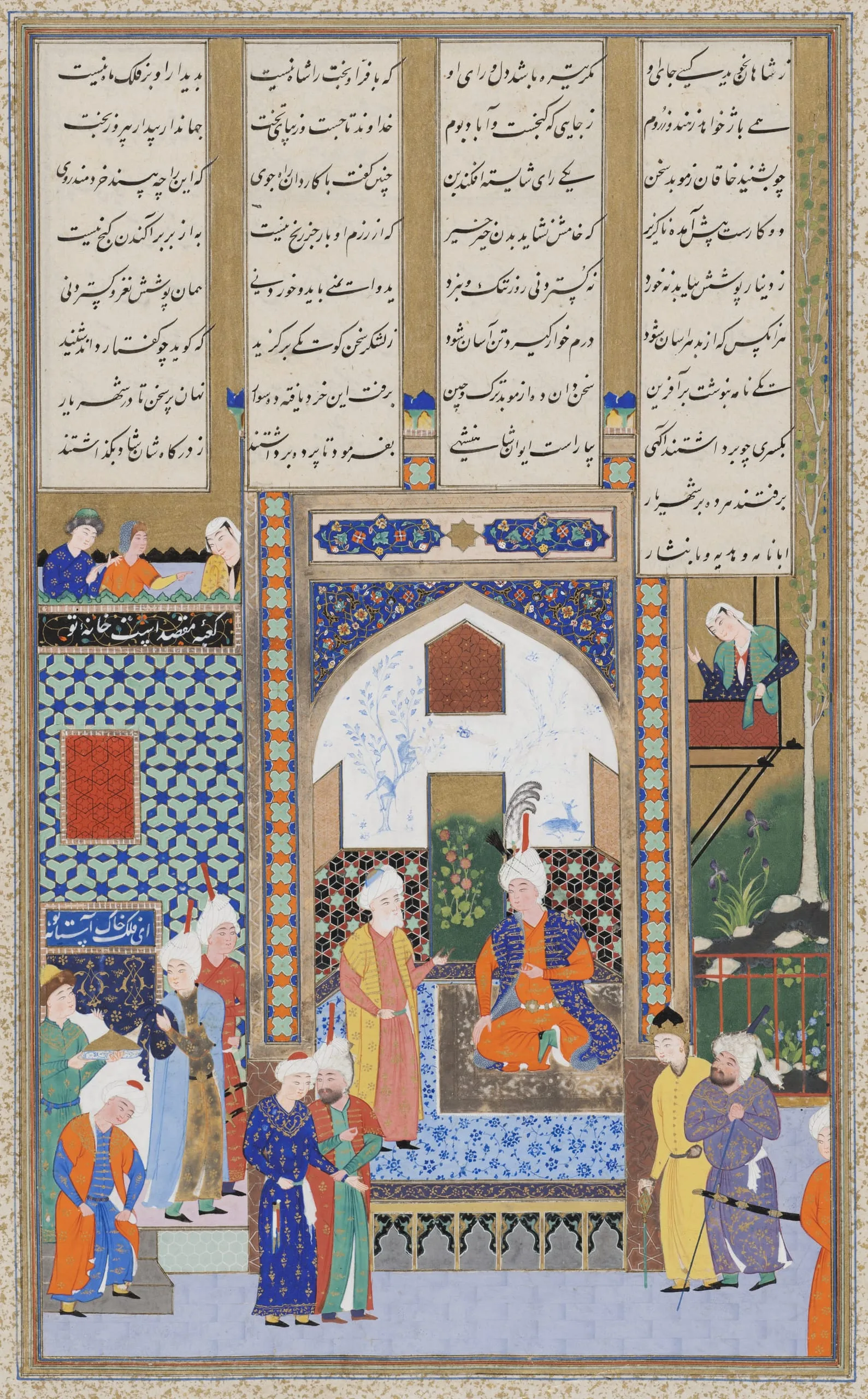
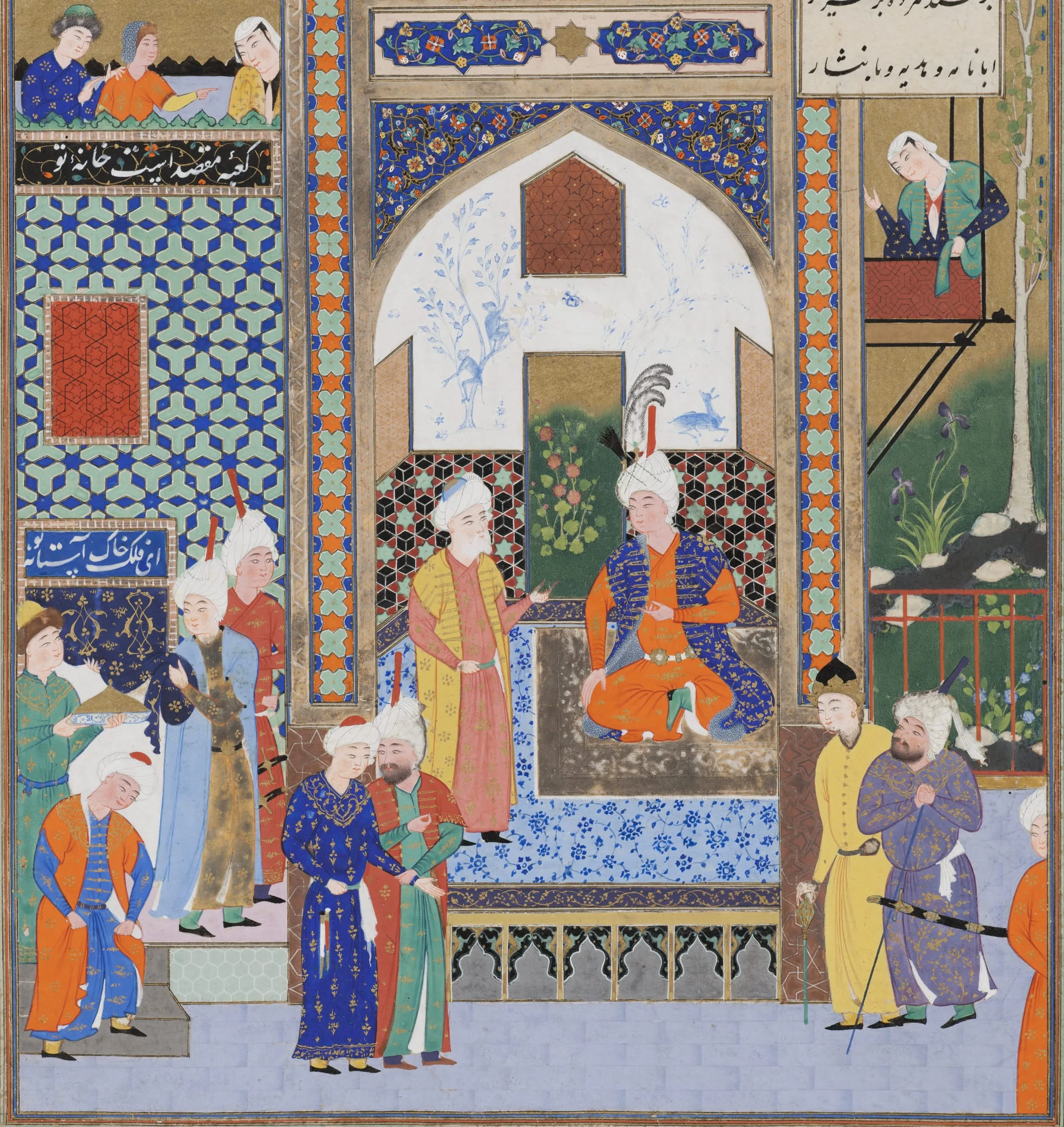
The Shahnama (Book of Kings), the Iranian national epic, was composed by Firdawsi and completed around 1010. It chronicles in verse the legendary and historical kings and heroes of the Persian Empire up to the Arab Muslim conquest in the seventh century. Illustrated manuscripts of the text, usually made under courtly patronage, only survive from the early fourteenth century onward; many of these were broken up in modern times for the sake of their paintings. Typically, the architectural settings and costumes of the depicted characters reflect the era in which the manuscript was made, drawing a connection between ancient kings and heroes and the then present-day court. On that account, the commissioning of such anachronistically illustrated manuscripts appealed to great kings and provincial rulers alike.
This page comes from a manuscript whose size, scale, and quality make it one of the most luxurious Islamic books ever created—a now-dispersed copy of the Shahnama made for Shah Tahmasp (r. 1524–76) in his capital, Tabriz, in northwestern Iran. The manuscript originally included innumerable illuminations; more than 1,000 pages of text, all with gold-flecked borders; and 258 illustrations, which use formalized conventions to depict a type of idealized world first perfected in Persian painting more than a century earlier. Here, the rich colors of the costumes and architectural decoration, the sedate poses of the figures, and the carefully contrived landscape and gold sky create a most suitable, if unreal, setting for a royal audience.
Illustrated manuscripts like the Shahnama were the result of a collaborative effort, one that required wealthy, generally royal patrons who could afford the costly materials and large staff required. Such books were produced in the kitabkhana (literally, “book house”), an atelier combining the functions of scriptorium, workshop, and library. The Shahnama, divided into fifty sections, each devoted to a particular king, allowed for a wide range of illustrations. Over time, some sections of the text and certain scenes came to be repeated, while specific compositions were reused but with subtle variations. Many of the compositional elements of this painting can be found among other folios in Tahmasp’s Shahnama and other contemporaneous manuscripts.
2024