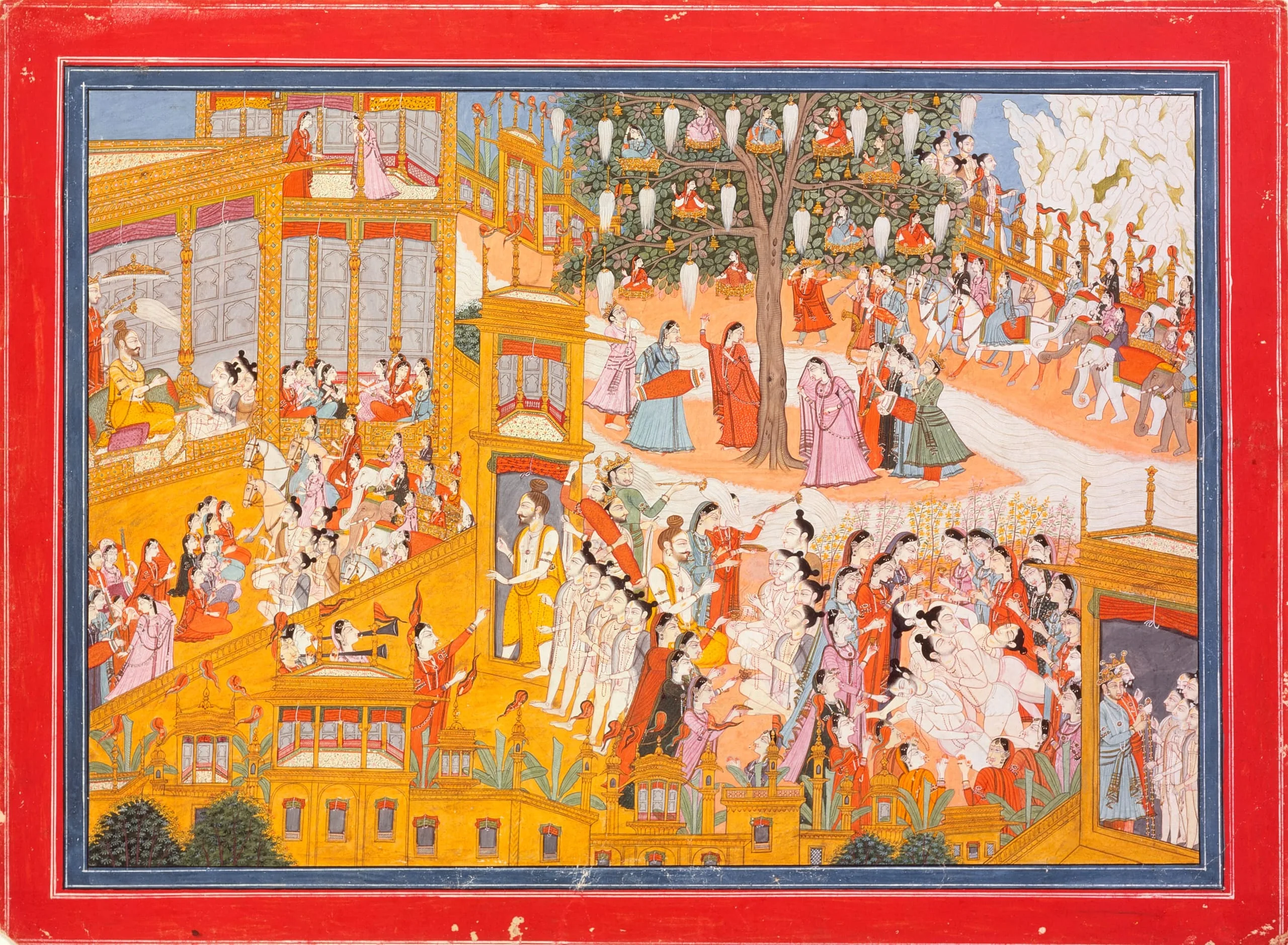
The Kedara Kalpa (Book of Kedara) is a Shaiva text exalting the merits of pilgrimage to Kedara-Kailasha, the Himalayan region of Kedarnath, Uttar Pradesh where Shiva is believed to reside. The text consists of Shiva telling his wife Parvati and son Karttikeya several tales about the “Great Path” (maha-pantha) that devotees must follow to reach his divine abode. One tale concerns five devotees (sadhakas) who make a pilgrimage to Kedara-Kailasha.
There are two major series of paintings illustrating the journey of the five pilgrims. The first series, to which LACMA’s folio belongs, is known as the “Large” series because of its larger format. Dispersed since before 1971, it has been attributed to the family workshop of Purkhu (active circa 1780-1820) in Kangra. Additional folios from this series are in the Philadelphia Museum of Art (2001-43-1), San Diego Museum of Art (1990.1250), and Virginia Museum of Fine Arts, Richmond (85.1548). The contemporaneous second series, known as the “Small” series, is mainly housed in the National Museum, New Delhi.
Here, in continuous narration, the five undifferentiated pilgrims wearing shawls and long bead necklaces arrive to celebrations in the city of King Shankha-Pal, who is clad in ascetic garb. The pilgrims are also shown swooning and being revived by palace women sprinkling the elixir of immortality (0). See Karuna Goswamy and B. N. Goswamy, A Sacred Journey (New Delhi: Niyogi Books; Zurich: Artibus Asiae, 2021), pp. 88-89, no. K25.