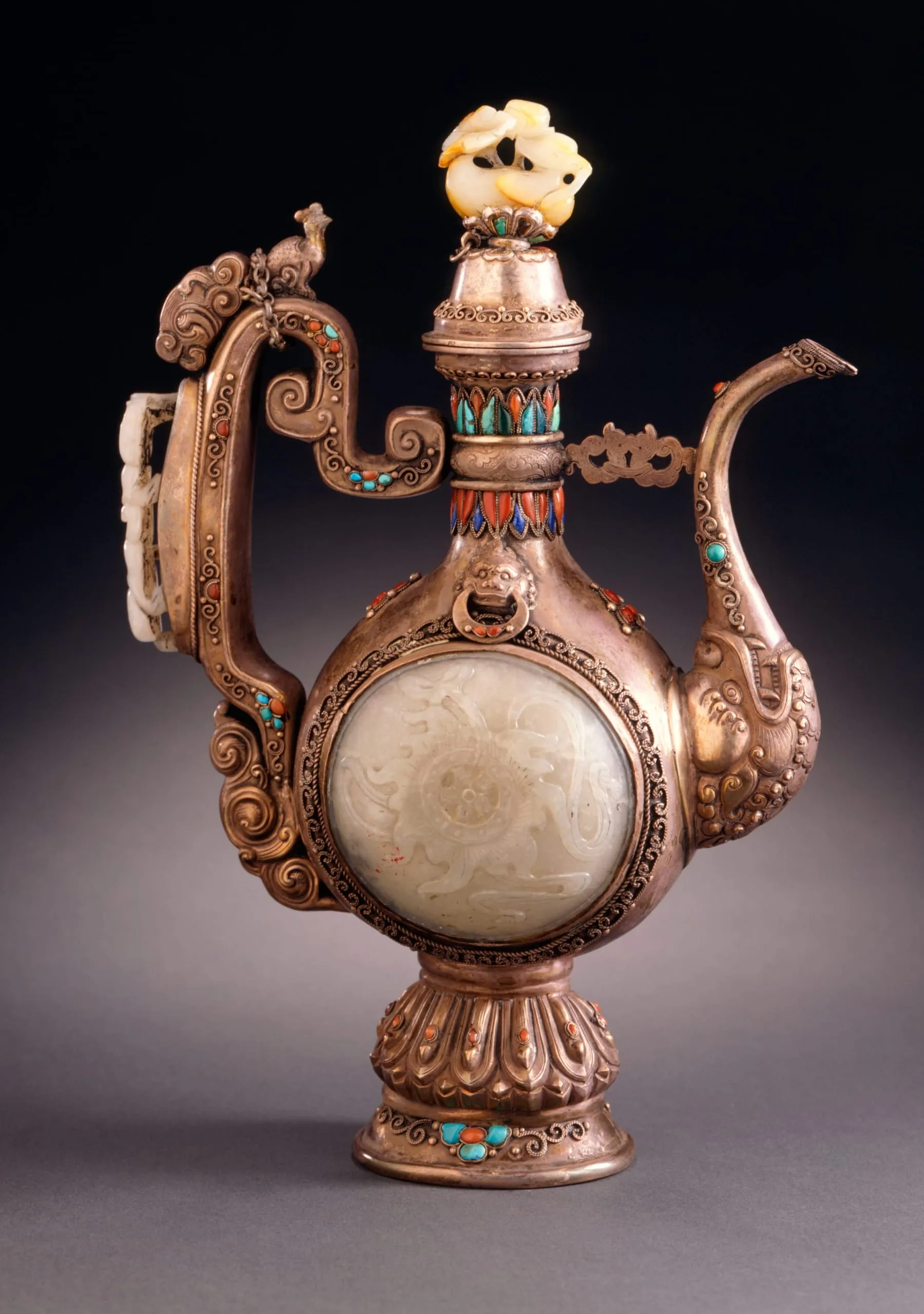
The ceremonial water ewer (Sanskrit: kalasha; Tibetan: ril-ba) is used in Buddhist rituals of ablution and consecration, and is a symbol of purification. During ceremonies, when a Buddhist priest sprinkles disciples with the "Water of Life" or "Nectar of Immortality" from the vessel, he bestows blessings. The water ewer is the symbol of Maitreya, the Buddha of the Future. It is also an attribute of the 8000-armed form of Avalokiteshvara (the Bodhisattva of Compassion), who uses it to relieve the thirst of all beings and purify their despondency and negative karma with the gentle waters of its compassion.
This morphological form of this Tibetan ewer derives from that of a Central Asian, Islamic, or Indo-Islamic water vessel (aftaba), such as AC1995.52.1 and M.83.2.2. The ewer has a bulbous body inset with a large white jade roundel adorned with a Buddhist Wheel of the Law (dharmachakra) and flying scarves. It is supported by a flaring pedestal foot with lotus petals inset with carnelian and turquoise. Above the roundel is a mask of a mythical animal, the zipac, which is a Tibetan apotropaic symbol resembling the Indian "Face of Glory" (kirttimukha) and the Chinese gluttonous creature (taotie). The tall neck has bands of carnelian, turquoise, and lapis lazul flanking a ring molding embellished with floral scrolls. The dome-shaped silver lid has a white jade gander holding lotuses in its beak. The vessel has a silver spout issuing out of the mouth of a mythical aquatic creature (makara). A support bracket of addorsed serpents joins the spout and neck. It has an elaborate compound S-shaped silver handle with a white jade plaque on the grip, a scrolling lower terminal attached to the body, and a rooster with a comb and foliated tail perched on top of the handle. See also M.75.10 and M.84.227.2.