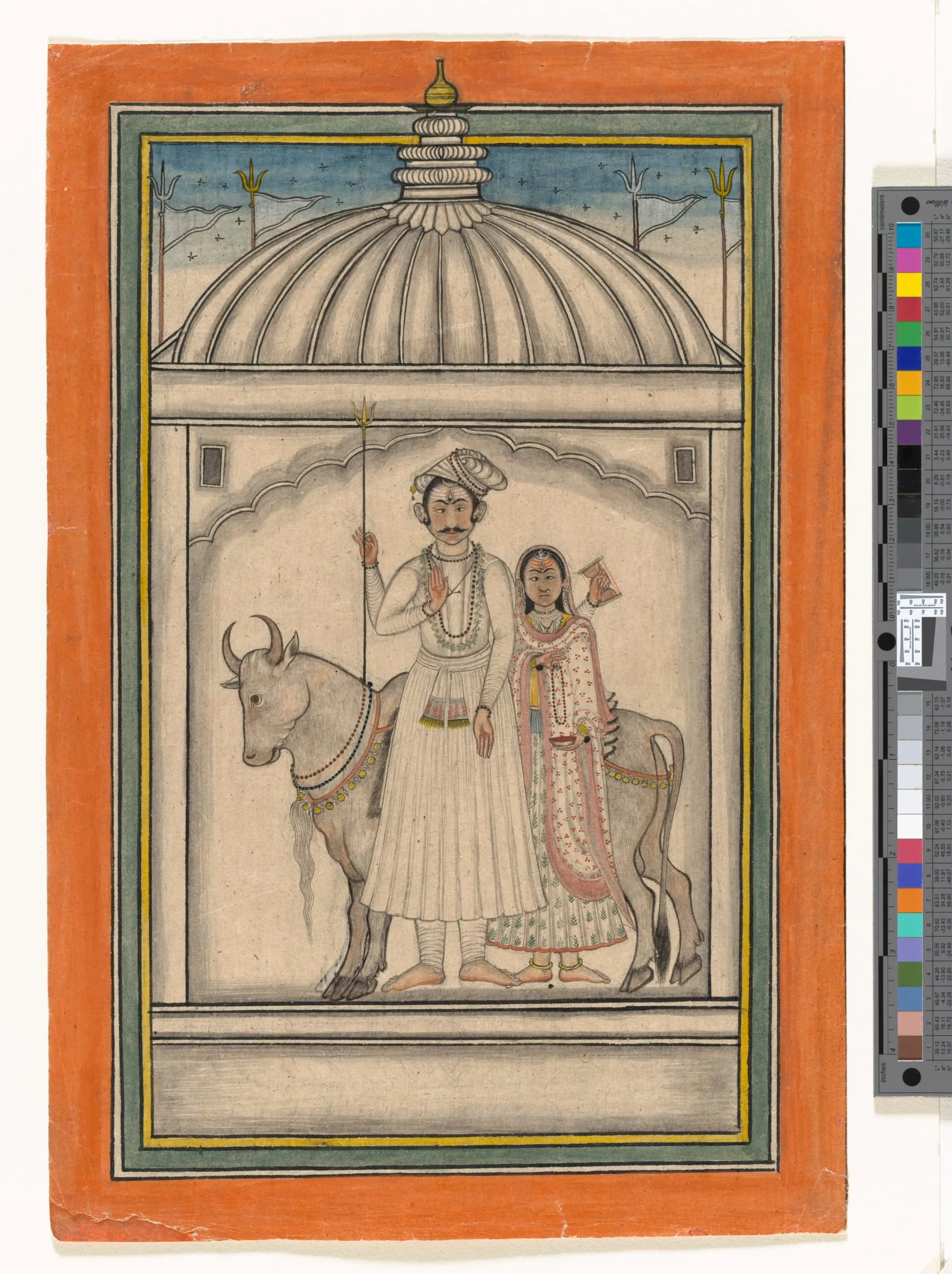
Shiva, the Hindu god of destruction, is a complex, multifaceted deity who assumes various manifestations to perform diverse functions or embody different philosophical principles. He has cosmic personas and roles, as well as spiritual and humanitarian guises. He has been called the erotic ascetic, as he is both the paramount practitioner of asceticism and yoga, and, conversely, an incomparable lover and devoted family man. Shiva’s chief wife, Parvati, is the daughter of Parvata, the personification of the Himalayas. She is the gracious feminine aspect of Shiva’s spiritual energy (shakti) and a fertility and mother deity.
Shiva and Parvati stand in front of Shiva’s caparisoned bull mount, Nandi, under an arched doorway in a pavilion or temple adorned with Shiva’s trident standards. Shiva has a third eye of wisdom (jñananetra), and horizontal sectarian markings and his emblematic crescent moon on his forehead. He has four arms. His rear hands hold his trident and hourglass-shaped drum. His front hands are held in the symbolic gestures of ‘fear-not’ (abhaya mudra) and ‘gift-giving’ (varada mudra). He wears Rudraksha (eye of Rudra/Shiva) beads (elaeo carpus seeds) as his turban adornment, long necklace, and bracelets. He also wears a pine needle garland and a floral waist sash over his long white outer garment. Parvati has the same forehead adornments as Shiva and wears profuse jewelry. She holds a Rudraksha bead rosary and a bowl of bhang, Shiva’s favored intoxicating drink.