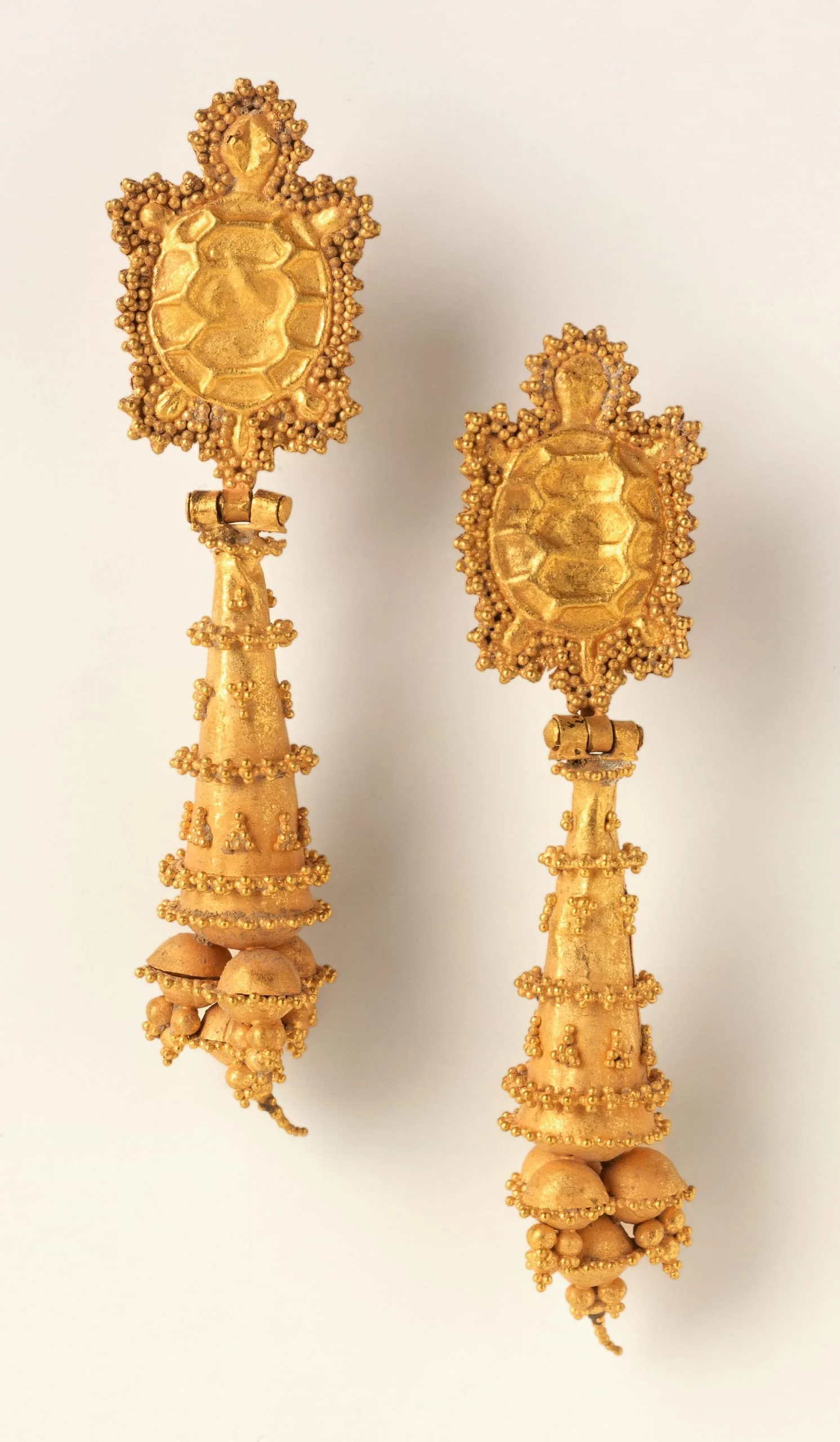
This delicate pair of gold earrings is one of a small corpus of surviving gold ornaments from ancient South Asia. Characterized by exquisite workmanship, the goldsmithing techniques included repoussé and sheet gold as well as fine granulation. Many of the extant examples were excavated from burial mounds in the Taxila region of present-day Pakistan and tumuluses in northern Afghanistan.
The upper element of each earring depicts a repoussé tortoise viewed from above. Beneath it is a hinged pendant is in the form of a tapering column embellished with bands and triangular clusters of granulations and terminated with hollow spheres and beads with granules.
The tortoise and the tapering column may also be an allusion to the Kurma (tortoise) Avatar of the Hindu god Vishnu. During the primordial Churning of the Ocean of Milk (samudra manthana) to recover the elixir of immortality (amrita), Kurma supported the inverted Mount Mandara, a spur of the axis mundi Mount Meru, when it was used as a churning stick with the cosmic serpent Vasuki serving as the rope. For an illustration of this legend, see a Chamba or Basholi painting attributed to circa 1760-1765 in the Philadelphia Museum of Art (1984-139-1).
Comparable examples of ancient South Asian gold jewelry are in the Metropolitan Museum of Art, New York (1981.398.3) and Cleveland Museum of Art (1973.66).