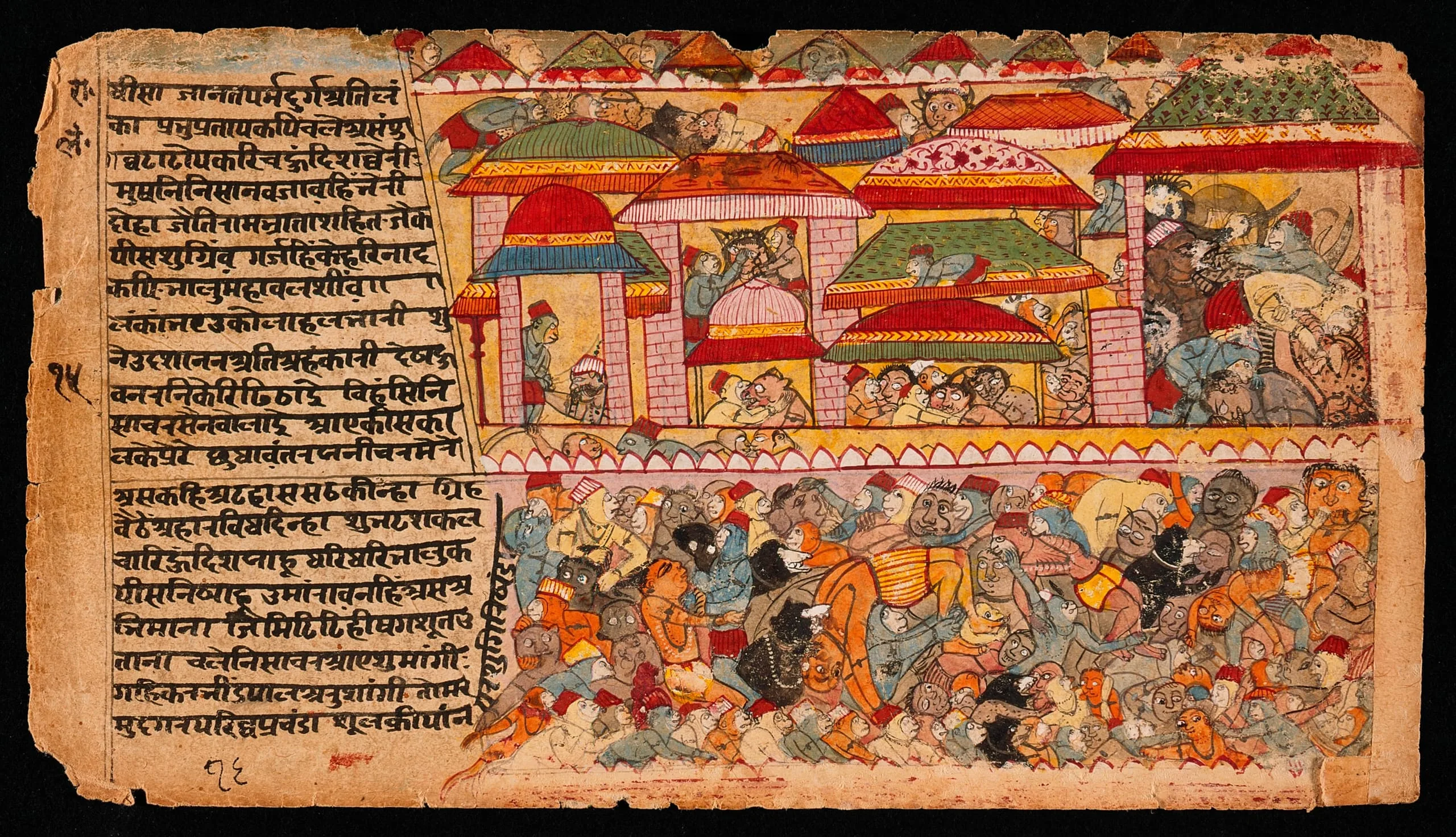
The Ramayana (Adventures of Rama) narrates the epic saga of the valiant Prince Rama and his dutiful wife, Princess Sita, who was abducted by Ravana, the arrogant ten-headed King of Lanka (probably modern Sri Lanka), during Rama's unjust fourteen-year forest exile from his capital of Ayodhya, Uttar Pradesh. To rescue Sita, Rama and his faithful brother Lakshmana assembled a great army of monkeys and bears led by the Monkey-King Sugriva and his Monkey-General Hanuman. After several magical battles, the princess was freed, and the happy couple triumphantly returned home to rule their kingdom. Rama and Sita epitomize the ideal ruler and the paragon of fidelity in Hindu culture.
This folio (no. 15) is from a series of a vernacular Hindi recension of the Ramayana, the Ramacharitmanas (Holy Lake of the Deeds of Rama), composed in 1575 by Tulsidas (1511-1623), who was born in Soron, Uttar Pradesh, and studied Sanskrit grammar in Varanasi. The Ramacharitmanas differs primarily from the Ramayana in that it portrays Rama as divine rather than mortal and it gives considerably increased emphasis to the role and personality of Hanuman.
The illustration is from Book 6 (Lanka kanda) when the army of monkeys and bears storm Ravana’s citadel and ferociously fight his demon horde. The frenetic battle scene aptly conveys the frenzy and fury of the assault.