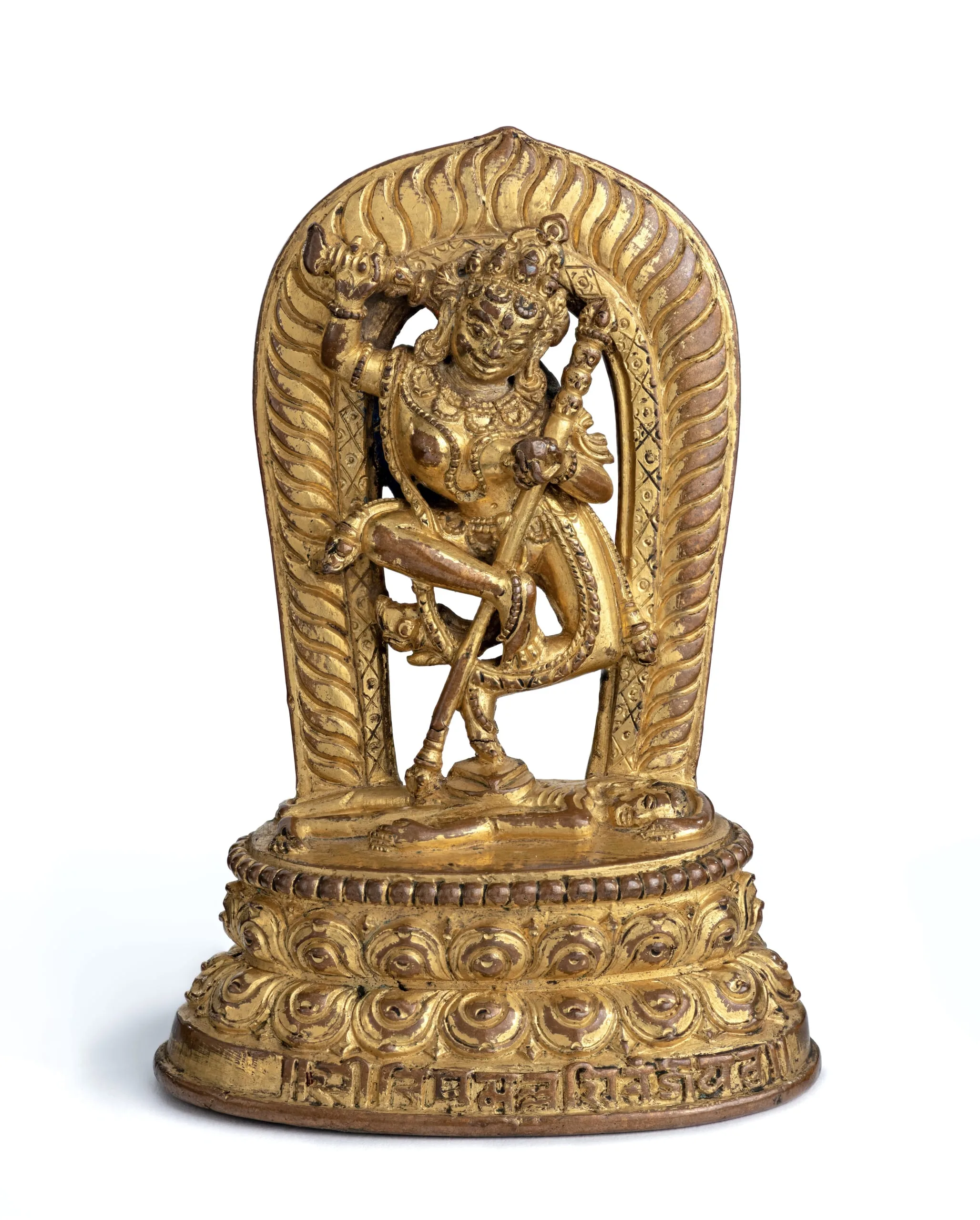
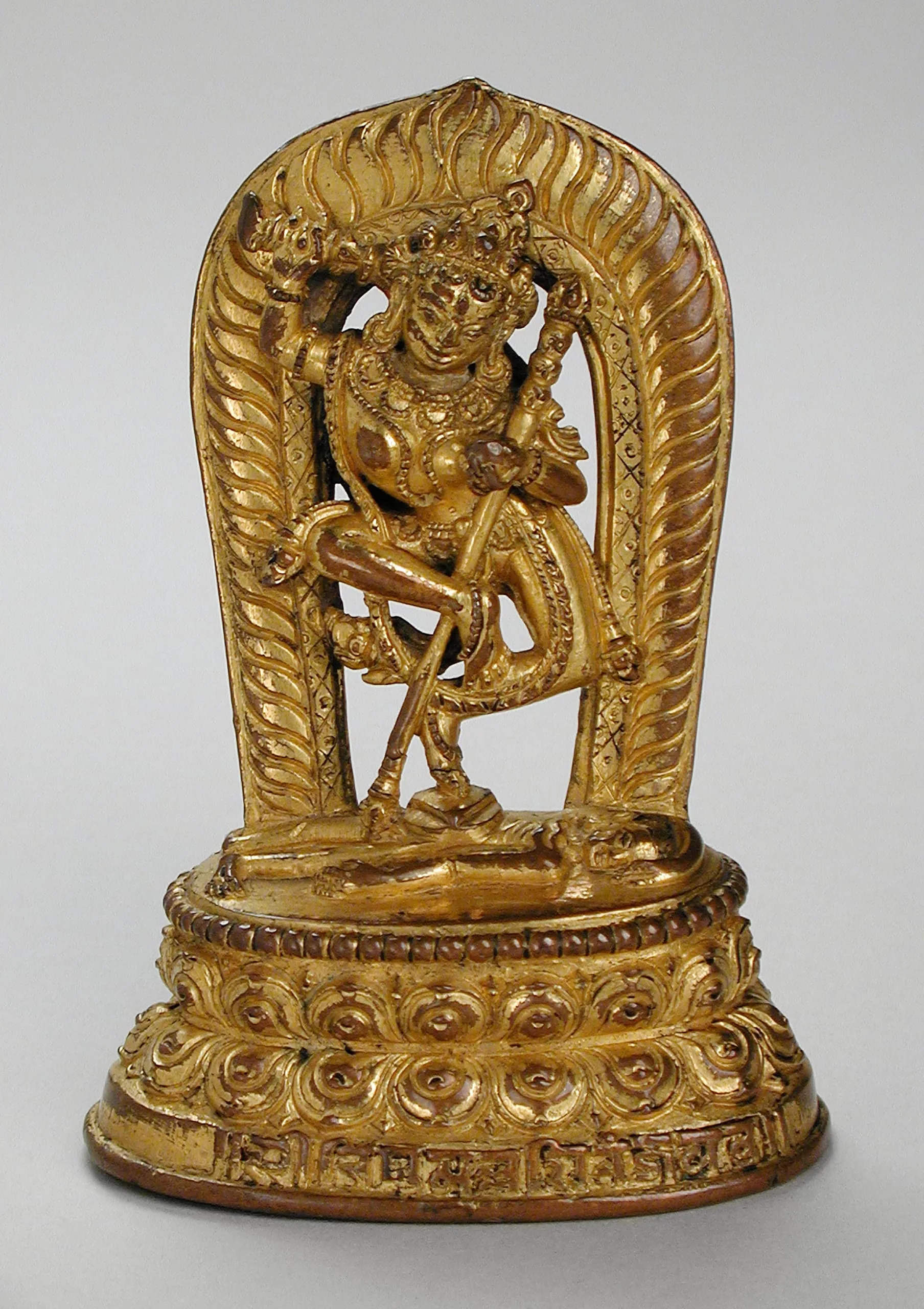
Nairatmya (Selfless One) is a Buddhist Dakini (Female Sky-goer), which is a class of enticing demigoddesses. She is the consort of Hevajra (see M.85.115.3, and M.81.6). She is usually represented as a dancing figure or in union with Hevajra. Occasionally, she is seated alone (see M.70.1.4).
Nairatmya is portrayed in the "half cross-legged" dance posture (ardhaparyanka-nritya), symbolic of a joyous and passionate Buddha nature. She is trampling a corpse atop a double lotus base with a cast devanagari inscription. She has a third eye, an ascetic’s piled hair crowned by a thunderbolt (vajra), a tiara, and profuse jewelry, including a long garland of severed skulls. Serpents are wrapped around her waist. Her upraised right hand holds a flaying knife (kartika) and her left hand holds a skullcup. A ritual staff (khatvanga) rests on her left shoulder. She is backed by a flaming aureole (prabhavali) with a diamond border.
The inscription reads, May Shri Ripumalla live long. (Translation by Ian Alsop.) Ripumalla (r. early 14th century) was a king of the Khasa Malla Kingdom in Western Nepal and Western Tibet, which ruled from the 11th to mid-14th century. Their capital was Semja, located in the Karnali River basin in Western Nepal. A thangka portrait of Ripumalla worshipping White (Sita) Tara dated 1312 is in Tibet Museum, Alain Border Foundation, Gruyères, Switzerland (ABP 038).
See Ian Alsop, "Metal Sculpture of the Khasa Mallas," in Singer, J.C.and Denwood, P. eds. Tibetan Art: Towards a Definition of Style (London: Laurence King Publishing, 1997), pp. 74-75, fig. 52.