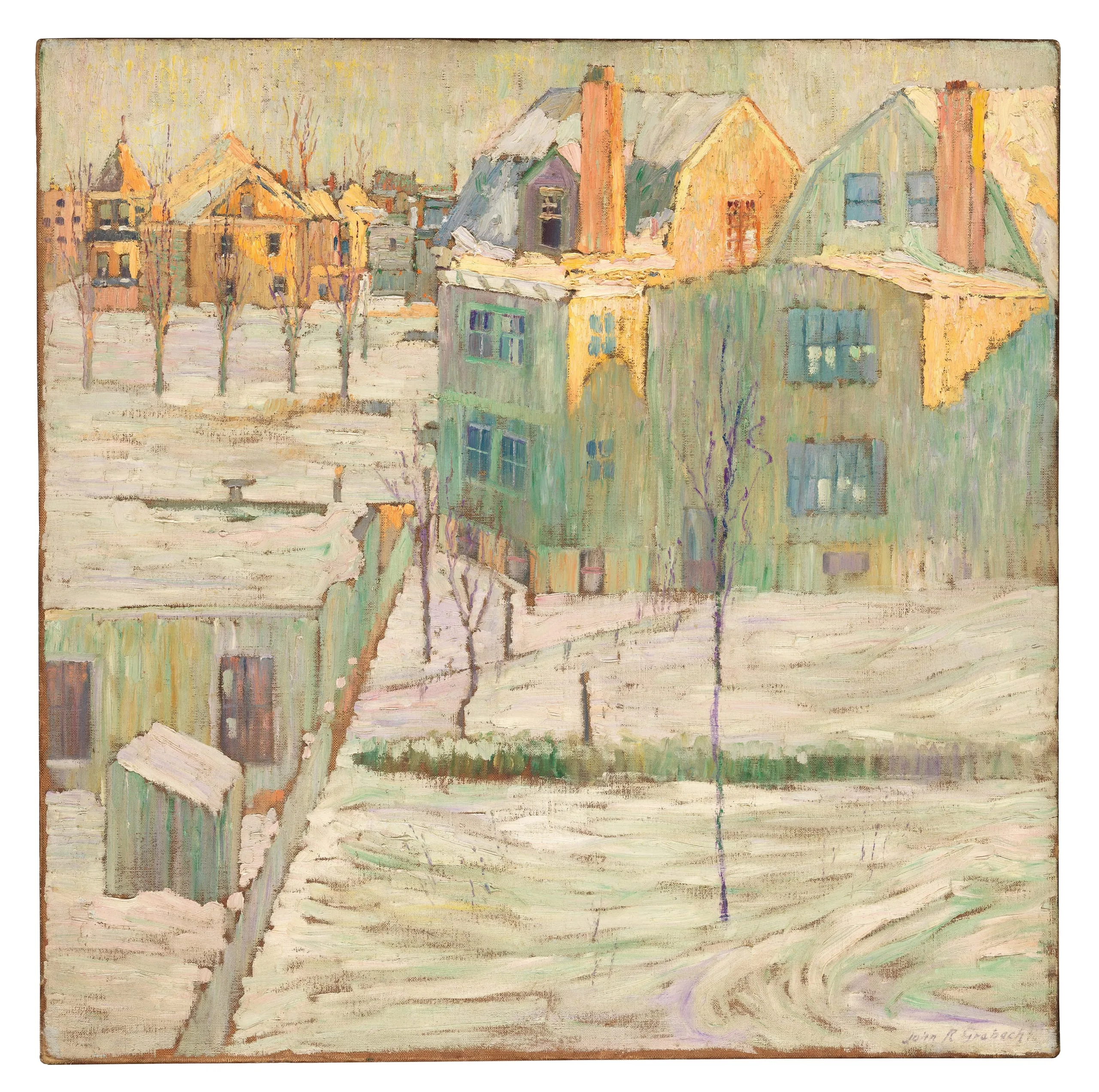
In 1912 Grabach moved to Greenfield, Massachusetts, drawn there by the landscape of this section of the Connecticut River Valley. Until he moved back to New Jersey in 1915, he devoted much of his time to painting winter landscapes -- possibly inspired by the snowy scenes of JOHN TWACHTMAN -- that were well received at the National Academy of Design annuals. During the late nineteenth century artists had begun using such images as a means to explore the potential of the color white, but by Grabach’s time such interest was more of a decorative nature. In true impressionist fashion Grabach found much color in the snowy image: a setting sun casts a golden orange on the rooftops, while cooler pastels of green and lavender describe the shadows. The impastoed brushwork is somewhat controlled in the delineation of the forms of the houses, but looser for the field of snow. The canvas is an exact square, a format popular with early twentieth-century impressionists and post-impressionists, as were a high viewpoint and brushwork that served to emphasize the picture plane. The buildings and yards are read as flat shapes in a jigsaw-puzzle arrangement. As Sunlit Houses is a view of a town, it foreshadows Grabach’s later urban images and probably was done just before he left Greenfield.