- Title
- Crossbar
- Date Made
- circa 1st century
- Medium
- Mottled red sandstone
- Dimensions
- 9 3/4 x 15 1/2 x 2 7/8 in. (24.76 x 39.37 x 7.3 cm)
- Accession Number
- M.85.224.5
- Curatorial Notes
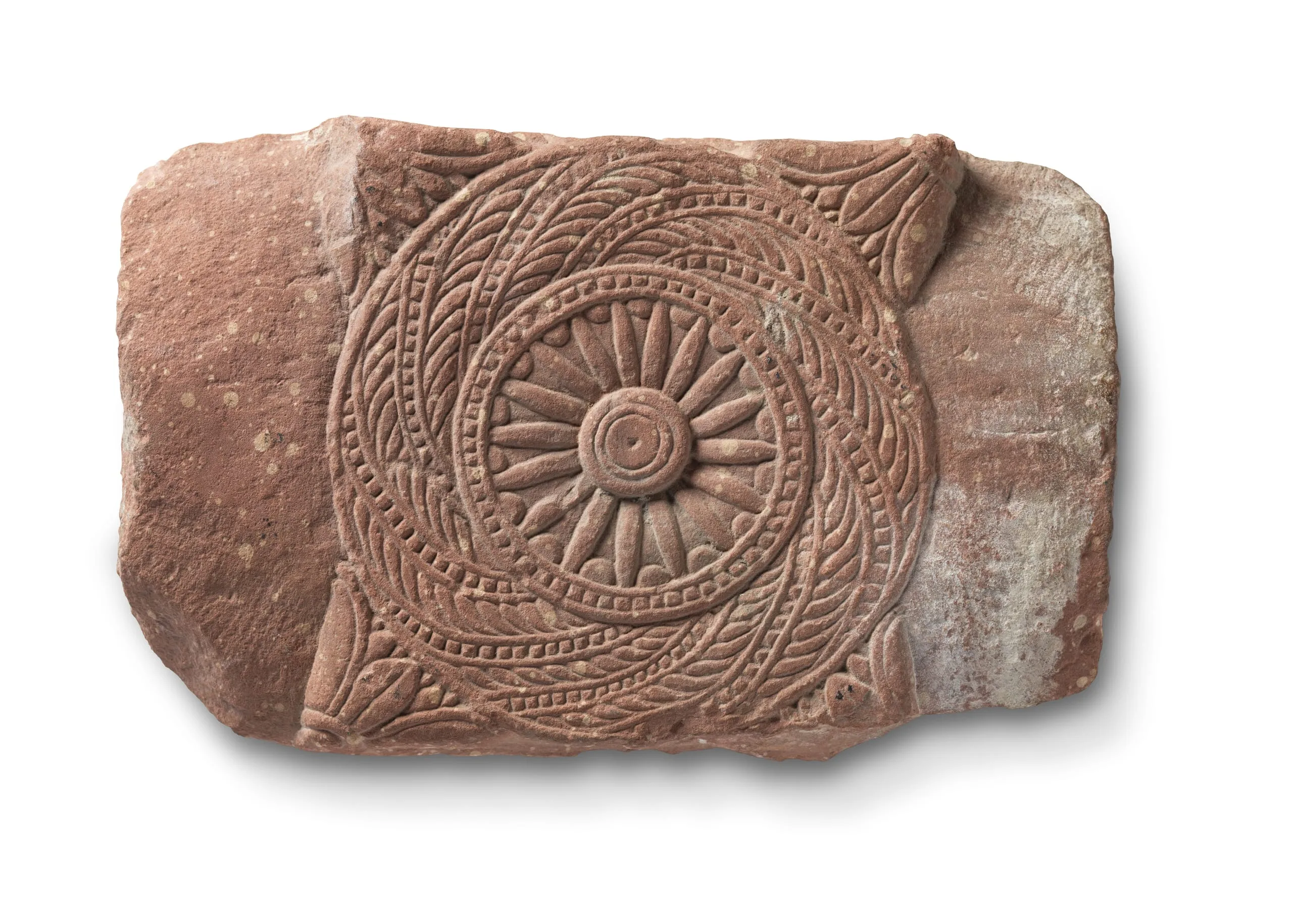
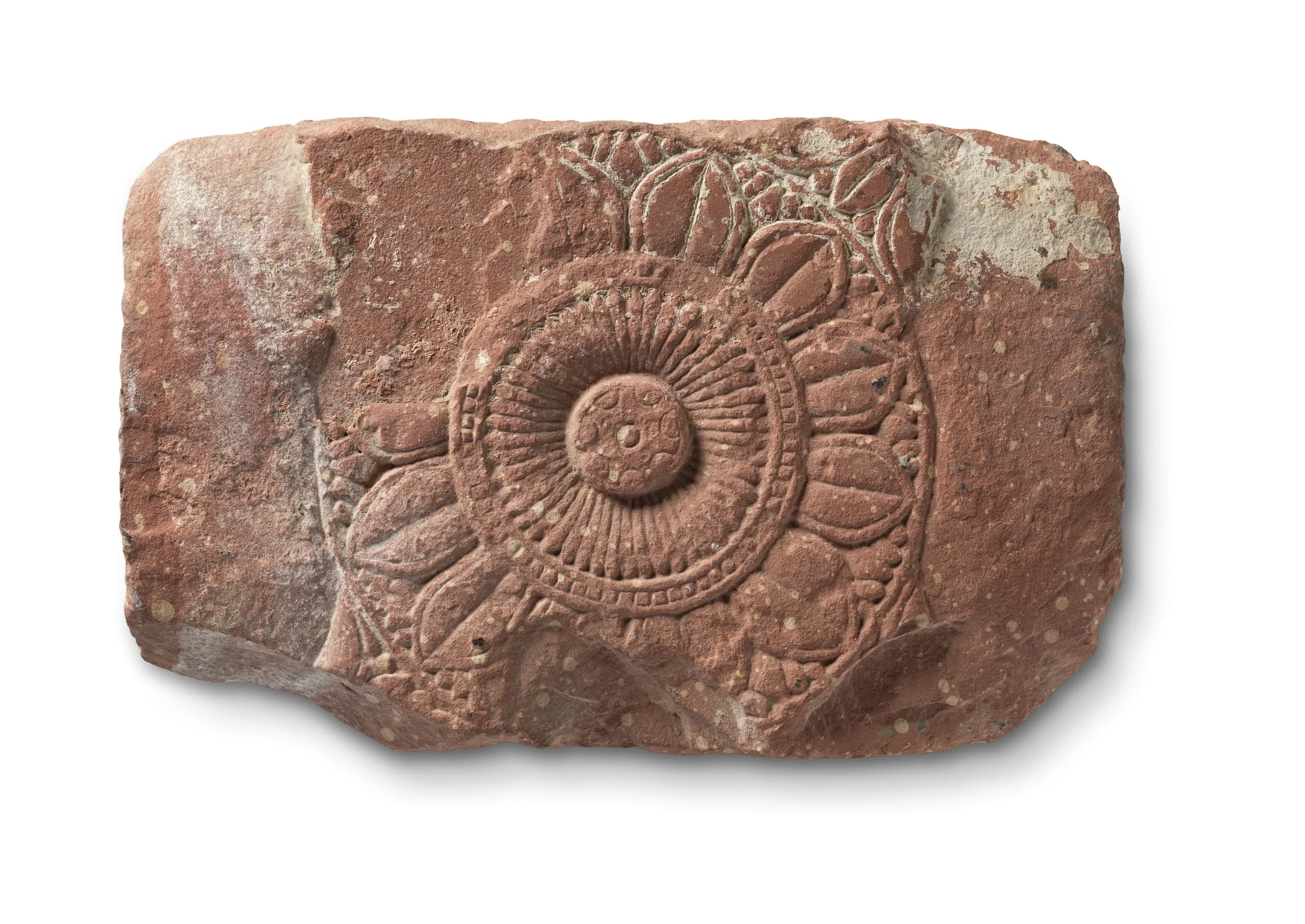
This crossbar (suchi) originally served to connect the pillars (thaba) of a railing (vedika) enclosing a Buddhist stupa (funerary monument) in Mathura, Uttar Pradesh. The railing pillars were typically adorned with voluptuous females symbolizing abundance and fertility (see M.78.9.16 and M.85.2.2). The figural pillars were often alternated with pillars festooned with lotus medallions and half-medallions. An ornamented copestone connected the railing sections (see M.81.90.21a-b). See a complete section of a comparable Mathura railing in the Cleveland Museum of Art (1943.71). The earliest Buddhist stupas held the Buddha’s ashes and relics, but later ones also interred the remains of the Buddha’s renowned acolytes or commemorated significant sites or events in the life of the Buddha.
Recto: Rather than a lotus medallion (see verso), this side of the crossbar is atypically decorated with what is likely a Buddhist Wheel of the Law encircled by a twisted floral-and-pearl garland. Lotus blossoms embellish the four vertices surrounding the garland.
Verso: This side bears a standard lotus medallion that once had twelve petals surrounding the gynoecium containing the pistil and stamens. Like the recto, the four vertices are graced with lotus blossoms.
- Selected Bibliography
- Pal, Pratapaditya. Indian Sculpture, vol.1. Los Angeles: Los Angeles County Museum of Art; University of California Press, 1986.
- Little, Stephen, Tushara Bindu Gude, Karina Romero Blanco, Silvia Seligson, Marco Antonio Karam. Las Huellas de Buda. Ciudad de México : Instituto Nacional de Antropología e Historia, 2018.
- Little, Stephen, and Tushara Bindu Gude. Realms of the Dharma: Buddhist Art across Asia. Los Angeles: Los Angeles County Museum of Art, 2025.