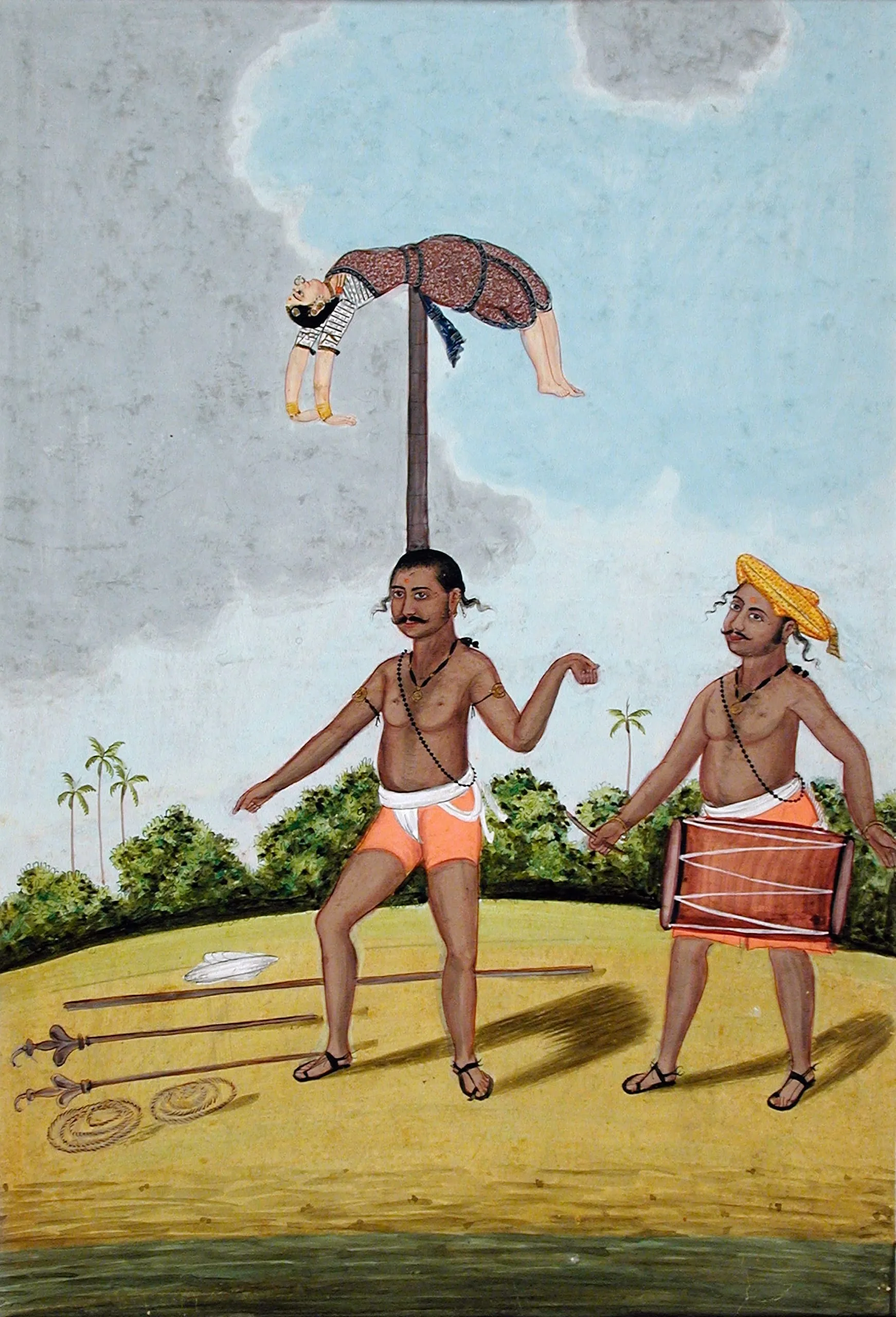
In the late 18th through mid-19th century, paintings of castes and occupations were produced in Thanjavur (Tanjore) for English East India Company officials and other European expatriates. The local artists of Thanjavur, known by British colonialists as “Moochys” (muchche), were members of the Telegu Raju community, many of whom had migrated from Hyderabad, Telangana and settled near the Thanjavur palace. Such genre images provide a detailed record of devotional and vocational aspects of traditional Indian life before the advent of photography.
This painting is mounted on a board with three subject identifications written along the bottom. The devanagari inscription reads, doman, which likely refers to the indigenous Dom or Dombara caste. The Tamil inscription reads, tompar (pole or rope dancers). (Translation by Stephen Markel.) The English inscription reads, “tumblers” and an undecipherable word. The gymnastic demonstration depicts a female acrobat balanced on a pole on top of the head of a man with his arms extended for stability. He is accompanied by a musician wearing a Maratha-style turban and playing a drum. The hemispherical groundline and broad expanse of the sky is a hallmark of Thanjavur painting of this period. A comparable painting of female pole dancers and a drummer by a Thanjavur artist is in the Victoria and Albert Museum, London (IS.75:28-1954).