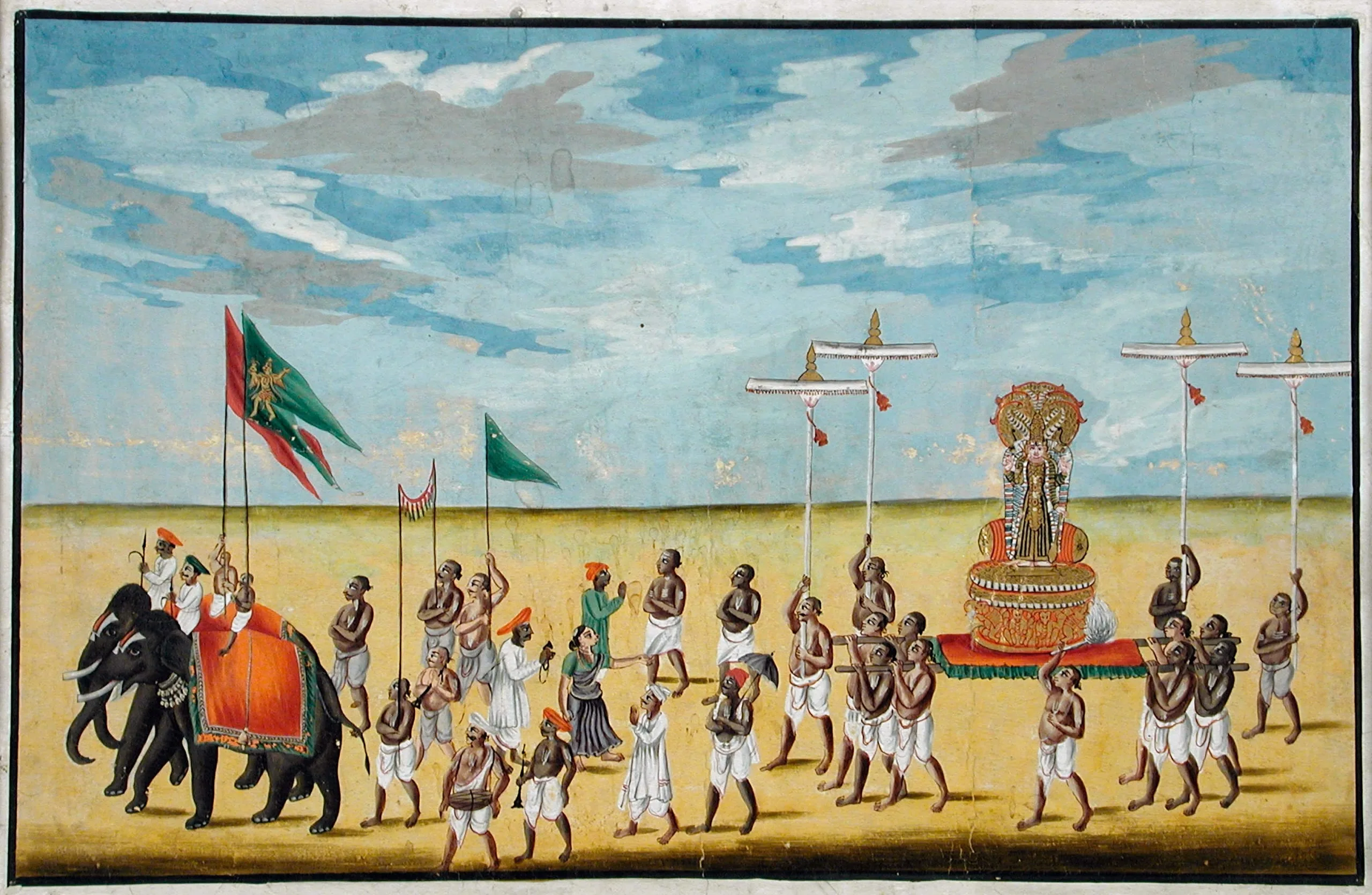
By the late 18th century, paintings of festivals, ceremonies, trades, occupations, and transportation modes were produced in Thanjavur (Tanjore) for English East India Company officials and other European expatriates. The local artists of Thanjavur, known by British colonialists as “Moochys” (muchche), were members of the Telegu Raju community, many of whom had migrated from Hyderabad, Telangana and settled near the Thanjavur palace. Such genre images provide a detailed record of devotional and vocational aspects of traditional Indian life before the advent of photography.
In this painting, a life-sized polychromy with gilding image of the Hindu god Balarama is being carried in procession on a litter by eight brahmins along with four parasol bearers and a man waiving an honorific fly whisk made from the white tail-hairs of a yak. The white-skinned Balarama stands beneath a multiheaded serpent hood on a circular throne with an elephant base. His lower right hand is raised to his tall crown. He holds his club named Saunanda in his lower left hand. His upper hands carry undetermined attributes. The procession is led by two elephants with riders carrying standards. The green standard has an image of Hanuman. Following them are additional standard-bearers and a group of musicians, some wearing Maratha-style turbans, and a female dancer. The broad band of cumulus clouds in the sky is a hallmark of Thanjavur painting of this period.
See also 37.28.17-.19.