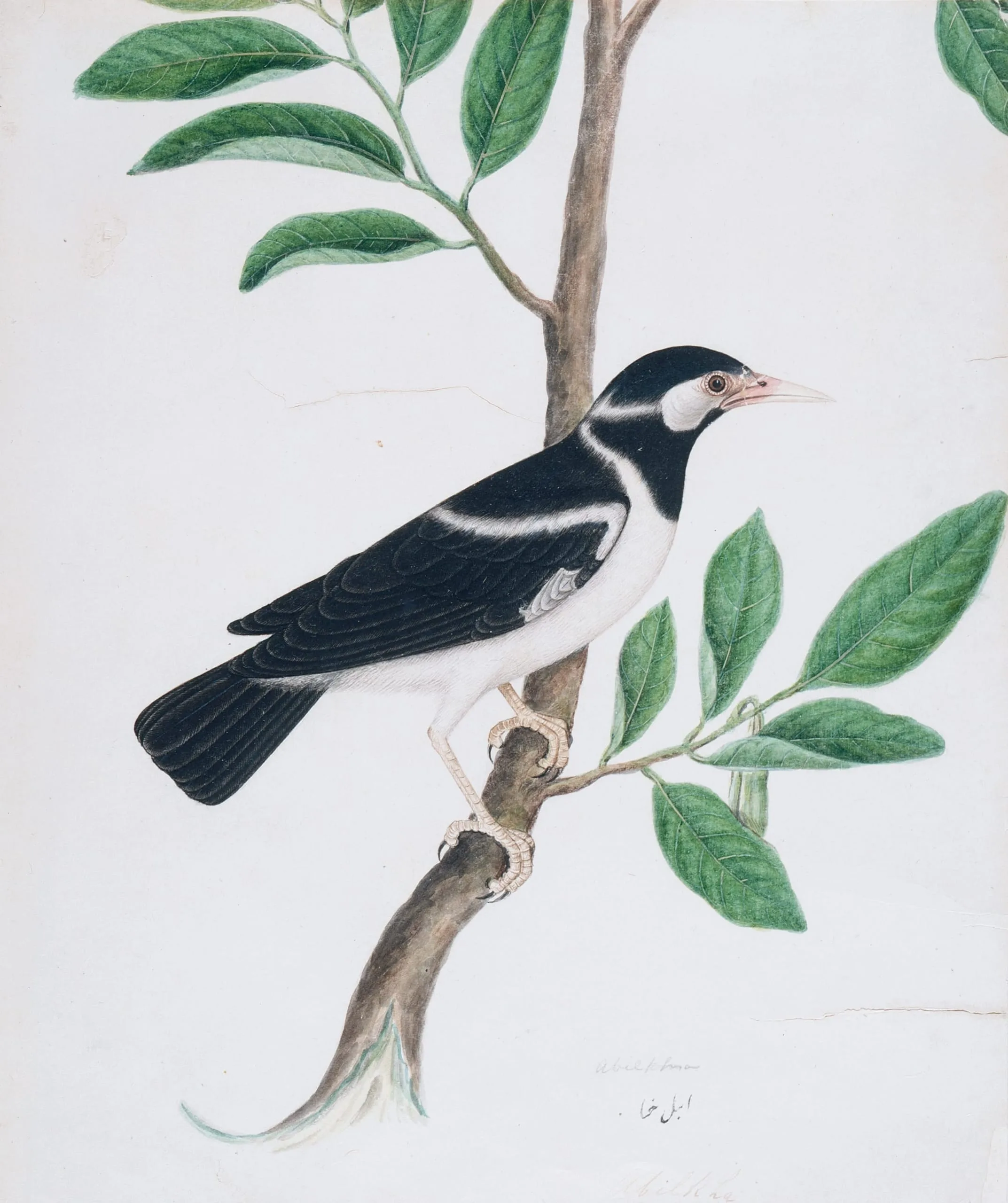
Painted with great finesse, this painting of a Pied Myna exemplifies the blending of Mughal and European artistic sensibilities and is an excellent example of the type of work patronized by the British in 19th-century Calcutta. British patrons recruited Indian court artists trained in the detailed and precise Mughal style of drawing to produce pictures of zoological and botanical subjects. The European patrons stressed acute observation in the name of scientific accuracy, as well as the Western techniques of foreshortening, shading, and perspective. The resultant nature studies were vibrant and fresh, with the same delicacy and sparkling colors that characterize the finest Mughal paintings.
Following the lead of the distinguished art patron Lady Mary Impey (1749-1818), the wife of the Chief Justice of the Supreme Court of Calcutta, Sir Elijah Impey (1732-1809), it became fashionable in British Calcutta society to commission and collect paintings of animals, birds, and botanical subjects by Indian artists. Interested in documenting their stay in exotic India, Europeans commissioned artists to paint scenes of Indian life, occupations, religious festivals, and deities.
See also M.72.36.1.