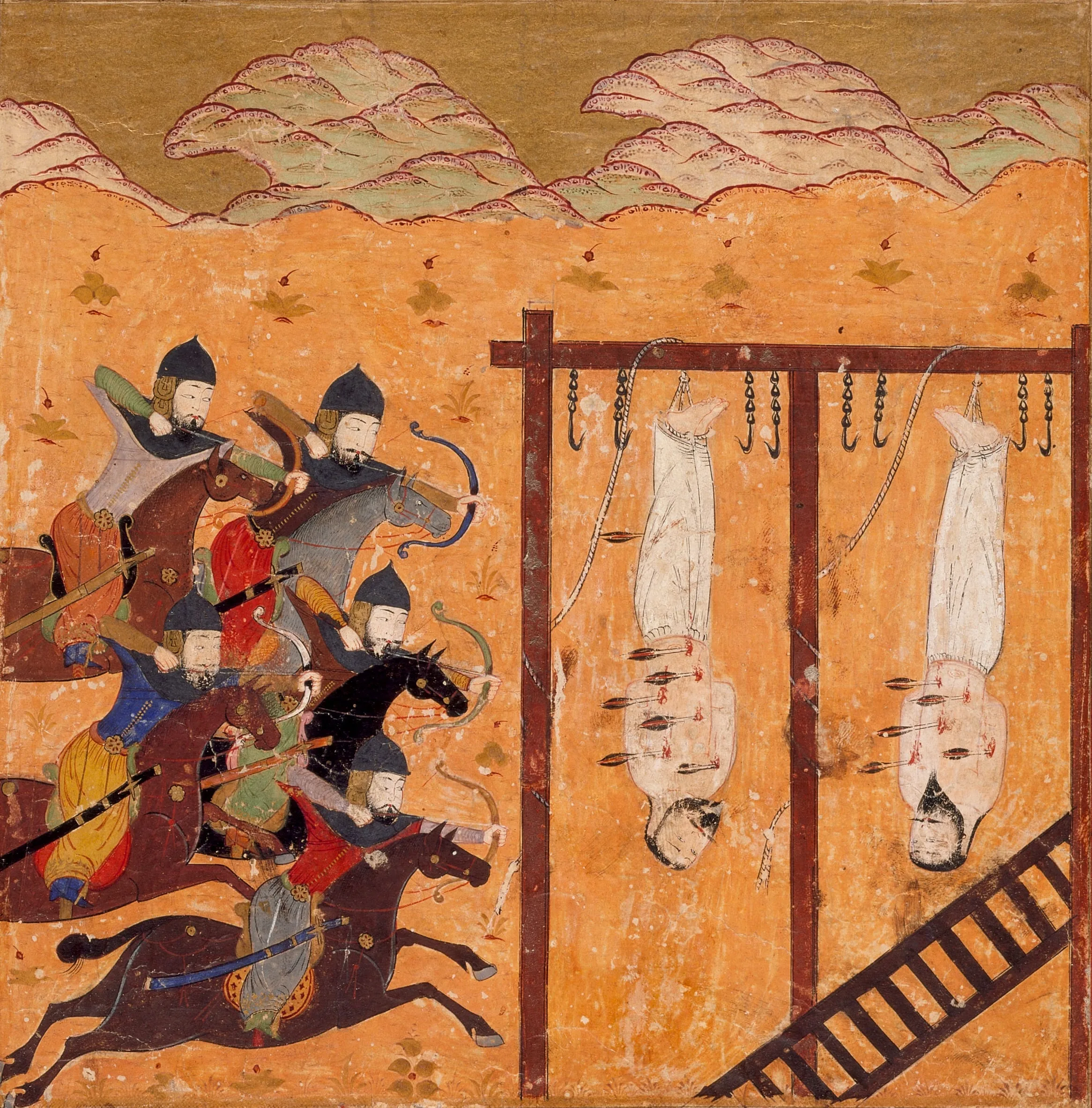
The Shahnama (Book of Kings), the Iranian national epic, was composed by Firdawsi and completed around 1010. It chronicles in verse the legendary and historical kings and heroes of the Persian Empire up to the Arab Muslim conquest in the seventh century. Illustrated manuscripts of the text, often made under courtly patronage, only survive from the early fourteenth century onward; many of these were broken up in modern times for the sake of their paintings. Manuscripts of the text were widely produced throughout the Persian-literate world, including South Asia.
Battles feature prominently in the Shahnama, as illustrated in this painting depicting two men suspended upside down and targeted by mounted archers. Although the painting has been separated from its text, comparison with a similar scene that preserves its text suggests this may depict an event from the story of Iskandar (Alexander the Great), in which he has ordered the execution of Janusiyar and Mahiyar, who betrayed King Darius, his Persian half-brother. LACMA’s painting exemplifies a Persian style associated with the city of Shiraz, characterized by bold colors, a linear composition, and simplified forms. It demonstrates the rich cultural exchange between fifteenth-century Iran and the sultanate states of India, particularly through the circulation of illustrated manuscripts and the movement of artists.
2024