- Title
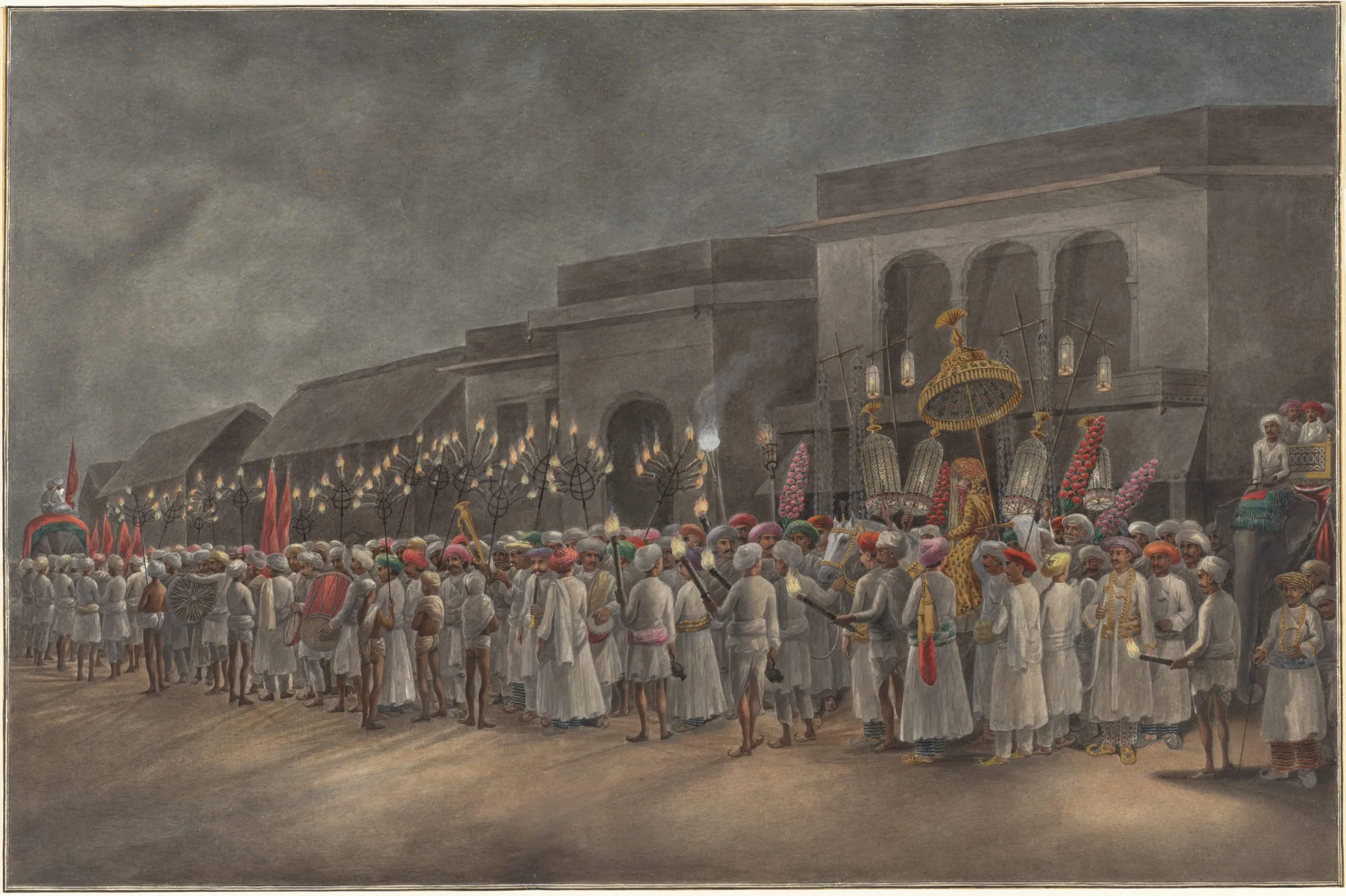
- A Hindu Bridegroom's Marriage Procession
- Date Made
- 1807-1809
- Medium
- Opaque watercolor, gold, and traces of silver on paper
- Dimensions
- 15 3/4 x 23 3/4 in. (40.005 x 60.325 cm)
Frame: 24 × 30 in. (60.96 × 76.2 cm)
- Accession Number
- M.85.180
- Curatorial Notes
This painting is attributed to Sewak Ram (active circa 1770-circa 1830) by stylistic comparison to similar works that are signed and dated by the artist. Sewak Ram was originally from Murshidabad, West Bengal. Seeking economic opportunities, by 1790 he had migrated to the commercial capital of Patna, Bihar (formerly known in the Mughal era as Azimabad and in ancient times as Pataliputra). Sewak Ram adopted Western linear perspective and figural modeling to accord with the collecting tastes of his newfound British patrons. He painted in two principal genres: ethnographic representations of traditional Indian occupations and largescale festival scenes.
This painting depicts the marriage procession of a Hindu bridegroom, who is shown near end of the cavalcade on horseback under a golden parasol. He wears floral garlands and is dressed in finery as a Rajput prince. His ritual path is lit and heralded by mica lanterns and candelabra standards. The nighttime procession of the bridegroom’s male relatives and friends is going to the future bride’s family dwelling to meet his wife-to-be and her kinfolk. A compositionally related painting by Sewak Ram of a daytime Muslim marriage procession is in the British Library, London (Add.Or.16).
See also 37.28.10.