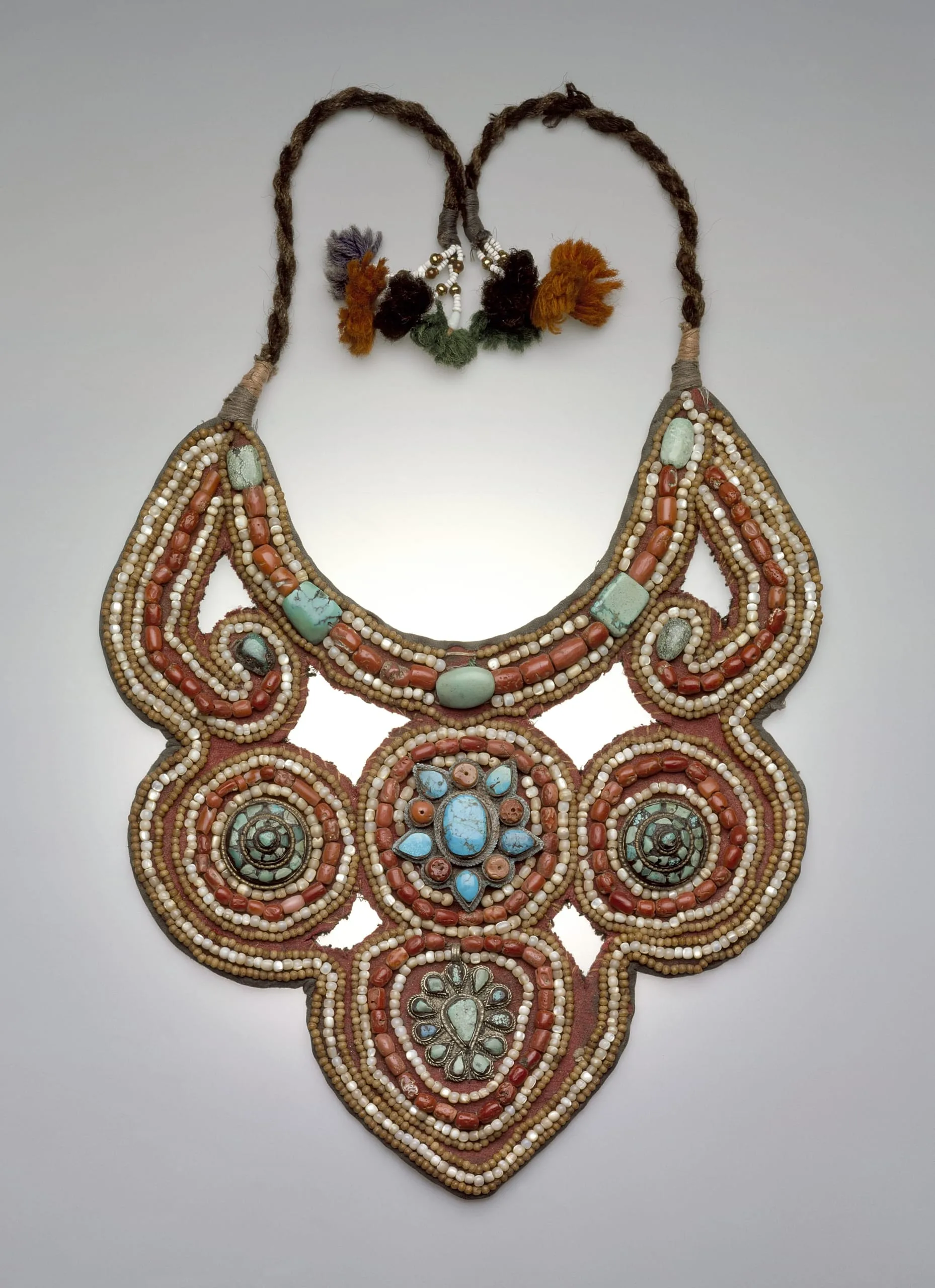
This ceremonial necklace (suta) was worn by children in the Kathmandu Valley during initiation rituals and was also used to adorn religious images. It is in the form of a ceremonial gorget, which was originally a European type of metal or leather body armor worn to protect the throat and upper chest. The Himalayan ornamental derivation was typically a cloth ground with gemstones fixed in symbolic and decorative designs. Here, the center of each of the four large circular fields of ornamentation has a lotus medallion created by the grouping of gemstones inlaid in silver (central top and bottom) or copper (flanking). See Oppi Untracht, Traditional Jewelry of India (New York: Harry N. Abrams, 1997), p. 155, no. 276; and John Clarke, Jewellery of Tibet and Himalayas (London: V&A Publications, 2004), p. 59, no. 41 and p. 114, no.113.
Comparable Nepalese ceremonial gorgets made of gilt silver or copper inlaid with gemstones, are in the Asian Art Museum, San Francisco (B60M22+); British Museum, London (1961,1214.1); and the Victoria and Albert Museum, London (IM.296&A-1913). See also M.86.191.3.